THE JOURNEY
Saints of Italy: the tombs of Rome, Assisi, Siena and Padua
- Where
- Italy, Vatican City
- Length
- About ten to twelve days
- Status
- Under consideration
The journey would begin in Rome, at the tombs of the Apostles Peter and Paul and in the basilicas that keep the city's oldest relics, then travel north through Assisi and Siena to end at the tomb of St. Anthony in Padua. The order makes sense on the map and in the Church's own memory: the Apostles first, then the saints of the Middle Ages, with a saint of our own time, St. Carlo Acutis, met in Assisi along the way. At each tomb the saint's life would be told accurately before the visit, and the pilgrim would hear plainly what is documented history and what is venerated by tradition, and would pray at both.
The route, and why each place belongs
- 1
Rome: the tombs of St. Peter and St. Paul
Vatican City and ItalyWhy it belongs
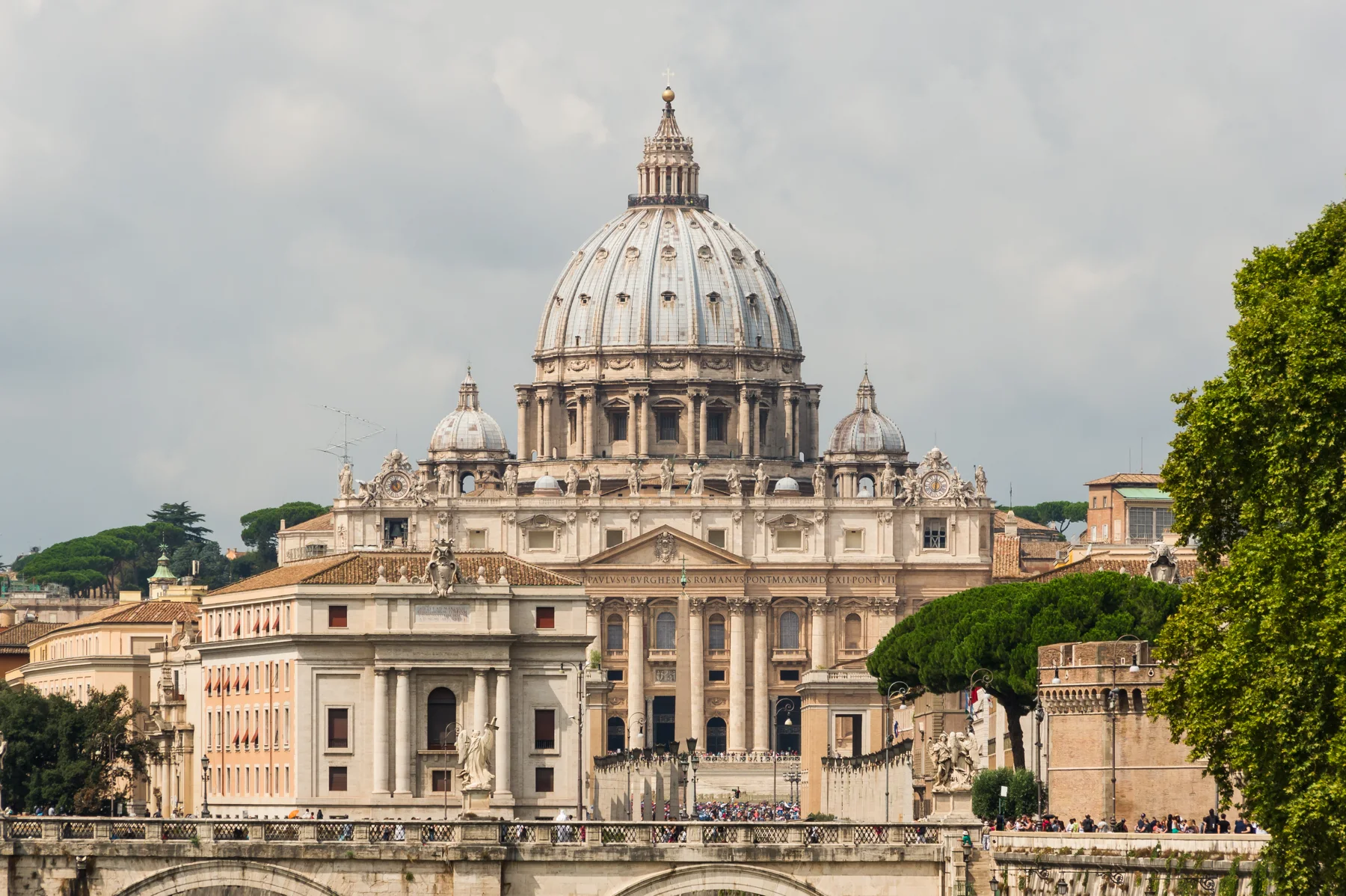
The high altar of St. Peter's stands over the Apostle's grave, the model of a church built over a saint's tomb, and the tomb of St. Paul lies beneath the papal altar of St. Paul Outside the Walls. St. John Paul II rests in a side chapel of St. Peter's, which shows the practice continuing in our own time.
What you would do there
The pilgrim would pray at the altar over St. Peter's grave, pause at the tomb of St. John Paul II, and on another day pray before the tomb of St. Paul, reading Acts 19:11-12, where cloths that had touched him are carried to the sick. A visit to the necropolis beneath St. Peter's is by advance reservation only and could be requested, not assumed.
- 2
Rome: Santa Croce in Gerusalemme and the relic basilicas
ItalyWhy it belongs
Santa Croce is described in the Holy See's Jubilee guide as built to be a great reliquary of the Passion, keeping the relics tradition associates with St. Helena. It is also where this pilgrimage would teach its clearest lesson: the Church has issued no judgment on the authenticity of the individual objects, and they are venerated as tradition.
What you would do there
The pilgrim would pray before the fragments venerated as the True Cross, a nail, relics of the Crown of Thorns and the Titulus Crucis. The same days could include St. John Lateran, where the canopy over the papal altar holds the reliquaries venerated as the heads of Sts. Peter and Paul, St. Mary Major, with the relic venerated by pious tradition as the crib of the Child Jesus, and Santa Maria sopra Minerva, where the body of St. Catherine of Siena rests.
- 3
Assisi: the tombs of St. Francis, St. Clare and St. Carlo Acutis
ItalyWhy it belongs
Three saints' tombs lie within a short walk of one another: St. Francis in the crypt of his basilica, St. Clare in hers, and St. Carlo Acutis at the Sanctuary of the Renunciation, the church of Santa Maria Maggiore. Together they show how differently the Church keeps her saints, from a sealed stone tomb to a body displayed for veneration.
What you would do there
The pilgrim would pray at the plain stone tomb of St. Francis, then at the tomb of St. Clare, and then at the tomb of St. Carlo Acutis, where a queue is likely. His body is displayed, and Church officials said when the tomb was opened in 2020 that it had undergone the normal process of decay, which would be explained before the visit.
- 4
Siena: Basilica of San Domenico
ItalyWhy it belongs
San Domenico keeps the head of St. Catherine of Siena, whose body the pilgrim would already have visited in Rome. No stop on the route raises more honestly the question of why saints' relics were divided, so that distant communities could venerate them.
What you would do there
The pilgrim would hear St. Catherine's life told before entering, pray before the relic of her head, and could read a few lines of her own words there, so that the visit stays with the person and the Lord she served.
- 5
Padua: Basilica of St. Anthony
ItalyWhy it belongs
The saint's tomb and the basilica's chapel of relics make this one of the great relic shrines of Italy, and a fitting place to end a journey made for the friendship of the saints.
What you would do there
The pilgrim would pray at the tomb of St. Anthony and visit the chapel of relics. The group could pray the Litany of the Saints here as the closing prayer of the journey, naming the saints whose tombs it has visited.
Prayer and the sacraments
Mass at a saint's tomb is the oldest way the Church has honored her martyrs, and it would be sought in the churches that hold these tombs where it can be arranged, or attended with the local community where the schedule permits; clergy arrangements are confirmed for each departure. Confession could be made in these same churches where confessors are available, and the Litany of the Saints would be prayed as a group along the way.
Pilgrim’s Time
Pilgrim's Time would be kept free in Rome and in Assisi, with nothing arranged. On this journey it is the natural time to go back alone to the one tomb that drew you here, to stay as long as you wish, and to touch a rosary or a holy card to the tomb where the shrine permits.
Pilgrim Pace
Several of these tombs lie in crypts reached by stairs, and the most visited ones involve standing in a queue. Rome would mean several churches in one day, Assisi and Siena are hill towns with steep cobbled streets, and some crypts are difficult or impossible for wheelchair users, so it would be right to ask how each tomb is reached and what the alternative is.
How Pilgrim Pace worksOther ways to make this pilgrimage
- Rome & Assisi, with the saints' tombs in view. The Rome & Assisi Classic already reaches the tombs of two Apostles and of St. Francis and St. Clare on two bases, and a pilgrim could ask about adding Santa Croce in Gerusalemme and the tomb of St. Carlo Acutis, which its sample itinerary does not list.
- Saints of France. A French journey could take the same shape among other saints, including St. Thérèse at Lisieux and St. Bernadette, whose body rests in a glass reliquary in the convent chapel at Nevers.
- A day with the relics, close to home. A parish or family could make a day pilgrimage to a relic chapel in the United States, such as St. Anthony's Chapel in Pittsburgh or the Maria Stein Shrine of the Holy Relics in Ohio, where the pastor or the shrine sets the programme.
No dated departures are currently announced. This is a journey Bold Pilgrim is considering, described so you can picture it. Dates, priest, Gateway Airport and price are published on a departure itself, and only when confirmed.
UNDERSTANDING THIS PILGRIMAGE
A relics and saints pilgrimage is a journey of prayer to the places where the saints are buried or where their relics are kept: the tombs of the Apostles in Rome, St. Francis and St. Carlo Acutis in Assisi, St. Anthony in Padua, St. Bernadette in Nevers, and many others. Catholics venerate relics; they do not worship them. The honor given to a saint's body is given because that body was a temple of the Holy Spirit and is destined for the resurrection, and it passes through the saint to Jesus Christ, whose grace made the saint holy.
What a relics and saints pilgrimage is
A relics and saints pilgrimage goes to the tombs of the Church's holy men and women and to the churches that keep their relics. Pilgrims pray at each tomb, ask the saint's prayers, attend Mass where the schedule permits, and hear the saint's life told before they arrive. The aim is to honor what God did in these people and to learn from them how to follow Christ.
It differs from a tour of famous churches in purpose more than in route. The same basilica can be visited for its art or for the person buried beneath its altar, and this pilgrimage goes for the person.
The Catholic foundation: why the Church keeps the bodies of her saints
Christianity is a religion of the body. God took flesh, died in that flesh, and rose in it, and the Creed ends with the resurrection of the body. So the Church has never treated the remains of her holy ones as debris. The Holy See's 2017 Instruction on relics gives the reason in a sentence: relics have always received particular veneration because the body of a saint, destined for the resurrection, has been on earth the living temple of the Holy Spirit.
The practice is as old as the martyrs. When St. Polycarp of Smyrna was put to death in the second century, his community wrote that they gathered his bones, more valuable than precious stones, and laid them where they could meet to keep the anniversary of his death. The same account, quoted in the Catechism, draws the line that still holds: we worship Christ as God's Son; we love the martyrs as the Lord's disciples and imitators. St. Jerome said it more bluntly to a critic: we do not worship, we do not adore, lest we bow to the creature rather than the Creator.
Scripture gives the pattern without giving a rule. A dead man revives on touching the bones of Elisha (2 Kings 13:20-21); a woman is healed when she touches the hem of Jesus' cloak; cloths that had touched St. Paul are carried to the sick (Acts 19:11-12). In each case the power is God's. The Council of Trent defended the veneration of relics in 1563, the Second Vatican Council repeated that the saints' authentic relics and images are held in veneration, and the Catechism lists the veneration of relics among the forms of popular piety, next to pilgrimages, processions and the Rosary.
The Church also governs the practice, because it has been abused. Canon 1190 of the Code of Canon Law states: 'It is absolutely forbidden to sell sacred relics.' The 2017 Instruction says that relics may not be displayed for the veneration of the faithful 'without a proper certificate of the ecclesiastical authority who guarantees their authenticity', and that even small relics are to be 'preserved and honored with a religious spirit, avoiding every type of superstition and illicit trade'. The familiar language of first-, second- and third-class relics is customary shorthand; it does not appear in the current Code of Canon Law or in the Instruction, which speaks of significant and non-significant relics.
Why a Catholic may feel drawn to it
Most people who make this kind of pilgrimage are following a friendship. A saint's life or writing reached them at some point, and they want to stand where that person is buried and say thank you, or ask for help. Others come because holiness in a book feels abstract, and a tomb is not abstract. Francis lies in this plain stone tomb. Bernadette was this small.
Some come with an objection. Relics can look strange, even macabre, to converts, to Protestant spouses, and to plenty of lifelong Catholics. That reaction is not a failure of faith, and a pilgrimage is a reasonable place to work it through. What looks at first like a preoccupation with death turns out to be a claim about life: that these bodies will rise, and that the people they belong to are alive in Christ now and pray for us.
What relics are not
A relic is not a charm. The Catechism names as superstition the idea that prayers or sacred signs work by their mere external performance, apart from the dispositions of the heart. No relic obliges God, and no shrine can promise a healing or an answer. When graces follow, the Church attributes them to God, who is free to act through the prayers of his saints.
Nor is a preserved body a certificate of holiness. The Holy See's 2017 Instruction on relics does not mention incorruption, and the steps to beatification and canonization, as the United States bishops' conference summarizes them, turn on a person's life, virtue or martyrdom and on miracles attributed to his or her intercession. Many saints' bodies decayed in the ordinary way. St. Carlo Acutis is one: Church officials in Assisi said plainly, when his tomb was opened in 2020, that his body had undergone the normal process of decay. And a relic is never merchandise. On that point the Code of Canon Law and the 2017 Instruction speak for themselves, and their words are given among the questions below.
Questions pilgrims ask
What is a relics and saints pilgrimage?
It is a journey of prayer to the tombs of the saints and the churches that keep their relics, such as the tombs of Sts. Peter and Paul in Rome, St. Francis and St. Carlo Acutis in Assisi, St. Anthony in Padua and St. Bernadette in Nevers. Pilgrims pray at each tomb, ask the saint's intercession, attend Mass where the schedule permits, and learn the saint's life. Relics are venerated, not worshipped: the honor is given to the saint, and through the saint to Christ, who made the saint holy.
Why do Catholics venerate relics, and is it worship?
It is not worship. Catholics venerate relics because, in the words of the Holy See's 2017 Instruction, a saint's body was on earth the living temple of the Holy Spirit and is destined for the resurrection. Adoration is given to God alone; as the Catechism puts it, we worship Christ as God's Son and love the martyrs as his disciples and imitators.
Full answer: Do Catholics worship relics?
What are first-, second- and third-class relics?
By custom, a first-class relic is a saint's body or a part of it, a second-class relic is something the saint owned or used, and a third-class relic is an object touched to either. The scheme is traditional shorthand, not Church law: the Holy See's 2017 Instruction speaks of significant and non-significant relics.
Full answer: What are first-, second- and third-class relics?
Do relics have the power to heal?
No relic has power of its own. The Church teaches that God alone works miracles, and that he is free to act through the prayers of his saints; healings have been associated with relics since the New Testament, where cloths that had touched St. Paul were carried to the sick (Acts 19:11-12). A relic is not a charm, and treating it as one is the superstition the Catechism warns against. A pilgrim may pray for healing at a saint's tomb with confidence. Neither the shrine nor the Church promises a cure.
Does a preserved body prove that someone is a saint?
No. The Church judges a person's life, virtue or martyrdom and the miracles attributed to his or her intercession, and many canonized saints decayed in the ordinary way. Bodies displayed in glass often have wax or silicone coverings, so ask what a shrine means when the word incorrupt is used.
Full answer: Which incorrupt saints can I see in Italy and France?
Are relics authentic, and how does the Church check?
It depends on the relic. For modern saints the chain of custody is documented: remains are examined in a formal canonical recognition under the bishop, and the 2017 Instruction requires a certificate of authenticity from Church authority before any relic is displayed for veneration. For ancient relics the evidence is often tradition, and some claims are doubtful or disputed. The Church does not ask anyone to believe as a matter of faith that a given relic is genuine. The prayer is addressed to the saint, who hears it either way.
Why are saints' bodies exhumed and sometimes divided?
During a cause for canonization the Church may open the grave to identify and preserve the remains and to move them to a place where people can pray. Relics were divided from early centuries so that distant communities could venerate a saint they could not travel to, which is why St. Catherine of Siena's body is in Rome and her head in Siena. Today this is tightly controlled: the 2017 Instruction says the dismembering of a body is not permitted unless the bishop has obtained the consent of the Holy See's Congregation for the Causes of Saints.
What does the Church say about buying and selling relics?
Canon 1190 §1 of the Code of Canon Law states: 'It is absolutely forbidden to sell sacred relics.' Article 25 of the Holy See's 2017 Instruction on relics states: 'The commerce (that is, the exchange of a relic for something else or for money) and the sale of relics (that is, the cessation of ownership of a relic for a corresponding price), as well as their display in profane or unauthorized places, are absolutely prohibited.' Canon 1190 §2 adds: 'Relics of great significance and other relics honored with great reverence by the people cannot be alienated validly in any manner or transferred permanently without the permission of the Apostolic See.' This page goes no further than those texts; for a particular case, ask your pastor or your diocesan chancery.