American Martyr Pilgrimage: Blessed Stanley Rother
Would I stay, if staying cost me everything?
A pilgrimage to the Guatemalan parish where Blessed Stanley Rother, a priest from Oklahoma, stayed with his people and was killed, to ask for the grace to stay faithful where God has placed you.
Most of us will never be asked to die for the faith. We are asked to stay: in a marriage, a parish, a vocation, a hard place. Stanley Rother was a farmer's son who struggled with Latin, failed his first year of theology, was sent home from the seminary, and was ordained anyway. He was not a hero by temperament. He became the pastor of a poor Maya town, learned its language and helped build its school and its hospital, and when his name appeared on a death list he went back for Holy Week because, as he wrote, the shepherd cannot run at the first sign of danger.
You would make this pilgrimage to pray in his church, among the people who asked to keep his heart, and to ask for his kind of fidelity. Everything on the way points past him to Christ, the Good Shepherd, who lays down His life for the sheep.
THE JOURNEY
The Shepherd Who Stayed: Guatemala City, Antigua and Lake Atitlán, to the Parish of Blessed Stanley Rother
Where
Guatemala
Length
About seven days
Status
Under consideration
This journey would follow one priest to the parish he refused to leave. Over seven days and six nights it would begin with a night in Guatemala City and a morning at its cathedral, go up to Antigua for two nights and the tomb of St. Hermano Pedro, the country's own saint of charity, and then cross the highlands to Lake Atitlán for two nights, based on the lake at Santa Catarina Palopó. One day there would be made by boat. Its morning and midday would belong, unhurried, to Santiago Atitlán, where Blessed Stanley Rother served the Tz'utujil people for thirteen years, where he was killed in 1981 and where his heart is kept; a shorter visit to the weavers of San Juan La Laguna would follow if the lake allowed. A last night in Guatemala City would come before the flight home. The order is deliberate: the capital and its dead, then the country's saint, then the shepherd and his flock.
The route, and why each place belongs
1
Guatemala City: the Metropolitan Cathedral
Why it belongs
The capital has no site of Blessed Stanley Rother's own, and its place here is that of the mother church of the country he served. The cathedral was built after the capital moved from what is now Antigua and was first used in 1815. He died, the Holy See's Dicastery for the Causes of Saints says, within a persecution of the Church in the years 1978 to 1981, during Guatemala's armed conflict of 1960 to 1996, and this is where the journey would first pray for the dead of those years. A memorial on the columns of the cathedral's atrium, dated 1998 in its inscription as transcribed, is described as carrying names of victims of that conflict; Bold Pilgrim would confirm it on the ground before building the morning around it.
What you would do there
After a quiet arrival evening, the first morning would be given to the cathedral: prayer for those killed in the conflict and for those who killed them, and Mass where the schedule permits. This would also be the time to hear the outline of his life: the Oklahoma farm, the seminarian who was sent home, the mission accepted in 1968. The visit would be short and on level ground, a gentle start after the flight, before the midday drive to Antigua.
2
Antigua Guatemala: San Francisco el Grande and the tomb of St. Hermano Pedro
Why it belongs
St. Hermano Pedro de San José Betancur, a Franciscan tertiary from Tenerife, came to this city in the seventeenth century and gave his life to the convalescent poor. St. John Paul II canonized him in Guatemala City in 2002 and called him the first Guatemalan saint. His remains rest in the Franciscan church of San Francisco el Grande. He has no historical tie to Blessed Stanley Rother. The two belong together only in this: three centuries apart, each spent himself in charity among Guatemala's poor, the one with a hospital in this city, the other with a school, a hospital and cooperatives beside a lake in the highlands.
What you would do there
The pilgrim would pray at the saint's tomb among the Guatemalans who come to thank him and to ask his help, and could see the objects and papers the sanctuary keeps from his life. Mass at the sanctuary would be sought where it can be arranged. What each person has carried from home could be laid down here in prayer, before the harder story that waits at the lake.
3
Antigua Guatemala: La Merced, the Cathedral of San José and the old city
Why it belongs
This stop's link to Blessed Stanley Rother is general Catholic heritage and nothing closer. Antigua was the capital for 230 years, until the earthquakes of 1773, and UNESCO names its cathedral, La Merced and its convents among the monuments of a World Heritage city. It shows the Church that had formed the country long before a priest from Oklahoma came to serve in it. The Mercedarian church of La Merced, finished in 1767, came through 1773 with little damage and is still in use.
What you would do there
The pilgrim would walk the level grid of the old city between La Merced, the cathedral on the central plaza and the convent ruins, with time to sit and pray in each church. The afternoon would be left open as Pilgrim's Time.
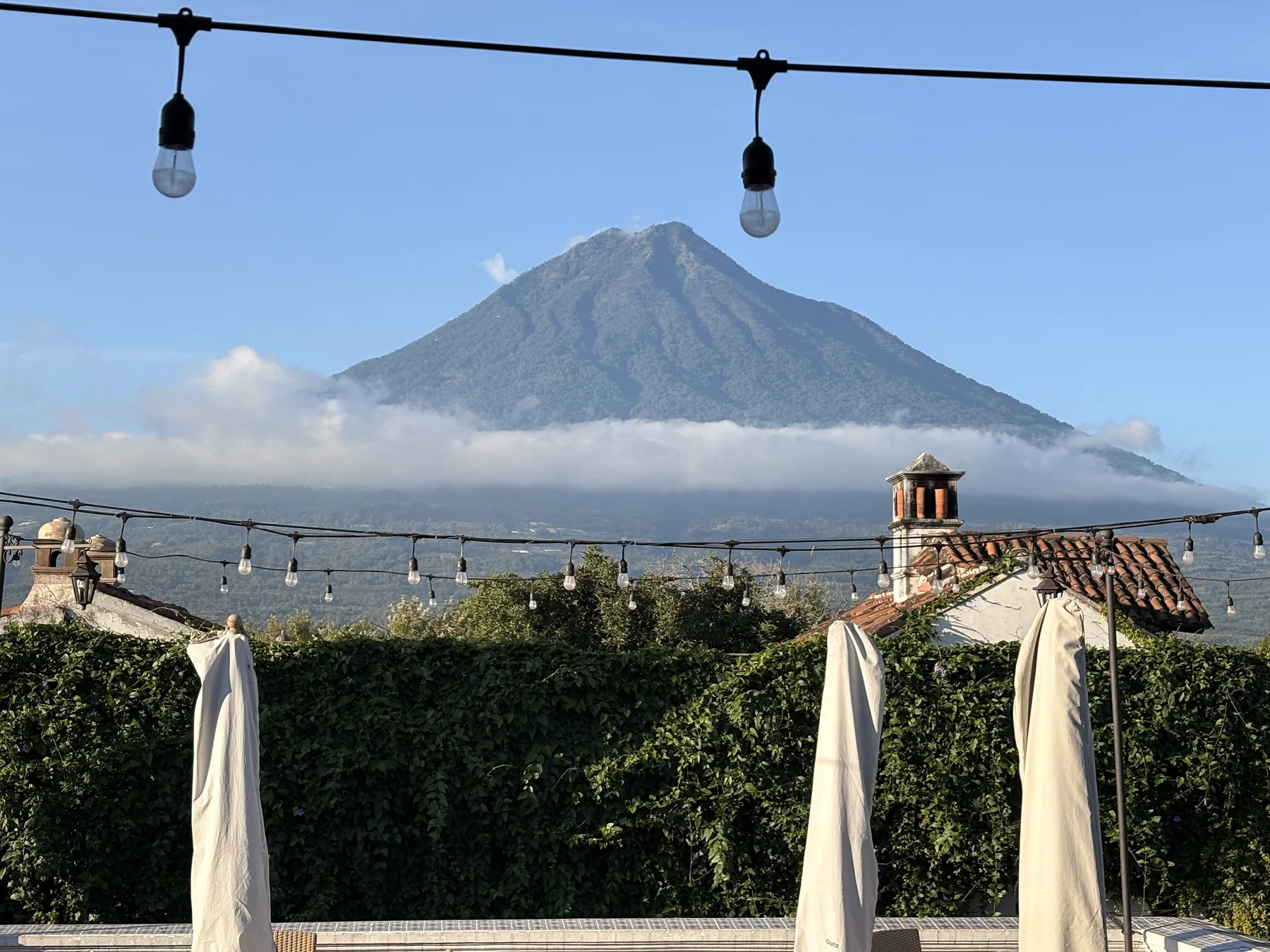
Morning over the rooftops of Antigua Guatemala, July 2026 · Photo: Andrew McGilly / Bold Pilgrim
4
Lake Atitlán: Santa Catarina Palopó
Why it belongs
The two lake nights would be based on the lake at Santa Catarina Palopó, a small Maya town on the shore beside Panajachel; lodging and transport there would be confirmed when a departure is planned. The town has no known connection with Blessed Stanley Rother and is not a place of pilgrimage. It belongs to the journey as the place to rest, pray and prepare on the eve of the day in his parish, and to be quiet afterward. Its patron, from whom it takes its name, is St. Catherine of Alexandria, virgin and martyr.
What you would do there
The group would arrive by road from Antigua and would not cross the lake that day. The afternoon would be Pilgrim's Time in the town, whose house fronts are painted in colours and designs drawn from its traditional woven blouse, and by the water. In the evening his letters could be read and night prayer said by the lake, with the next morning's crossing in mind. The last morning at the lake would be kept quiet before the drive back to the capital.
5
Santiago Atitlán: the parish church of Santiago Apóstol and the memorial of his heart
Why it belongs
This is the spiritual centre of the pilgrimage. It is the church of the Tz'utujil parish he served from 1968 until his death. He learned the people's language, celebrated Mass in it and worked on the Tz'utujil New Testament. When his body was taken home to Oklahoma, his parishioners asked his family to let them keep his heart, and the family agreed. His heart and a relic of his blood remain in the church. He had written, months before he died, that the shepherd cannot run at the first sign of danger.
What you would do there
On the lake day the boat would go here first, in the morning, and the group would walk up from the dock to the church with the whole morning and the midday hours before it. There would be time to pray where his heart is kept, to hear his last letters read aloud, and for Mass where it can be arranged with the parish. This is a living parish, and a group would come as guests of the people he served, on the parish's terms, with veneration of the relics as the parish allows.
6
Santiago Atitlán: the room where he was killed
Why it belongs
In the early hours of 28 July 1981 three masked men entered the rectory beside the church and shot him in one of its rooms. He was 46. Pope Francis recognized his death as martyrdom in 2016, and he was beatified in Oklahoma City on 23 September 2017. Catholic press reports from 2017 to 2019 describe the room as kept as a chapel in his honour; its present arrangement is for the parish to say. The parish school now bears the name his people gave him, Padre Apla's.
What you would do there
Where the parish can receive a group, the pilgrim would enter the room in silence and pray there. Nothing here is a museum piece; it is a parish house. Before the midday meal in the town and the early-afternoon boat there would be time, where it can be arranged, to meet parishioners who remember him. A priest travelling with the group would ask the parish in advance about celebrating Mass.
7
San Juan La Laguna
Why it belongs
San Juan La Laguna is not a pilgrimage site and has no known connection with Blessed Stanley Rother; nothing found ties his ministry to it. It would be a short cultural visit, part of Pilgrim's Time on the lake day. Its only bearing on this pilgrimage is that its people are Tz'utujil, the same people he served across the water. The town is known for women's weaving cooperatives that dye their thread with plants of the region.
What you would do there
If the lake allowed, the boat would call here in the early afternoon for a visit to one weaving and natural-dye cooperative and a walk past the street murals of Tz'utujil life, with a brief prayer in the town's church if it is open. It would be the shorter half of the day by design, and the first thing to be left out: if the wind were up, the group would return directly from Santiago Atitlán.
8
Guatemala City: the night before departure
Why it belongs
The last night in the capital is practical, and it is better to say so. It would place the group near the airport after a return from the lake made in daylight. Beyond the cathedral visited on the first morning, no further Catholic site in the capital has been verified for this journey, so none is claimed for this evening.
What you would do there
The evening would be the group's own closing: thanksgiving, a last reading from his letters and night prayer together, with Mass that day where a priest accompanies the group and it can be arranged. The transfer to the airport would follow the next morning.
Prayer and the sacraments
Mass would be sought each day where a priest accompanies the group and the churches can receive it: at the cathedral, at the sanctuary of St. Hermano Pedro and above all in the parish of Santiago Atitlán, where any celebration by a visiting priest would be asked of the parish in advance and cannot be promised. Clergy arrangements would be confirmed for any departure. Confession would be offered where confessors are available. The Rosary could be prayed on the road and on the lake, a time of adoration kept where adoration is possible, and his letters read aloud at the places they describe.
Pilgrim’s Time
Pilgrim's Time would be protected in Antigua and at the lake. In Antigua it would be an open afternoon for the cloisters, the market, coffee and textiles, or a return to Hermano Pedro's tomb. At the lake it would be the afternoon of arrival and the last morning at Santa Catarina Palopó, by the water and in the painted streets of the town, together with the short visit to the weavers of San Juan La Laguna on the lake day.
Pilgrim Pace
The days would be short on walking but real in other ways. Antigua and the lake both lie at about 1,500 metres and the road between them climbs higher, so the first days should be gentle. Antigua's streets are level but roughly cobbled. Two half-days would be spent on winding mountain roads. The lake day would start early, because the wind on Lake Atitlán generally rises after midday and can make the water rough; that is why Santiago Atitlán would come first and San Juan La Laguna would be dropped if conditions required. The day would mean three boardings of a small boat, each with a step in and out and a walk up from the water. Road transfers would be planned for daylight.
The fitting extension would be at home: his body rests in the chapel altar of the Blessed Stanley Rother Shrine in Oklahoma City, whose church was built to mirror the one in Santiago Atitlán, and Okarche, the farm town where he was born and first buried, could be visited with it. Pilgrims who had prayed where his heart is kept could finish where his body lies. Independent days of rest at Lake Atitlán or in Antigua afterward would be separate from the pilgrimage. Those independent days are where an outing such as Pacaya would belong. The volcano is within reach of Antigua and is commonly walked as a half-day hike over loose volcanic ground. It is an adventure, not a place of pilgrimage, and no part of Blessed Stanley Rother's story. Access depends on the volcano's alert level and the park closes when activity rises, so it would be arranged locally and could not be promised.
Other ways to make this pilgrimage
Oklahoma first: the shrine in Oklahoma City and Okarche. A long weekend at home could take in the shrine where his body rests, its museum of his life, and his home town of Okarche, as a pilgrimage in its own right or as preparation for Guatemala.
For his memorial, 28 July. A journey timed for the days around the anniversary of his death, when pilgrims from Oklahoma have joined the parish of Santiago Atitlán before, would fall in the rainy season; taking part would be by arrangement with the parish.
For priests and seminarians. A bishop, a vocation office or a priests' fraternity could make the same route as a pilgrimage of pastors to a pastor, with their own conferences and with Mass in his parish where it can be arranged.
No dated departures are currently announced. This is a journey Bold Pilgrim is considering, described so you can picture it. Dates, priest, Gateway Airport and price are published on a departure itself, and only when confirmed.
WHAT YOU MAY EXPERIENCE
What the pilgrim may experience
The centre of the week would be part of one day: a morning and midday in Santiago Atitlán, reached by boat, in the church where his heart is kept and, where the parish can receive the group, in the room where he was killed. The group would not sleep in Santiago Atitlán. It would be based across the water, on the lake at Santa Catarina Palopó, and would come to the parish as a guest. Everything else in the week prepares for those hours or follows from them: the cathedral in the capital, the tomb of St. Hermano Pedro in Antigua, the quiet of the lake before and after.
Much of what matters cannot be scheduled from a distance. The parish publishes no visiting arrangements that we could find, so Mass, veneration of the relics and entry to the room would each be asked of the parish beforehand and received as it allows.
In practice
Praying in the church where Blessed Stanley Rother's heart is kept
Silence in the room where he was killed, where the parish can receive visitors
Mass in the parish he served, where it can be arranged
Crossing Lake Atitlán by boat in the morning
Praying at the tomb of St. Hermano Pedro in Antigua
Praying in the cathedral of Guatemala City for the dead of the years in which he died
Hearing his letters read aloud in the places they describe
Who Blessed Stanley Rother was
Stanley Francis Rother was born on 27 March 1935 in Okarche, Oklahoma, the eldest child of a farming family. He struggled with Latin, failed his first year of theology and was sent home from the seminary in San Antonio; he was given a second chance at Mount St. Mary's in Maryland and was ordained on 25 May 1963. In 1968 he joined his diocese's mission at Santiago Atitlán, on the southern shore of Lake Atitlán.
There the man who had struggled with Latin learned Spanish and Tz'utujil, celebrated Mass in the people's language and worked on the Tz'utujil New Testament, which the Archdiocese of Oklahoma City says was published after his death. The Holy See's Dicastery for the Causes of Saints credits him with helping to found cooperatives for farmers and weavers, a credit union, a school, a hospital and a Catholic radio station. His people called him Padre Apla's, their form of his middle name, Francis.
Who this pilgrimage may be for
It may suit priests and seminarians, who see in him a parish priest without glamour; Oklahomans and Midwestern Catholics, for whom he is one of their own; Catholics of Guatemalan and Central American family; and anyone weighing a commitment that has become costly. It asks for some stamina, an early start or two, and a willingness to be a guest in a poor and prayerful parish.
Priests, deacons and seminarians
Catholics from Oklahoma and the central United States
Catholics of Guatemalan and Central American heritage
Parish and diocesan groups with a mission partnership in Latin America
Anyone discerning whether to stay in a costly commitment
Those who pray for persecuted Christians
A spiritual purpose has no Pilgrim Pace of its own; the actual itinerary determines the pace. The journey described here would be light on walking but would ask something in other ways: Antigua and Lake Atitlán lie at about 1,500 metres and the road between them climbs higher, Antigua's streets are cobbled, two half-days would be spent on winding highland roads, and the lake day would mean an early start, three boardings of a small boat and a walk up from the dock in Santiago Atitlán. The wind on the lake generally rises after midday, so the boat would go to Santiago Atitlán first and the shorter visit to San Juan La Laguna would be left out if conditions required. Road transfers would be planned for daylight.
PLACES AND PEOPLE THAT MATTER
The holy places
Parish church of Santiago Apóstol, Santiago Atitlán
The parish he served from 1968 to 1981, where his heart and a relic of his blood are kept. The spiritual centre of the pilgrimage.
The room where he was killed, Santiago Atitlán rectory
Where he was shot on 28 July 1981; press reports describe it as kept as a chapel in his honor. Visits are for the parish to allow.
San Francisco el Grande and the tomb of St. Hermano Pedro, Antigua Guatemala
The resting place of the saint whom St. John Paul II called the first Guatemalan saint.
Metropolitan Cathedral, Guatemala City
The mother church of the country he served, where the journey would first pray for the dead of the years in which he died.
La Merced and the Cathedral of San José, Antigua Guatemala
Churches of a World Heritage city that was the capital until 1773; general Catholic heritage, with no direct link to Blessed Stanley Rother.
Lake Atitlán and Santa Catarina Palopó
The lake on whose southern shore his parish stands, and the lakeshore town where the group would be based for two nights. A place to rest and pray, with no part in his story.
Blessed Stanley Rother Shrine, Oklahoma City
His body rests in the chapel altar; the shrine church was built to mirror the one in Santiago Atitlán.
Saints and holy people
Blessed Stanley Rother
The Oklahoma priest and martyr whose parish, relics and place of death are the purpose of the journey. He is Blessed, beatified on 23 September 2017.
St. Hermano Pedro de San José Betancur
The seventeenth-century Franciscan tertiary of Antigua, canonized in Guatemala City in 2002, whose tomb the journey visits. He has no historical tie to Blessed Stanley Rother; he is the saint of the country Blessed Stanley served.
Devotions and practices
Prayer at the relics and the place of a martyr's death
The Church's oldest form of honoring martyrs, kept here in the church that holds his heart and in the room where he died, as the parish allows.
Christ the Good Shepherd (John 10)
His own image for his priesthood: the shepherd who does not run.
Prayer for priests and for persecuted Christians
A natural prayer at each stop, from the cathedral in the capital to Santiago Atitlán.
The Rosary
Prayed on the road and on the lake, with Mary invoked as Queen of Martyrs.
Our Lady and this pilgrimage
Mary is invoked on this pilgrimage as Queen of Martyrs, a title from the Litany of Loreto, and the Rosary would be its daily prayer on the road and on the lake. The shrine built in his honor in Oklahoma City includes a re-creation of Tepeyac Hill with statues of Our Lady of Guadalupe and St. Juan Diego.
UNDERSTANDING THIS PILGRIMAGE
An American Martyr pilgrimage follows Blessed Stanley Rother, the Oklahoma priest killed in 1981 in his mission parish of Santiago Atitlán, Guatemala, and beatified in 2017 as a martyr. He is the first person born in the United States whom the Church has declared a martyr. The journey would go from Guatemala City to Antigua and on to Lake Atitlán, and from there by boat to the Tz'utujil Maya parish he served for thirteen years, where his heart is kept. Pilgrims go to pray where an ordinary priest chose to stay with his people.
His death, and what the Church has said
The Dicastery places his death within a persecution of the Church in Guatemala in the years 1978 to 1981, during the country's armed conflict. Catechists of his parish were abducted and killed. Early in 1981, after his name appeared on a death list, he went home to Oklahoma, and in April he returned in time for Holy Week. In the early hours of 28 July 1981 three masked men entered the rectory and shot him. He was 46. No one has been held responsible.
Pope Francis recognized his death as martyrdom on 1 December 2016, and he was beatified in Oklahoma City on 23 September 2017, with Cardinal Angelo Amato presiding. At the Angelus the next day the Pope said he had been killed "in hatred of the faith" for his work of evangelization and human promotion among the poorest in Guatemala. His title today is Blessed. The Archdiocese of Oklahoma City, which promotes his cause, says a miracle is required for his canonization; none had been announced in the sources read for this page on 8 October 2026. His memorial is listed for 28 July.
In what sense an 'American martyr'
The phrase needs its qualifier. Blessed Stanley Rother is the first person born in the United States whom the Church has declared a martyr, and the first U.S.-born priest to be beatified. He is not the first martyr honored on American soil: St. Isaac Jogues and two companions were killed in what is now New York State in the 1640s, but they were born in France. Nor is he the only U.S.-born martyr of Guatemala: Blessed James Miller, a De La Salle Brother from Wisconsin, was killed there in 1982 and beatified in 2019. Blessed Stanley died far from home, as the pastor of a Guatemalan parish.
Where he is honored today
He is honored in two countries. His body rests in the chapel altar of the Blessed Stanley Rother Shrine in Oklahoma City, dedicated in 2023, whose church was built to mirror the one in Santiago Atitlán. His heart and a relic of his blood remain, at his parishioners' request, in the church of Santiago Apóstol in Santiago Atitlán, and Catholic press reports describe the room where he died as kept as a chapel in his honour. This pilgrimage goes to Guatemala; the Oklahoma shrine is its natural companion.
Questions pilgrims ask
Who was Blessed Stanley Rother?
Blessed Stanley Rother (1935 to 1981) was a Catholic priest from Okarche, Oklahoma, who served from 1968 as a missionary pastor to the Tz'utujil Maya in Santiago Atitlán, Guatemala. He learned their language, celebrated Mass in it and helped found a school, a hospital and cooperatives. He was shot in his rectory on 28 July 1981 during a persecution of the Church. Pope Francis recognized him as a martyr in 2016, and he was beatified in Oklahoma City on 23 September 2017.
Is Stanley Rother a saint?
Not yet. His title is Blessed. He was beatified on 23 September 2017, after Pope Francis recognized his death as martyrdom. The Archdiocese of Oklahoma City, which promotes his cause, says one miracle is required for canonization; reports as late as August 2026 still described the cause as waiting for one, and we found no announcement when this page was checked on 8 October 2026. His memorial is listed for 28 July, the day of his death.
In what sense is Blessed Stanley Rother an American martyr?
He is the first person born in the United States whom the Church has declared a martyr, and the first U.S.-born priest to be beatified. Earlier martyrs died in what is now the United States, among them St. Isaac Jogues and two companions in New York State in the 1640s, but they were born in France. Blessed Stanley was born in Oklahoma and died in Guatemala.
Where is Blessed Stanley Rother buried, and where is his heart?
His body rests in the altar of the chapel at the Blessed Stanley Rother Shrine in Oklahoma City. His heart and a relic of his blood are kept in the church of Santiago Apóstol in Santiago Atitlán, Guatemala, the parish where he served and was killed.
Can you visit the place where Blessed Stanley Rother was killed?
In principle, yes. He was killed in the rectory beside the parish church of Santiago Apóstol in Santiago Atitlán, on Lake Atitlán, and Catholic press reports from 2017 to 2019 describe the room as kept as a chapel in his honor. It belongs to a working parish, which publishes no visiting arrangements that we could find, so a group visit, and any Mass by a visiting priest, would need to be arranged with the parish in advance.
Is it safe to make a pilgrimage to Guatemala?
That is a judgment to make with current information. The U.S. Department of State rates Guatemala Level 3, Reconsider Travel, in an advisory issued on 12 March 2026 and read for this page on 8 October 2026. It tells travelers not to go to San Marcos and Huehuetenango Departments, Zone 18 of Guatemala City or the city of Villa Nueva, none of which is on this route. It names Antigua and Lake Atitlán as popular destinations served by tourist police, and notes that U.S. government employees may not travel outside the capital at night. Read the current advisory before deciding; conditions change.
Who is St. Hermano Pedro of Antigua?
St. Pedro de San José Betancur (1626 to 1667), known as Hermano Pedro, was a Franciscan tertiary from Tenerife who cared for the convalescent poor in what is now Antigua Guatemala; his followers became the Bethlehemite congregation. St. John Paul II beatified him in 1980 and canonized him in Guatemala City on 30 July 2002, calling him the first Guatemalan saint. His remains rest in the church of San Francisco el Grande in Antigua.
Church documents are cited for doctrine and discipline; shrine and diocesan pages for institutional facts. Where a claim rests on tradition or private revelation, the page says so.
RELATED WAYS TO CONTINUE
Classic Pilgrimages that serve this purpose
None of the three Classic Pilgrimages visits the places this pilgrimage depends on, and we would rather say so than stretch a connection.
Upcoming departures
No dated departures are currently announced.
Dates, priest, Gateway Airport, price and availability are published on the departure itself, and only when confirmed. This page describes a reason for going, not a departure.