THE JOURNEY
In the Footsteps of Francis: Assisi, La Verna, Greccio and Rome
- Where
- Italy
- Length
- About eight or nine days
- Status
- Under consideration
This journey would settle in Assisi for most of its days and follow the life of St. Francis in the order he lived it: the call at San Damiano, the renunciation before the bishop, the beginnings at the Portiuncula, the stigmata on La Verna, and then his tomb. La Verna would be a day out from Assisi, so that the pilgrim goes up to the mountain of the cross and comes back down to the crypt where the story comes to rest. The road south would then pass through the Rieti Valley at Greccio, the place of the crib, and the journey would end in Rome at St. John Lateran, because Francis took his way of life to the Pope and renewed the Church only from inside her.
The route, and why each place belongs
- 1
Assisi: San Damiano and the Basilica of St. Clare
Why it belongs
San Damiano, below the town, is where Francis was praying around 1205 when, as the early accounts tell it, he heard Christ say, "Go, Francis, and repair my Church in ruins," and it is where St. Clare lived for more than forty years. The painted cross itself is now in the Basilica of St. Clare, where the Poor Clares brought it in 1257.
What you would do there
The pilgrim would pray before the original San Damiano cross in the Chapel of the Crucifix and at St. Clare's resting place in the crypt, then walk down through the olive groves to San Damiano itself. The cathedral of San Rufino, where by tradition both Francis and Clare were baptized, would be a fitting place to recall one's own baptism.
- 2
Assisi: the Sanctuary of the Renunciation
Why it belongs
At the church of Santa Maria Maggiore the Sanctuary of the Renunciation keeps the memory of the day Francis stood before Bishop Guido, gave back everything he had from his family, and was covered with the bishop's own cloak. It is the moment the break with his old life became public.
What you would do there
Unhurried prayer where Francis gave everything back, and at the tomb of St. Carlo Acutis, who has rested in the same church since April 2019. Carlo was not a Franciscan, but he loved Assisi and wished to remain in the city of St. Francis; two young men, eight centuries apart, are remembered under one roof.
- 3
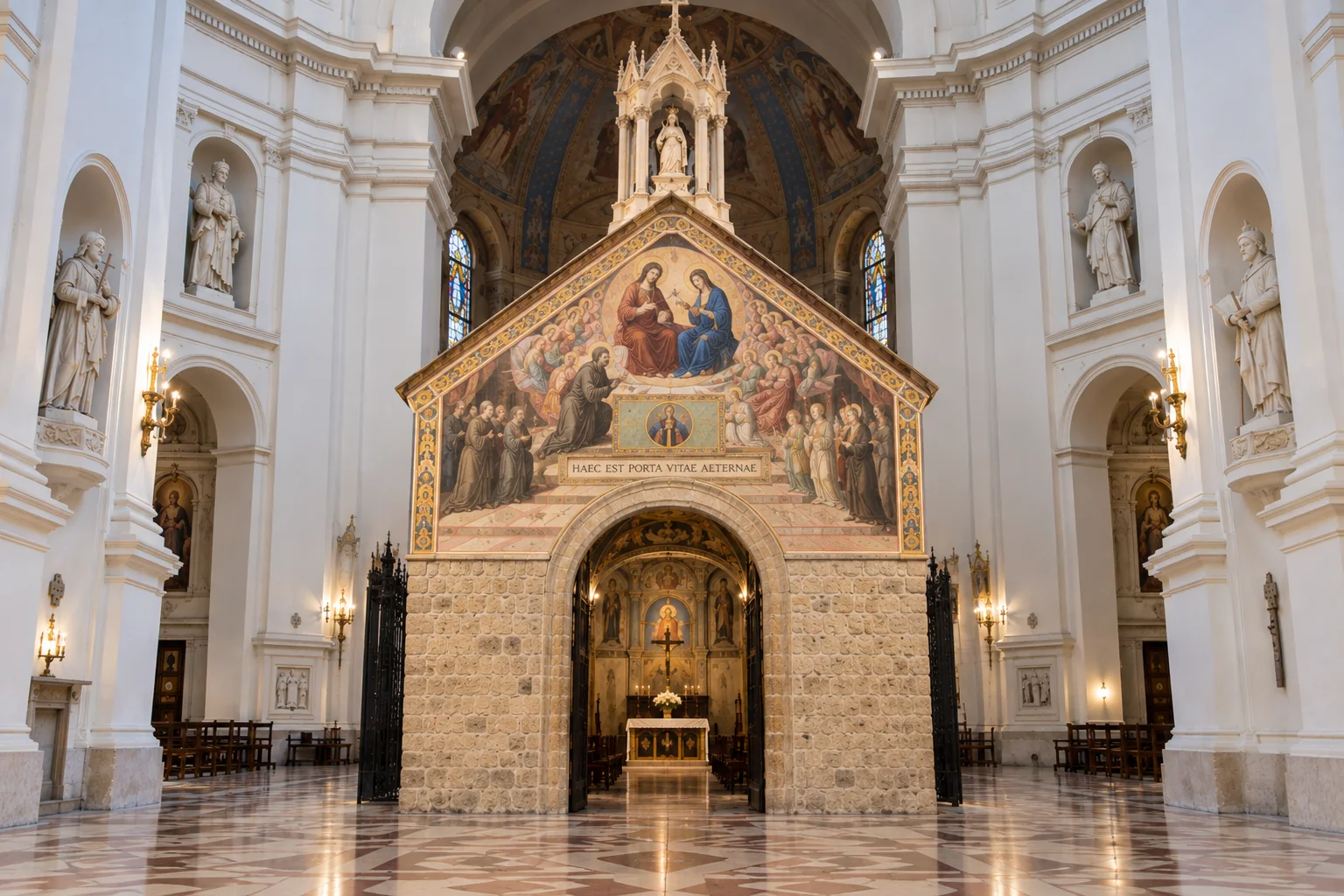
Assisi: the Portiuncula, Basilica of St. Mary of the Angels
Why it belongs
The little chapel in the valley is where the order began, where Clare was received, and beside which Francis died on the evening of October 3, 1226. It is a chapel of Our Lady, and Francis made it the home of his brotherhood.
What you would do there
The pilgrim would step into a chapel small enough to cross in a few steps, standing inside a vast basilica, and pray there in silence. This is also the place of the Pardon of Assisi, a plenary indulgence attached to the Portiuncula under the Church's usual conditions, which only makes sense alongside Confession.
- 4
La Verna
Why it belongs
On this mountain in the Tuscan Apennines Francis received the stigmata in September 1224, two years before his death. In the Franciscan devotion to crib, cross and altar, La Verna is the cross, and for many pilgrims it is where the journey turns from affection to seriousness.
What you would do there
A day among the woods and rock of the most austere of the Franciscan places, with prayer at the Chapel of the Stigmata, which marks the place. The day would be kept quiet, with time to be alone on the mountain where Francis went to be alone with God.
- 5
Assisi: the Basilica of St. Francis and the tomb
Why it belongs
The crypt of the basilica, kept by the Conventual Franciscans, holds the saint's tomb. Having followed his life from the call to the mountain, the pilgrim would come here last in Assisi, as to the place of arrival.
What you would do there
Standing in silence with other pilgrims around the plain stone tomb, and praying the short prayer Francis left for every church: "We adore You, Lord Jesus Christ, here and in all Your churches throughout the whole world, and we bless You, because by Your holy Cross You have redeemed the world."
- 6
Greccio
Why it belongs
In the Rieti Valley, between Assisi and Rome, Francis had a manger prepared at Christmas 1223 with hay, an ox and a donkey, and Mass was celebrated over it. Greccio is the crib, as La Verna is the cross.
What you would do there
On the way south the pilgrim would stop at the hillside sanctuary, enter the cave chapel where the manger stood, and hear the account of that Christmas read in the place where it happened.
- 7
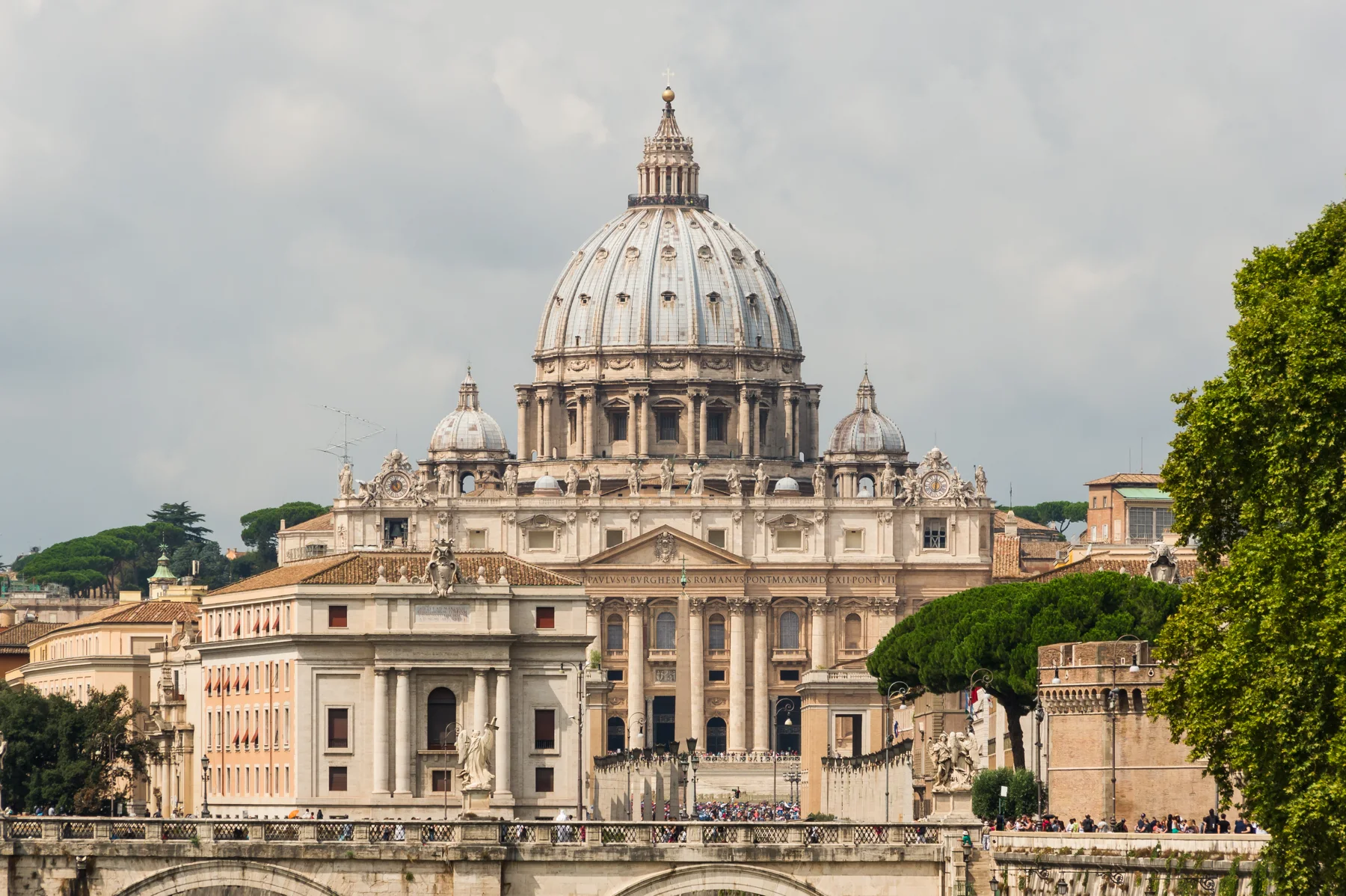
Rome: St. John Lateran
Why it belongs
Francis went to Rome to ask Pope Innocent III to approve his way of life. The Pope's cathedral keeps the memory of that appeal and, as the tradition tells it, of the Pope's dream of a poor man holding up the collapsing basilica.
What you would do there
The journey would close with a visit to the Lateran and a prayer for the Church Francis was sent to repair, and for the grace to carry something of his simplicity home.
Prayer and the sacraments
Mass would be sought, where the schedule permits, in the places where Francis and Clare prayed, and Confession where confessors are available, most fittingly at the Portiuncula; clergy arrangements are confirmed for each departure. Time before the Blessed Sacrament, which Francis and Clare both loved, and silence in the small chapels would give the days their shape.
Pilgrim’s Time
Pilgrim's Time would be kept for Assisi in the early morning and in the evening, after the day visitors have left, when a pilgrim could return alone to the crypt or to the San Damiano cross. Those with the energy could use a free afternoon for the hermitage of the Carceri, in the woods of Mount Subasio above the town, where Francis withdrew to pray.
Pilgrim Pace
Assisi is a steep hill town with stone streets and stairs, and the way down to San Damiano involves a real gradient; La Verna and Greccio are mountain and hillside sites with uneven paths and steps, and the days to them include road transfers. The Portiuncula, in the valley, is level. Anyone with limited mobility should ask how each site would be reached.
How Pilgrim Pace worksIf you can stay longer
A pilgrim who wants to follow Francis's sons could extend north to the tomb of St. Anthony in Padua or south to the shrine of St. Padre Pio at San Giovanni Rotondo; either would be planned as a separate addition, not as part of this route.
Other ways to make this pilgrimage
- Rome & Assisi. The Classic route begins among Rome's basilicas, St. John Lateran among them, and ends with unhurried days in Assisi at the Basilica of St. Francis, the Basilica of St. Clare and the Portiuncula.
- Arriving on foot. One or more waymarked stages of the Via di Francesco could bring a pilgrim into Assisi on foot, with the route and distance setting the pace.
- Greccio in Advent. A journey centred on the crib of 1223 belongs to the Advent & Christmas pilgrimage, which offers Christmas Time in Rome with Greccio as another way.
No dated departures are currently announced. This is a journey Bold Pilgrim is considering, described so you can picture it. Dates, priest, Gateway Airport and price are published on a departure itself, and only when confirmed.
UNDERSTANDING THIS PILGRIMAGE
St. Francis saw in Jesus Christ, poor and crucified, a love worth giving everything for, and a Franciscan pilgrimage goes to the places where he and St. Clare learned to see it: Assisi above all, and beyond it the mountain of La Verna, Greccio in the Rieti Valley, and the Rome where Francis asked the Pope's blessing on his way of life. Pilgrims go to pray where Francis prayed, at his tomb, before the San Damiano cross and in the little chapel of the Portiuncula. The purpose is not to admire Francis but to follow him to the One he followed.
What this pilgrimage means, and its Catholic foundation
Francis was born in Assisi in 1181 or 1182, the son of a cloth merchant, and died at the Portiuncula on the evening of October 3, 1226. In between, by his own account in the Testament, it had seemed to him very bitter to see lepers, and the Lord Himself led him among them. Around 1205 he was praying before a painted crucifix in the half-ruined church of San Damiano when, as the early accounts tell it, he heard Christ say, "Go, Francis, and repair my Church in ruins." He took it literally and started carrying stones. It turned out to mean more.
What makes this a Catholic pilgrimage, and not a tribute to a likeable medieval figure, is how Francis understood that call. He went to Rome to ask Pope Innocent III to approve his way of life, and he renewed the Church only in communion with her. Benedict XVI put it bluntly: the real historical Francis is "the Francis of the Church." Francis adored Christ in the Eucharist, insisted on reverence for priests because they consecrate it, and wrote in his Testament that in this world he saw nothing bodily of the Son of God except His most holy Body and Blood.
Franciscan tradition gathers his devotion around three moments of Christ's self-giving: the crib, the cross and the altar. Each has a place on the map. Greccio is the crib, La Verna is the cross, and the Portiuncula and San Damiano are the school of prayer and poverty where both were learned. Pope Francis, preaching in Assisi in 2013, warned against a sentimental reading: Franciscan peace "is not something saccharine," and it is not a vague harmony with nature. It is the peace of Christ, received by someone who took up His yoke.
Why a Catholic may feel drawn to it
Francis is loved well beyond the Church, and many pilgrims arrive by a side door: the Canticle of the Creatures, the animals, a garden statue, a sense that he was free in a way they are not. That is a fair place to start. In 1979 St. John Paul II proclaimed him the patron of ecology, and Laudato si' calls him "the example par excellence of care for the vulnerable."
Others come at a turning point. Francis was a young man with a comfortable future in his father's trade when everything he had planned stopped making sense. Clare was eighteen when she left her family's house at night to join him. People who are simplifying their lives, changing work, discerning a vocation, or tired of owning too much often recognize themselves in one of them.
And some come because they want the Gospel without footnotes. Francis asked to live it plainly. A pilgrimage in his company tends to ask a plain question in return: what would it look like if I did what Christ said?
The places, and what each one is for
Assisi holds the beginning and the end. The Basilica of St. Francis, kept by the Conventual Franciscans, holds his tomb in the crypt. The Basilica of St. Clare holds her remains and the original San Damiano cross, which the Poor Clares brought with them when they moved inside the walls in 1257. San Damiano itself, below the town, is where Francis heard his call and where Clare lived for more than forty years. Down in the valley, inside the great Basilica of St. Mary of the Angels, stands the Portiuncula, the small chapel where the order began, where Clare was received, and beside which Francis died. The Friars Minor keep it. Above the town, in the woods of Mount Subasio, the hermitage of the Carceri shows where he withdrew to pray.
Assisi also keeps the place where Francis made the break with his old life public. In the dispute with his father he stood before Bishop Guido, stripped off his clothes and gave back everything he had from his family, and the bishop covered him with his own cloak. The Sanctuary of the Renunciation (Santuario della Spogliazione), at the church of Santa Maria Maggiore, keeps that memory. Since April 2019 the same church has held the tomb of St. Carlo Acutis, the teenager from Milan canonized on September 7, 2025. Carlo was not a Franciscan. He spent most of his holidays at a family home in Assisi and felt at home there; the Holy See's biography says that from Francis he learned to respect creation and to give himself to the poorest, and that his body was brought to Assisi to honour his wish to remain in the city of St. Francis. Two young men, eight centuries apart, are remembered under one roof, and the place deserves the same unhurried time as the basilicas.
La Verna, in the Tuscan Apennines, is the mountain where Francis received the stigmata in September 1224, two years before his death. It is the most austere of the Franciscan places and, for many pilgrims, the one that changes the tone of the journey from affection to seriousness.
The Rieti Valley, between Assisi and Rome, is often called the Holy Valley, and Greccio is the most visited of its four small Franciscan sanctuaries. There, at Christmas 1223, Francis had a manger prepared with hay, an ox and a donkey, and Mass was celebrated over it. A few weeks earlier, on November 29, 1223, Pope Honorius III had confirmed his Rule. The valley's other sanctuaries are described in the separate answer on the Rieti Valley.
Rome belongs to the story because Francis went there. St. John Lateran keeps the memory of his appeal to Innocent III, and of the Pope's dream, as the tradition tells it, of a poor man holding up the collapsing basilica.
Questions pilgrims ask
What is a Franciscan pilgrimage?
A Franciscan pilgrimage is a journey of prayer to the places where St. Francis and St. Clare of Assisi lived: Assisi itself, and often La Verna, Greccio in the Rieti Valley, and Rome. Pilgrims pray at Francis's tomb, before the San Damiano cross and in the Portiuncula chapel. Its aim is the one Francis had: to follow Jesus Christ more closely, in simplicity and in communion with the Church. It differs from a sightseeing visit to Assisi in purpose more than in route.
Where do you go on a St. Francis pilgrimage?
The centre is Assisi: the Basilica of St. Francis with his tomb, the Basilica of St. Clare with the San Damiano cross, San Damiano, the Portiuncula in the valley, the Carceri hermitage above the town, and the Sanctuary of the Renunciation, where Francis gave up his inheritance and St. Carlo Acutis is now entombed. A fuller route adds La Verna in Tuscany, where Francis received the stigmata in 1224, and Greccio in the Rieti Valley, which recalls the Christmas crib of 1223. Rome completes it at St. John Lateran, where Francis asked Pope Innocent III to approve his way of life.
Where did St. Francis receive the stigmata?
On the mountain of La Verna in the Tuscan Apennines, in September 1224, two years before his death. The Sanctuary of La Verna stands there today and receives pilgrims; the linked answer explains how to reach it.
Full answer: Can I visit La Verna, where St. Francis received the stigmata?
What is the Portiuncula indulgence, or Pardon of Assisi?
It is a plenary indulgence that, by Franciscan tradition, St. Francis asked of Pope Honorius III in 1216 for those who visit the Portiuncula repentant and confessed. According to the sanctuary, it may be gained there on any day of the year, and at the beginning of August in Franciscan and parish churches everywhere, under the Church's usual conditions. The Catechism teaches that an indulgence remits temporal punishment for sins already forgiven; it is not forgiveness itself and it is not automatic.
Full answer: How do I gain the Portiuncula indulgence (the Pardon of Assisi)?
Where is the original San Damiano cross?
In the Basilica of St. Clare in Assisi, in the Chapel of the Crucifix, not at San Damiano. Francis was praying before this painted cross in the church of San Damiano around 1205 when, as the early accounts tell it, he heard Christ call him to repair His Church. The Poor Clares took the cross with them when they moved from San Damiano to the new basilica inside the town walls in 1257, and they have kept it since. Pilgrims usually visit both places.
Do I have to be Catholic, or a Franciscan, to make a Franciscan pilgrimage?
No. You do not need to belong to a Franciscan order or parish, and guests who are not Catholic are welcome at the shrines and at Mass. Laudato si' notes that Francis is much loved by non-Christians too. The honest expectation is that you will meet Francis as he was, a man whose whole life was about Jesus Christ; the linked answer explains what a guest can expect at Mass.
Full answer: Do I have to be Catholic to go on a Catholic pilgrimage?
Can I make a Franciscan pilgrimage on foot?
Yes. The Via di Francesco is a waymarked route to Assisi, with a northern branch from Florence or Rimini by way of La Verna and a southern branch from Rome through the Rieti Valley. It has its own pilgrim credential and a certificate of completion, the Testimonium Viae Francisci. Pilgrims with less time can walk a short stage into Assisi.