Why make this pilgrimage
Some people carry a duty long after it has ended: the names of those who did not come home, a decision made under pressure, years away from the sacraments, or simply gratitude that has never found a place to be spoken. This pilgrimage is for that. It is made by veterans, service members, their families, first responders and anyone drawn to these saints, and it asks one thing: where in the Church can courage, grief and conscience be brought to God?
The answer it offers is the company of saints who knew danger and obedience from the inside and gave both to Christ. It does not celebrate war and it does not tour battlefields. It goes to a village, a tomb, a rock in the sea and a market square, and it seeks what these saints sought: a clear conscience, mercy, and the peace of Christ, the Prince of Peace.
THE JOURNEY
France with St. Joan, St. Martin and St. Michael: Domrémy, Reims, Orléans, Tours, Mont-Saint-Michel and Rouen
- Where
- France
- Length
- About eight to ten days
- Status
- Under consideration
This journey would cross northern France from east to west in the company of three saints: St. Joan of Arc, who kept faith with Christ under an unjust trial; St. Martin of Tours, the soldier whose conscience spoke inside his uniform; and St. Michael the Archangel, whose battle is against evil and never against people. It would begin where Joan's life began, at Domrémy, and end where it ended, at Rouen, so that the whole pilgrimage is held between her calling and her death. Reims and Orléans would be visited in travel order, the reverse of the order in which she reached them, and Tours and Mont-Saint-Michel lie naturally on the road west before the route turns back to Rouen. It would be led by prayer and not by battlefield touring.
The route, and why each place belongs
- 1
Domrémy-la-Pucelle
Why it belongs
This is the village in eastern France where Joan was born in 1412 and where, at thirteen, she first understood herself to be called. The Church canonized her for her holiness and did not define the nature of her 'voices'; she said the first she heard was St. Michael's.
What you would do there
The pilgrimage would open quietly here, in the countryside of her childhood, with time to name the intentions each pilgrim is carrying and the people being prayed for. It is a place to ask the question she faced: what God is asking, and whether one has the courage to answer.
- 2
Reims
Why it belongs
At Reims Charles VII was crowned on 17 July 1429, the moment Joan's public mission reached what she had been sent to do. It belongs here as a place to think about duty carried through to its end, and about what a person does once the task is finished.
What you would do there
Pilgrims would pause in the city of the coronation to give thanks for duty completed, their own or that of someone they love, and to pray for those now serving. Mass could be celebrated here where the schedule permits.
- 3
Orléans
Why it belongs
The siege of Orléans was raised on 8 May 1429 after Joan arrived. Benedict XVI noted that before the fighting she wrote to the English proposing a just peace, and that her life of prayer rested on daily Mass and frequent Confession and Communion.
What you would do there
The visit would be made as prayer for peace and not as a study of the siege: the Rosary for those in danger, and a reading of her offer of peace. It would be a fitting place to begin preparing for Confession.
- 4
Tours: the Basilica of St. Martin
Why it belongs
St. Martin was a Roman cavalryman who cut his cloak in two for a freezing beggar at Amiens, dreamed of Christ wearing it, and later asked for his discharge with the words, "I am the soldier of Christ: it is not lawful for me to fight." His tomb lies in the crypt of the present basilica, rediscovered in 1860; most of his body was burned in 1562, and the basilica keeps the tomb site and surviving relics.
What you would do there
Pilgrims would go down to the tomb in the crypt and pray there for the dead by name. A day of remembrance for the fallen would be kept at Tours, with Mass offered for them where the schedule permits and Confession where confessors are available.
- 5
Mont-Saint-Michel Abbey
Why it belongs
The Mount has been a sanctuary of St. Michael since the eighth century. Its foundation tradition, an appearance of the Archangel to St. Aubert, Bishop of Avranches, in 708, is a tradition and not a defined event. St. Michael is not a human soldier: he is the archangel of Daniel and Revelation, whose battle is against evil.
What you would do there
Those who are able would climb to the abbey at the summit and pray the Prayer to St. Michael for protection against evil, for themselves and for those still serving. Mass at the abbey would be sought only where it can be arranged.
- 6
Rouen: the Old Market Square
Why it belongs
Here Joan was burned on 30 May 1431, aged nineteen, calling on the name of Jesus, after a trial by a hostile Church court whose verdict the Church annulled in 1456. There is no tomb: the decretal letter of her canonization states that her ashes were thrown into the Seine, and no bodily relics of her are known to survive.
What you would do there
The pilgrimage would end standing in the square where she died, in silence and then in prayer, entrusting to Christ whatever each pilgrim has carried across France. A closing Mass of thanksgiving could be celebrated in the city where the schedule permits.
Prayer and the sacraments
Mass would be celebrated where the schedule permits, and a pilgrim could ask a priest to offer it for someone who did not come home; clergy arrangements are confirmed for each departure. An unhurried Confession, where confessors are available, would be given real room, with the Rosary on the road, the Prayer to St. Michael at the Mount, and silence at the tomb in Tours and in the square at Rouen.
Pilgrim’s Time
Pilgrim's Time, the protected free time inside the pilgrimage, would be generous on this journey, above all at Tours and Rouen. It could be used to return alone to St. Martin's tomb, to write down the names of the dead, to speak with a priest, or simply to rest after a long day on the road.
Pilgrim Pace
The Joan of Arc sites are spread across northern and eastern France, which would mean long coach days between stops. Mont-Saint-Michel is a steep climb with many steps, and the crypt at Tours is reached by stairs, so pilgrims with service-connected injuries should describe what they need in advance.
How Pilgrim Pace worksIf you can stay longer
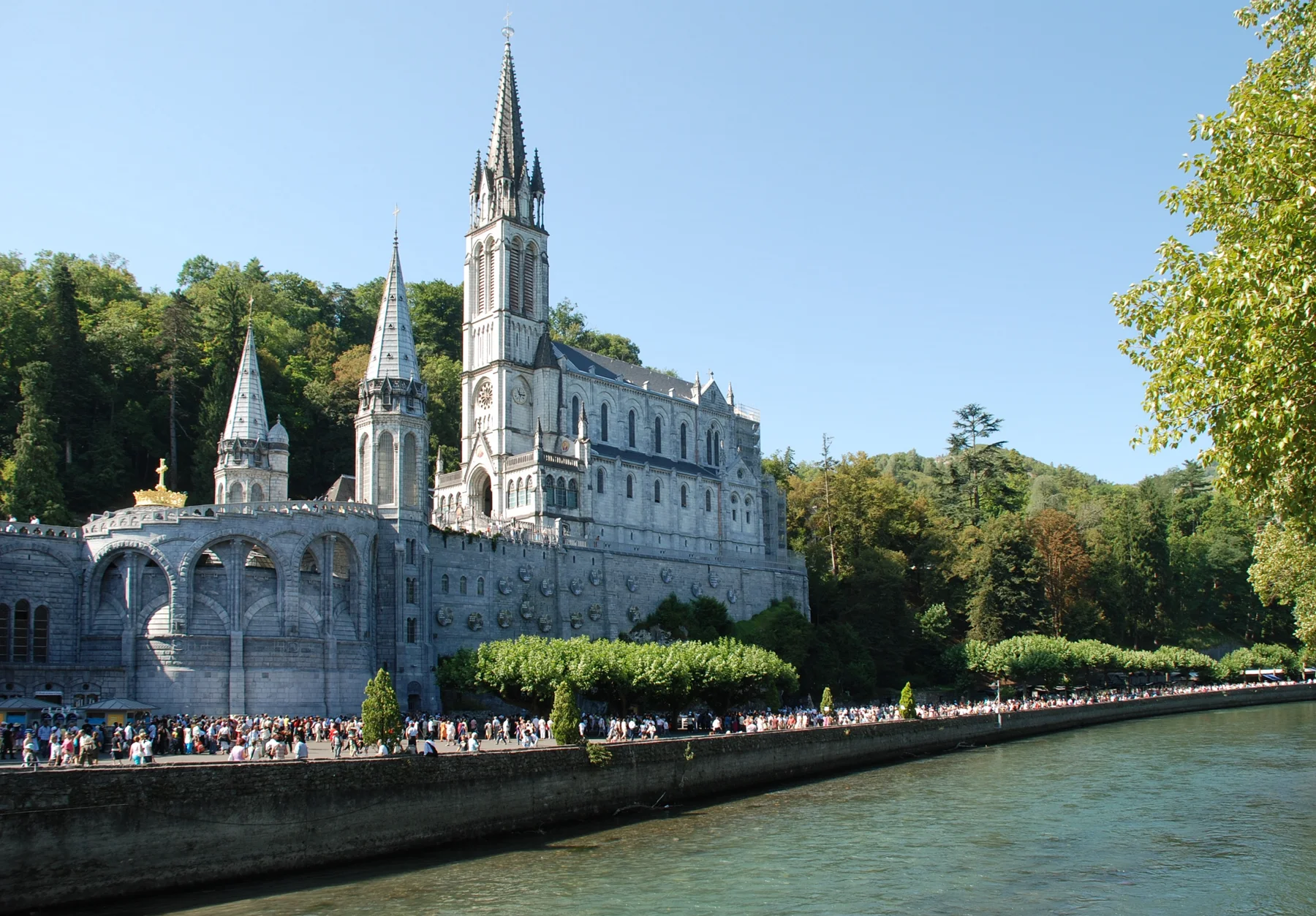
Those who wished could continue south for a quiet stay at the Sanctuary of Our Lady of Lourdes, which is largely level and well equipped for wheelchair users, to pray at the Grotto where soldiers of once-opposed nations have prayed together for peace. Such a stay would be separate from the International Military Pilgrimage and from Warriors to Lourdes, with which Bold Pilgrim is not affiliated.
Other ways to make this pilgrimage
- The soldier who laid down his sword: Pamplona, Loyola, Montserrat and Manresa. A journey in Spain could follow St. Ignatius from the place he fell wounded in 1521 to the altar of Our Lady at Montserrat where he left his sword and dagger, for those leaving service and asking what comes next.
- Lourdes for those who serve. A quiet stay at Lourdes for veterans, service members and their families could be made on its own or within the Fatima and Lourdes Classic, as a journey separate from the military pilgrimages held there by others.
- The Gargano: St. Michael's cave at Monte Sant'Angelo. A shorter pilgrimage in Puglia could centre on the cave shrine where, by ancient tradition, St. Michael appeared, reached by a long staircase and within reach of San Giovanni Rotondo.
No dated departures are currently announced. This is a journey Bold Pilgrim is considering, described so you can picture it. Dates, priest, Gateway Airport and price are published on a departure itself, and only when confirmed.
Who it may be for
Veterans of any era, including those who have been away from the sacraments since their service. Active-duty Catholics and reservists, for whom a pilgrimage may mark a deployment survived, a retirement or a separation from service. Spouses, parents and children, who serve in their own way and are often the ones who pray hardest. Families of the fallen. Police officers, firefighters and emergency personnel, whom Pope Francis addressed alongside the armed forces at the 2025 Jubilee.
It is also for Catholics who have never worn a uniform and are simply drawn to Joan, Martin, Ignatius or Michael, or who want to pray for those who serve. No one needs a service record to go. Those who served in another country's forces, and those who could not in conscience serve, belong here too; St. Martin's story speaks to both.
No dated departures are currently announced. The Classic Pilgrimages are sample journeys, the purpose-built routes described on this page are under consideration only, and clergy arrangements are confirmed for each departure.
- Veterans of any era and any branch
- Active-duty, reserve and National Guard Catholics
- Military spouses, parents and children
- Families of the fallen
- Police officers, firefighters and emergency personnel
- Catholics devoted to St. Joan of Arc, St. Michael, St. Martin or St. Ignatius
A spiritual purpose has no Pilgrim Pace rating; the actual itinerary determines the pace. Typical considerations: the Sanctuary of Lourdes is largely level and well equipped for wheelchair users. Mont-Saint-Michel means a steep climb with many steps, and the cave at Monte Sant'Angelo is reached by a long staircase. The Joan of Arc sites are spread across northern and eastern France, which means long coach days. Pilgrims with service-connected injuries should describe what they need before booking, and Pilgrim's Time, the protected free time inside the pilgrimage, should be generous.
UNDERSTANDING THIS PILGRIMAGE
Yes. The Church honors those who serve, and she keeps places where duty, grief and conscience can be brought to God. A military and warrior saints pilgrimage is a Catholic journey to those places and to the saints who were soldiers, who served soldiers, or who showed a soldier's courage in the service of God: St. Joan of Arc, St. Martin of Tours, St. Ignatius of Loyola, St. Michael the Archangel and the chaplains who gave their lives for their men. It is made by veterans, service members, military families, first responders and anyone drawn to these saints. Its purpose is not to celebrate war. It is to bring duty, sacrifice, memory and conscience to Jesus Christ, the Prince of Peace.
The Catholic foundation: courage in the service of peace
The Church does not bless war. The Catechism begins from the fifth commandment, says that all citizens and all governments are obliged to work to avoid war, and urges everyone to pray and act so that God may free the world from it (CCC 2307-2308). It allows the defense of a people by military force only under strict conditions, once all peace efforts have failed (CCC 2308-2309). Peace, it says, is more than the absence of war: it is "the image and fruit of the peace of Christ" (CCC 2304-2305).
Within that teaching the Church speaks with real respect about those who serve. "Those who are sworn to serve their country in the armed forces are servants of the security and freedom of nations," and when they carry out their duty honorably they contribute to the common good and to peace (CCC 2310). The same passage protects conscience on both sides: those who refuse to bear arms for reasons of conscience are to be provided for, the moral law remains fully in force during armed conflict, and blind obedience does not excuse a crime (CCC 2311-2313).
The virtue underneath all of this is fortitude, which the Catechism describes as firmness in difficulty and constancy in pursuing the good, a virtue that "enables one to conquer fear, even fear of death" (CCC 1808). Scripture treats soldiers as people God addresses. John the Baptist tells them to do no extortion and accuse no one falsely (Luke 3:14). Jesus praises the faith of a centurion (Matthew 8:5-13). A centurion at the foot of the Cross confesses who Jesus is (Mark 15:39), and the centurion Cornelius is baptized with his household (Acts 10).
At the Jubilee of the Armed Forces, Police and Security Personnel in 2025, Pope Francis described the vocation as being "a constant defender of life" and added a warning that belongs on any page like this one: "Be vigilant against the temptation to cultivate a warlike spirit." He also said plainly that the task of chaplains is not "to bless perverse acts of war" but to be the presence of Christ beside those who serve. That is the spirit of this pilgrimage.
The saints of this pilgrimage, and what 'warrior' does and does not mean
None of these saints is honored for winning battles. Each is honored for what he or she did with courage in front of God.
St. Joan of Arc, a peasant girl from Domrémy, carried a standard showing Christ and kept the names of Jesus and Mary together. Benedict XVI noted that before the fighting at Orléans she wrote to the English proposing a just peace, and that her prayer life rested on daily Mass, frequent Confession and Communion. Captured, tried by a hostile Church court at Rouen and burned in 1431 at nineteen, she died calling on the name of Jesus. The Church annulled the verdict in 1456 and canonized her in 1920. She stands on this page for conscience and fidelity under pressure, including pressure from churchmen.
St. Martin of Tours was a Roman cavalryman who cut his military cloak in two for a freezing beggar at the gate of Amiens and then dreamed of Christ wearing it. His biographer Sulpicius Severus records that he later asked for his discharge with the words, "I am the soldier of Christ: it is not lawful for me to fight," and offered to stand unarmed before the enemy line to show it was not cowardice. He is the saint of this pilgrimage for anyone whose conscience has had to speak inside a uniform.
St. Ignatius of Loyola was struck by a cannonball defending Pamplona in 1521. During a long recovery at Loyola he read the lives of Christ and the saints, and at Montserrat he hung his sword and dagger at Our Lady's altar and kept watch through the night before walking on to Manresa. St. Francis of Assisi went to war for his city, was held prisoner in Perugia, set out on a second campaign and turned back at Spoleto. Both are saints of what comes after service.
Some of these stories need care. Of St. Sebastian, the Catholic Encyclopedia says that little more than the fact of his martyrdom and his burial on the Appian Way can be proved; the account of the officer shot with arrows comes from later Acts. The same care applies to St. George, a real martyr whose dragon is a later legend. St. Michael is not a human soldier at all. He is the archangel of Daniel and Revelation, whose battle is against evil, not against people.
Chaplains: no greater love
Military chaplains carry the sacraments to places where few others can bring them. Two American priests are the modern faces of that service, and because their causes for canonization are still in progress, the wording matters.
Fr. Emil Kapaun, a priest of the Diocese of Wichita and a U.S. Army chaplain, was captured in Korea in 1950 and died in a prison camp in 1951 after spending himself for his fellow prisoners. In February 2025 Pope Francis authorized a decree recognizing his offering of life. As of October 2026 he has the title Venerable and is not beatified. His remains, identified in 2021, rest in the Cathedral of the Immaculate Conception in Wichita.
Fr. Vincent Capodanno, a Maryknoll priest and U.S. Navy chaplain, was killed in Vietnam in 1967 while going to wounded Marines. The Archdiocese for the Military Services, USA opened his cause for canonization in 2006 and reports where it stands.
Pilgrims may pray privately for the intercession of both priests and for their causes. Neither is given public liturgical veneration as a Blessed or a saint, and no patronage should be claimed for them.
Questions pilgrims ask
What is a military and warrior saints pilgrimage?
It is a Catholic pilgrimage to the places of saints who were soldiers, who served soldiers, or who showed great courage in God's service, such as St. Joan of Arc, St. Martin of Tours, St. Ignatius of Loyola and St. Michael the Archangel. Veterans, service members, military families and first responders make it to give thanks, pray for the dead, go to Confession and ask for peace. It does not celebrate war. The Catechism calls those who serve honorably "servants of the security and freedom of nations," and it calls every Christian to work for peace.
Who is the patron saint of soldiers?
There is no single one. Soldiers have long invoked St. George, whom Vatican News says is considered a patron of knights and soldiers; St. Martin of Tours, a Roman soldier who became a bishop; St. Sebastian, a Roman martyr remembered by tradition as an imperial guardsman; and St. Michael the Archangel, whom the Catholic Encyclopedia calls patron of the medieval orders of knights. St. George was a real martyr of the persecution of Diocletian, and the dragon is a later legend. St. Joan of Arc is one of the Patronesses of France; we have found no Church act naming her patron of soldiers, and she closes this page as Bold Pilgrim's devotional choice. Lists that assign a saint to each branch of the U.S. military are popular custom and are not official Church designations.
Can a Catholic serve in the military?
Yes. The Catechism says: "Those who are sworn to serve their country in the armed forces are servants of the security and freedom of nations," and that when they carry out their duty honorably they contribute to the common good and to peace (CCC 2310). It also teaches that the moral law remains in force during armed conflict, that non-combatants, the wounded and prisoners must be treated humanely, and that blind obedience does not excuse those who carry out criminal orders (CCC 2312-2313). Public authorities are to make fair provision for those who refuse to bear arms for reasons of conscience (CCC 2311). A question about one's own conscience belongs with a priest.
Does honoring soldier saints mean the Church approves of war?
No. The Church teaches that everyone is obliged to work to avoid war and permits armed defense only under strict conditions (CCC 2308-2309). The saints on this pilgrimage are honored for holiness, not for victories. St. Martin left the army saying he was a soldier of Christ. St. Ignatius hung up his sword at Montserrat. St. Joan offered her enemies a just peace before she fought, and died calling on the name of Jesus. Pope Francis told the armed forces in 2025 to "be vigilant against the temptation to cultivate a warlike spirit."
Is there a Catholic pilgrimage for veterans and service members?
Yes. The best known is the International Military Pilgrimage to Lourdes, held every year and coordinated by the French military diocese; Americans take part through Warriors to Lourdes, run by the Knights of Columbus with the Archdiocese for the Military Services, USA. Bold Pilgrim is not affiliated with either and has no dated departures currently announced. Any pilgrimage can be made with a veteran's intentions.
Full answer: Can American veterans join the International Military Pilgrimage to Lourdes?
Why is Joan of Arc a saint if a Church court condemned her?
Because the trial was unjust and the Church said so. Joan was tried at Rouen in 1431 by a court under Bishop Pierre Cauchon that was hostile to her, and her appeal to the Pope was refused. She was burned on 30 May 1431, aged nineteen, calling on the name of Jesus. A new process opened under Pope Callixtus III heard about 120 witnesses and declared the condemnation null on 7 July 1456. She was beatified in 1909 and canonized by Benedict XV on 16 May 1920. Her feast is 30 May.
Are Father Emil Kapaun and Father Vincent Capodanno saints?
Not yet. As of October 2026 Fr. Emil Kapaun, an Army chaplain who died in a Korean prison camp in 1951, has the title Venerable; a miracle is still required for his beatification. The cause of Fr. Vincent Capodanno, a Navy chaplain killed in Vietnam in 1967, was opened in 2006, and the Archdiocese for the Military Services, USA reports where it stands. Catholics may pray privately for the intercession of both.
Full answer: Can I visit Father Emil Kapaun's tomb in Wichita?
Is this pilgrimage also for police officers, firefighters and other first responders?
Yes. Pope Francis addressed the armed forces, police and security personnel together at their Jubilee in 2025 and described their shared mission as defending life. The same intentions apply: thanksgiving, prayer for fallen colleagues, Confession, protection and peace. By long custom St. Michael the Archangel is invoked by police officers and St. Florian by firefighters, and many American dioceses celebrate an annual Blue Mass for first responders.