PILGRIMAGE BY SPIRITUAL PURPOSE · VOCATION AND STATE OF LIFE
Vocation & Discernment Pilgrimage
What is God asking of me, and how will I know?
A pilgrimage made to listen for God's call, whether to marriage, priesthood, consecrated life or a major decision, in the places where saints heard and answered theirs.
You come to this pilgrimage carrying a question that has not settled at home: whether to marry, whether you are being asked to consider priesthood or consecrated life, or what a large decision ought to be when you make it before God. Ordinary life rarely gives that question the time it needs. A pilgrimage can give it distance from routine, days that are not already spoken for, and prayer that is more than a few minutes at the edge of the day.
It does not hand anyone an answer, and the glow of a holy place is not by itself a calling. What it offers is the company of someone who faced the same question and learned, slowly, how to listen. This journey follows St. Ignatius of Loyola from the room where he first noticed what was moving in his own heart to the tomb where his answer ended, so that you can learn his way of listening and take it home to be tested with those who know you.
THE JOURNEY
In the Footsteps of St. Ignatius: Loyola, Montserrat, Manresa and Rome
Where
Spain, Italy
Length
About eight to ten days
Status
Under consideration
The journey would follow one man's discernment in the order he lived it. It would begin at Loyola in the Basque Country, where a wounded soldier noticed which desires left him dry and which left a joy that stayed; cross northern Spain to Montserrat, where he laid down his sword; stay at Manresa, where he prayed for almost a year and the Spiritual Exercises took shape; and end in Rome at his tomb in the Church of the Gesù. Because the places come in the sequence of a real decision, from first stirring to surrender to long prayer to a life given, a pilgrim could bring a question of their own along the same road, with fewer sites and more open time than a standard itinerary.
The route, and why each place belongs
1
Sanctuary of Loyola, Azpeitia
Spain
Why it belongs
This is where discernment began for Ignatius. Recovering from his wound in the family tower house in 1521, he noticed that daydreams of worldly glory left him "dry and sad," while thoughts of living as the saints had lived left a joy that stayed.
What you would do there
The pilgrim would enter the tower house around which the sanctuary is built and pray in the Chapel of the Conversion, the room where he lay recovering. The first unhurried days would be kept here, with a short introduction to what Ignatius called consolation and desolation and the first evenings of the Examen.
2
Montserrat
Spain
Why it belongs
At the Benedictine abbey and shrine of Our Lady of Montserrat, in March 1522, Ignatius made a general confession, left his sword and dagger at Our Lady's altar and kept a night's vigil. It is the place where the old life was put down before the new one was clear.
What you would do there
The pilgrim would pray at the shrine of Our Lady where he kept his vigil and could name before her whatever would need to be laid down in order to choose freely. Confession could be sought here where confessors are available.
3
The Cave of St. Ignatius, Manresa
Spain
Why it belongs
Ignatius stayed at Manresa for almost a year, praying in a cave above the river Cardoner and drafting the notes that became the Spiritual Exercises. It is the heart of the route, because it shows that a call is tested in long prayer and not settled in a moment.
What you would do there
The pilgrim would pray in the cave, now within a Jesuit sanctuary with a spirituality centre beside it, and would be given the longest stretch of open time on the journey: silence, writing, slow reading of the call of Samuel, the Annunciation and the first disciples in John's Gospel, and the Suscipe, "Take, Lord, and receive."
4
Church of the Gesù, Rome
Italy
Why it belongs
Ignatius governed the young Society of Jesus from Rome and died there on 31 July 1556. His tomb, beneath the altar of St. Ignatius in the Gesù, shows where a discernment begun on a sickbed at Loyola finally led.
What you would do there
The pilgrim would pray at the tomb, could leave a written intention there, and could visit the rooms of St. Ignatius near the church where access allows. The journey would close here by offering the question back to God and deciding whom to speak with at home.
Prayer and the sacraments
Each day would close with the Examen, the short prayer of reviewing the day with God that Ignatius taught, and the journey would keep time for silent prayer before the Blessed Sacrament at the sanctuaries. Mass would be celebrated where the schedule permits, with clergy arrangements confirmed for each departure, and Confession could be sought where confessors are available.
Pilgrim’s Time
Pilgrim's Time would be the centre of this journey and not a break from it, with the longest protected stretches at Loyola and Manresa. It would be used for silence, walking, journaling and, where a priest, religious or fellow pilgrim is willing to listen, honest conversation about the question you brought.
Pilgrim Pace
The Loyola sanctuary and the Gesù are easy to reach, while Montserrat and Manresa involve slopes and steps. The route would also include a long transfer across northern Spain between the Basque Country and Catalonia, and onward travel from Spain to Rome.
From Rome, a half-day could be added at the Augustinian shrine of Our Lady of Good Counsel at Genazzano, a hill town outside the city where pilgrims, several popes among them, have asked Mary's help in decisions. Those with more time could continue to Assisi, to the San Damiano crucifix in the Basilica of St. Clare and to the Sanctuary of the Renunciation, where St. Carlo Acutis rests.
Other ways to make this pilgrimage
Two Yeses: Assisi and Rome. Built on the Rome & Assisi Classic with fewer sites and more unscheduled time, this could set Francis and Clare at San Damiano beside a personal visit to the tomb of St. Ignatius in the Gesù.
A Discernment Camino. A young adult group or vocations office could walk the final stages to Santiago with morning prayer, stretches of silence and an evening conversation, arranging its own priest.
Lisieux and Alençon for couples. A couple praying about engagement or the first years of marriage could visit the places of St. Thérèse and of her parents, Sts. Louis and Zélie Martin, who each sought religious life before finding their vocation in marriage.
No dated departures are currently announced. This is a journey Bold Pilgrim is considering, described so you can picture it. Dates, priest, Gateway Airport and price are published on a departure itself, and only when confirmed.
WHAT YOU MAY EXPERIENCE
What a pilgrim may experience
Less than you might expect in the way of signs, and more in the way of clarity about yourself. Pope Francis's summary of what Ignatius learned is useful: "In order to make good decisions, one must listen to one's own heart." A discernment pilgrimage makes that listening possible. The days tend to be simple: Mass, time before the Blessed Sacrament, confession where it is available, a place connected with someone who faced a decision like yours, and long unclaimed stretches for walking, writing or sitting still. Many pilgrims find that the quiet shows them what they actually want, what they are afraid of, and which of those is doing the deciding.
Ignatius's vocabulary helps here. He called the movements that draw a person toward God, with peace, courage and love, consolation, and the heaviness and restlessness that pull away, desolation. His best-known rule is a practical one: "In time of desolation never to make a change." The reverse caution also applies. The glow of a holy place is not by itself a calling, and a decision reached on the last night of a pilgrimage deserves to be tested in ordinary time before anyone acts on it.
Conversation matters as much as silence. Pope Francis described the spiritual companion as someone "not who decides for us, no: but who accompanies us." If a priest or religious is travelling with your group, he or she may be willing to listen; that depends on the group and cannot be assumed. A fellow pilgrim who is asking the same question can be nearly as valuable. Either way, the pilgrimage is a beginning. The people who help you finish are at home: a spiritual director, your pastor, a vocation director, or, for a couple, those preparing you for marriage.
In practice
Praying in the room where St. Ignatius's conversion began
Sitting before the San Damiano crucifix in the Basilica of St. Clare
Unscheduled hours for silence, journaling and the Examen
Mass, where the schedule permits, and confession where a shrine offers it
A conversation with a priest, religious or fellow pilgrim who has faced the same question, where one is available
Walking a stage of a pilgrim road with one question and no phone
Leaving a written intention at a saint's tomb
Who it may be for, and what it is not
This kind of pilgrimage suits a young adult who suspects a call to priesthood or religious life and has not said so aloud; a couple deciding whether to marry; someone weighing a career, a move or a commitment and wanting to decide it before God instead of merely deciding it; and people later in life asking what the next years are for. It also suits those who simply want to learn how to discern, since the question "what is God asking of me today" does not end once a state of life is settled.
It is not a recruitment event, and nobody on a well-run pilgrimage should push you toward an answer. It is not a substitute for a seminary visit, a community's come-and-see days, or regular spiritual direction, which are how the Church actually tests a vocation. And it is not for men already in priestly formation or for priests as priests; those are different pilgrimages with their own purposes.
A practical note for groups: a campus minister, young adult leader or vocations team can organize a discernment pilgrimage, and a lay organizer does not need a priest in order to begin planning. Mass and Confession on the journey do require a priest, and it is worth arranging early for one who is willing to give time to conversation.
Young adults who sense a possible call to priesthood or religious life and have not yet acted on it
Dating or engaged couples asking whether they are called to marry each other
People facing a major decision about work, study, a move or a commitment
Adults in mid-life or approaching retirement asking what the next chapter is for
Campus ministries, young adult groups and vocations teams planning a group pilgrimage
Parents and godparents who want to pray for a son's or daughter's vocation
Catholics settled in a vocation who want to learn discernment as a daily habit
A spiritual purpose has no Pilgrim Pace rating; the actual itinerary determines the pace. Physically, the places associated with this pilgrimage vary: the Loyola sanctuary and the Gesù are easy to reach, Montserrat and Manresa involve slopes and steps, Assisi is a hill town, and a Camino stage is sustained walking. A discernment journey usually works best with fewer sites and more protected Pilgrim's Time than a standard itinerary.
PLACES AND PEOPLE THAT MATTER
The holy places
Sanctuary of Loyola (Azpeitia)
The Loyola family tower house, with the Chapel of the Conversion in the room where Ignatius recovered from his wound and first noticed the difference between passing and lasting joy.
The Cave of St. Ignatius, Manresa
Ignatius stayed in Manresa for most of a year (1522-23), prayed in a cave above the river Cardoner, and drafted the notes that became the Spiritual Exercises; a Jesuit sanctuary and spirituality centre stand there now.
The small church where Francis heard the call to "repair my Church," later Clare's convent for forty years; the San Damiano crucifix is now kept in the Basilica of St. Clare.
The Grotto beneath the basilica is the place tradition identifies with the Annunciation; its altar is inscribed Verbum caro hic factum est, "Here the Word was made flesh."
Montserrat
The Benedictine abbey and shrine of Our Lady where Ignatius made a general confession, left his sword and dagger at the altar and kept a night vigil in March 1522.
Church of the Gesù and the rooms of St. Ignatius, Rome
Ignatius governed the young Society of Jesus from Rome and died there on 31 July 1556; his tomb is beneath the altar of St. Ignatius in the Gesù, and pilgrims also visit the rooms of St. Ignatius near the church. · Rome pilgrimage hub
Sanctuary of the Renunciation (Santa Maria Maggiore), Assisi
The church that keeps the memory of St. Francis's renunciation before his bishop is also where St. Carlo Acutis rests: a founder's radical choice and a lay teenager's ordinary holiness in one place. · Assisi pilgrimage hub
Lisieux and Alençon
Les Buissonnets, the Carmel and the basilica in Lisieux, and the Martin family's Alençon, set a contemplative vocation and a married vocation side by side in one family.
The Sea of Galilee
The shore where the Gospels place the calling of the first disciples and the risen Lord's "Follow me" to Peter. · The Holy Land pilgrimage hub
Shrine of Our Lady of Good Counsel, Genazzano
An Augustinian shrine about 40 km from Rome where pilgrims, several popes among them, have asked Mary's help in decisions. According to tradition the image venerated there came from Shkodër in Albania in 1467.
He learned to tell God's leading from his own daydreams while convalescing at Loyola, began to set down the method at Manresa, and was named heavenly patron of all Spiritual Exercises by Pius XI in 1922.
His vocation unfolded through what Benedict XVI called "a slow process of spiritual conversion": the crucifix of San Damiano, the renunciation before the bishop, and a Gospel passage heard at Mass.
She went on pilgrimage to Rome in 1887 to ask the Pope's leave to enter Carmel at fifteen, and later wrote that she had found her vocation: "my vocation is Love."
She left her family's house at eighteen to follow Francis's way of life and held to that choice for forty years at San Damiano.
Sts. Louis and Zélie Martin
Each sought religious life and was turned away before they met and married in Alençon in 1858; they were canonized together in 2015 and are a witness that marriage is a vocation discerned.
A lay teenager who answered the universal call to holiness in ordinary life, through daily Mass, Eucharistic adoration, frequent Confession, charity and the use of his computer skills for the Gospel; he is a witness that vocation begins with holiness and is not only a question of priesthood or religious life.
Devotions and practices
The daily Examen
St. Ignatius's short prayer of reviewing the day with God; Pope Francis recommended asking at day's end what brought joy or sadness as a way of learning to discern.
The Spiritual Exercises
The retreat St. Ignatius developed from his months at Manresa; Pius XI named him heavenly patron of all Spiritual Exercises in 1922.
Eucharistic adoration
Unhurried silent prayer before the Blessed Sacrament is a practice vocation offices commonly recommend to people discerning.
The Suscipe ("Take, Lord, and receive")
Ignatius's prayer of self-offering, often prayed by people placing a decision in God's hands.
Confession
A clear conscience makes for clearer listening; many pilgrimage shrines offer the sacrament, though availability depends on the shrine and the day.
Lectio divina with the call narratives
Praying slowly with Samuel ("Speak, LORD, for your servant is listening"), the Annunciation, and the first disciples in John 1.
Prayer to Our Lady of Good Counsel
A Marian title long associated with asking for light in decisions, centred on the Augustinian shrine at Genazzano.
Our Lady and this pilgrimage
Mary's yes at the Annunciation (Luke 1:38), which the Church venerates at Nazareth as the place where "she pronounced the fiat," is the pattern of every vocation: a call received, questioned honestly, and accepted in trust. Under the title Our Lady of Good Counsel she is asked for light in decisions, and at Cana her only instruction is the one discernment ends in: "Do whatever he tells you."
UNDERSTANDING THIS PILGRIMAGE
A vocation and discernment pilgrimage is a journey to holy places made with one question in mind: what is God calling me to do with my life? It puts prayer, silence, the sacraments and honest conversation ahead of sightseeing, usually in places where a saint faced the same question, such as Loyola and Manresa for St. Ignatius, Assisi for St. Francis and St. Clare, or Nazareth, where Mary gave her yes. It does not deliver an answer on schedule; it gives the question room, and the Church's ordinary guides help you test what you hear once you are home.
The Catholic foundation: a call before a choice
The Church begins with the conviction that nobody is uncalled. The Second Vatican Council teaches that "all the faithful of Christ of whatever rank or status, are called to the fullness of the Christian life and to the perfection of charity" (Lumen Gentium 40). The Catechism calls love "the fundamental and innate vocation of every human being" (CCC 1604). Holiness is the first vocation. Within it the Church speaks of particular callings, among them marriage, the priesthood and consecrated life, and the Catechism says the vocation to marriage is "written in the very nature of man and woman" (CCC 1603).
So a vocation is received before it is chosen. Pope Francis described it as "a gift and a task," and gave its basic structure in one line: "God calls us in love and we, in gratitude, respond to him in love." Discernment is the name for the patient work of recognizing that call. In his 2022 catechesis he called it "that reflection of the mind, of the heart, that we have to do before making a decision," and said plainly that it "involves hard work" and "requires a filial relationship with God."
Two cautions keep this honest. First, a vocation is never a private certainty. For the priesthood the Catechism is direct: anyone who thinks he recognizes the signs of a call "must humbly submit his desire to the authority of the Church" (CCC 1578). Second, discernment is not a technique for getting what we want out of life. It is a way of following Jesus Christ, who put the first question to his first disciples, "What are you looking for?", and then gave an invitation in place of an explanation: "Come, and you will see" (John 1:38-39).
Why pilgrimage and discernment belong together
The Catechism says pilgrimages "evoke our earthly journey toward heaven and are traditionally very special occasions for renewal in prayer" (CCC 2691). That is close to a description of what discernment needs: distance from routine, time that is not already spoken for, and prayer that is more than a few minutes at the edge of the day. A vocation director who leads discernment pilgrimages for young men put it this way: "A pilgrimage is an external journey in which the traveler is challenged to make a parallel internal journey."
The saints most associated with discernment were themselves pilgrims at the turning points. Recovering from his wound at Loyola in 1521, Ignatius noticed that daydreams of worldly glory left him "dry and sad," while thoughts of going to Jerusalem and living as the saints had lived left a joy that stayed. He then went on pilgrimage to Montserrat, laid his sword and dagger at Our Lady's altar, kept a night's vigil, and spent almost a year in prayer at Manresa, where the Spiritual Exercises took shape. Thérèse Martin, at fourteen, traveled to Rome on pilgrimage in 1887 and asked Pope Leo XIII to let her enter Carmel at fifteen. His answer was noncommittal and she felt the audience had failed. She entered the following April. A pilgrimage did not hand either of them a decision. It was part of how they learned to carry one.
Dioceses and communities still use pilgrimage this way. In 2013 the Archdiocese of Detroit walked thirty-three young men, most of them discerning, along the Camino. One concluded he was not called to the priesthood, and the vocation director counted that as discernment working as it should. That is the right expectation to bring.
The places where this question has been asked before
The most coherent route is the Ignatian one, because it follows a discernment from start to finish: the family tower house at Loyola, where a wounded soldier noticed what was happening in his own heart; the shrine of Our Lady of Montserrat, where he left his sword; Manresa, where he prayed for most of a year; and Rome, where he is buried in the Church of the Gesù. Pius XI named Ignatius heavenly patron of all Spiritual Exercises in 1922, and the Exercises exist to help a person choose well before God.
Other places serve the same question from a different angle. Assisi holds two decisions made young and for good: Francis before the crucifix of San Damiano and before his bishop, and Clare leaving her family's house to follow him. Lisieux and Alençon hold a whole family's discernment, since Thérèse's parents, Sts. Louis and Zélie Martin, each sought religious life, were turned away, and found their vocation in marriage. In the Holy Land a pilgrim can pray at Nazareth, where the Church venerates the place of Mary's fiat, and on the shore of Galilee, where fishermen were asked to follow. Near Rome, the Augustinian shrine of Our Lady of Good Counsel at Genazzano has drawn people with decisions to make for centuries.
Assisi now holds a third witness, and a different kind. In the Sanctuary of the Renunciation, the church that keeps the memory of Francis giving everything back before his bishop, rests St. Carlo Acutis, a layman from Milan who died at fifteen and was canonized on 7 September 2025. He was not a Franciscan and never reached the age of choosing a state of life. What he shows is the call that comes before every other one. Pope Leo XIV said at his canonization that Carlo grew up "naturally integrating prayer, sport, study and charity into his days." For someone who fears that a vocation must mean leaving ordinary life behind, his tomb is a good place to pray.
None of these places is required, and none has a special power to answer the question. They are chosen because someone there said yes to God, at a cost, and the Church has kept the memory.
Questions pilgrims ask
What is a vocation discernment pilgrimage?
It is a pilgrimage made to pray about a calling or a major decision: marriage, priesthood, consecrated life, or what to do next. Its program favors silence, Mass, confession, adoration and conversation over a full list of sights, and it usually visits places where a saint discerned a call, such as Loyola and Manresa (St. Ignatius), Assisi (St. Francis and St. Clare) or Nazareth. Dioceses, religious communities and campus ministries organize them, and individuals make them alone. It supports discernment; it does not replace spiritual direction or the Church's own process for testing a vocation.
Can a pilgrimage help me discern my vocation?
It can help, and it cannot decide for you. Discernment needs prayer, silence and time, and a pilgrimage can give all three away from ordinary pressures. Pope Francis taught that discernment "involves hard work." Treat whatever you notice on pilgrimage as something to test afterward with a spiritual director, a pastor or a vocation director.
What does the Catholic Church mean by a vocation?
A vocation is a call from God. The Second Vatican Council teaches that "all the faithful of Christ of whatever rank or status, are called to the fullness of the Christian life and to the perfection of charity" (Lumen Gentium 40). The Catechism calls love "the fundamental and innate vocation of every human being" (CCC 1604) and says the vocation to marriage is "written in the very nature of man and woman" (CCC 1603). Pope Francis described vocation as "a gift and a task."
Is a discernment pilgrimage only for people considering priesthood or religious life?
No. Marriage is a vocation the Church says is "written in the very nature of man and woman" (CCC 1603), and discerning it deserves the same seriousness. The call to holiness comes first and belongs to everyone: at the canonization of two laymen, St. Pier Giorgio Frassati and St. Carlo Acutis, Pope Leo XIV said, "All of you, all of us too, are called to be Saints." The same habits of prayer and listening apply to decisions about work, study, a move or retirement. A discernment pilgrimage suits anyone who wants to make a significant choice before God.
What is Ignatian discernment?
It is the way of recognizing God's leading that St. Ignatius of Loyola learned during his convalescence in 1521 and set down in the Spiritual Exercises. He noticed that some desires left him "dry and sad" afterward while others left lasting joy, and he learned to read those movements, which he called desolation and consolation, in prayer. In practice it combines honest attention to the heart, gathering facts, weighing reasons, seeking counsel, and offering the choice to God. One well-known rule: "In time of desolation never to make a change."
Will God give me a clear answer or a sign on pilgrimage?
Do not count on one. The Church does not teach that pilgrimage produces signs, and most vocations are recognized gradually, through prayer, lasting desire, circumstances and the judgment of others. Ignatius learned by noticing, over weeks, which thoughts left a joy that stayed, and his rule cuts both ways: "In time of desolation never to make a change," and do not treat the glow of a holy place as a decision either. Pray about the question there, write down what you notice, and test it at home with someone who knows you before you act.
Who is the patron saint of vocations and discernment?
There is no single patron officially assigned to vocational discernment. St. Ignatius of Loyola has the nearest formal title: Pius XI declared him "the heavenly Patron of all Spiritual Exercises" in 1922, and the Exercises exist to help a person choose well before God. That is a patronage of the Exercises, not of vocations. Catholic writers also commend St. Joseph and St. Francis de Sales as intercessors. St. Alphonsus Liguori is sometimes called a patron of vocations, but that is a customary title we have not traced to any Church declaration; his established patronage is of confessors and moral theologians. Mary is invoked as Our Lady of Good Counsel. Bold Pilgrim closes this page with St. Ignatius as its own devotional choice.
What prayers do people pray when discerning a vocation?
Simple ones, repeated. Samuel's prayer, "Speak, LORD, for your servant is listening" (1 Samuel 3:9), is the classic. St. Ignatius's Suscipe, "Take, Lord, and receive all my liberty," offers the decision back to God. The daily Examen reviews where the day brought joy or sadness. Pope Francis suggested asking, "Jesus, what would you do in my place?" Many add the Rosary, time before the Blessed Sacrament, and a prayer to Our Lady of Good Counsel. On pilgrimage these fit into the day's quiet hours and, where the schedule permits, Mass.
Church documents are cited for doctrine and discipline; shrine and diocesan pages for institutional facts. Where a claim rests on tradition or private revelation, the page says so.
The Assisi days include the Basilica of St. Clare, where the San Damiano crucifix is kept, and the Porziuncola at Santa Maria degli Angeli, with a free afternoon to be still. The flexible time in Rome leaves room for a personal visit to the Gesù and the tomb of St. Ignatius, which is not a scheduled stop.
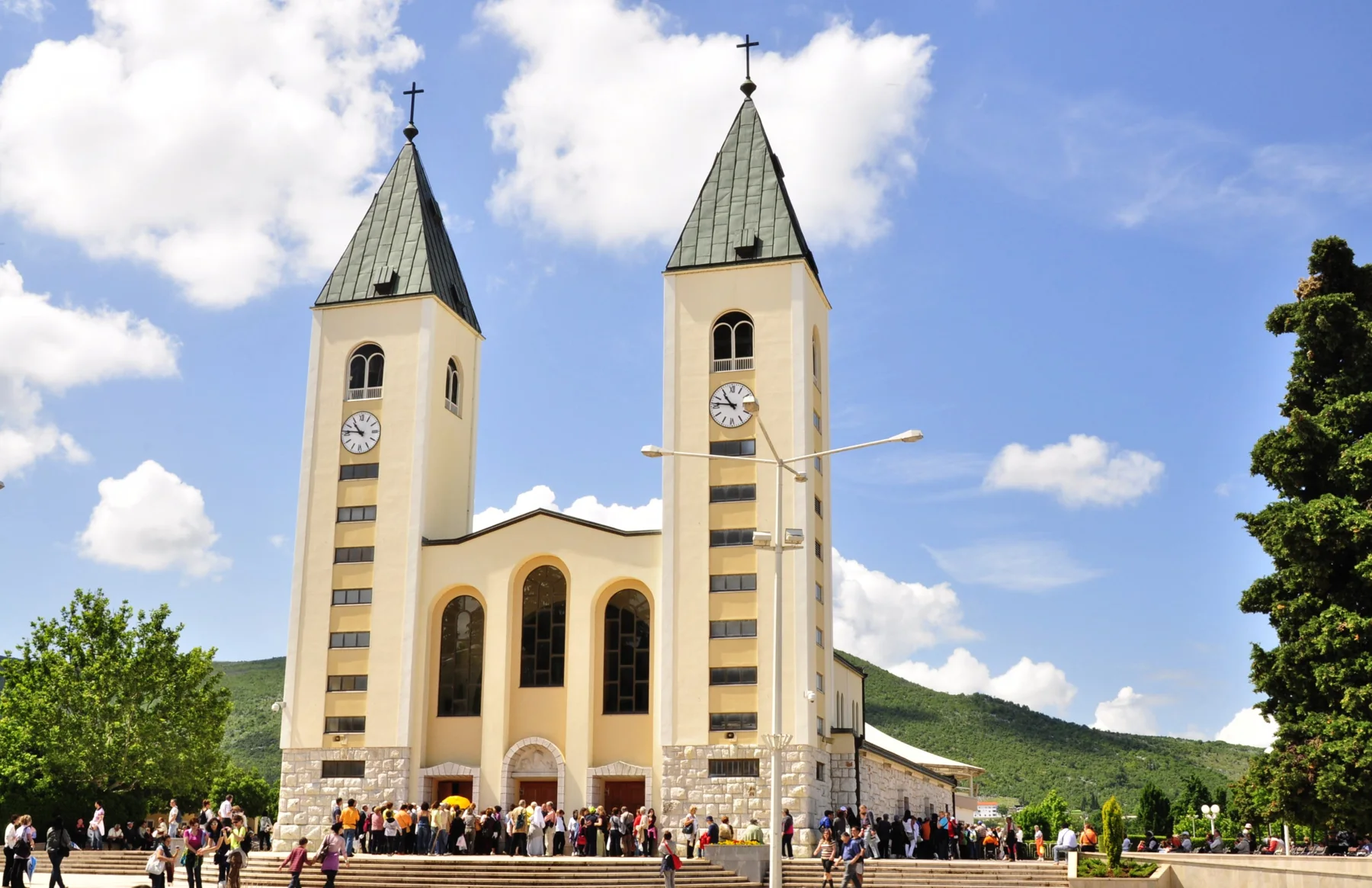
Its settled base around the prayer life of St. James parish, with a quieter day for confession, adoration or personal prayer according to the parish program, gives the unhurried time discernment needs. The Holy See's 2024 Note permits public devotion and pilgrimage there and names "many vocations to priestly, religious, and married life" among the spiritual fruits; it makes no judgment that the alleged apparitions are supernatural.
Classic Pilgrimages begin with the place. They are sample itineraries; confirmed departures and prices have not been announced.
Upcoming departures
No dated departures are currently announced.
Dates, priest, Gateway Airport, price and availability are published on the departure itself, and only when confirmed. This page describes a reason for going, not a departure.