Why make this pilgrimage
You spend the year giving out: lessons, attention, patience, faith. Many who teach in Catholic schools were hired for a subject and found only later that they were also expected to be witnesses. Sooner or later a teacher asks where he or she goes to be taught, and to remember why the work was worth beginning.
This pilgrimage answers by taking those who teach, as disciples, to Christ the one Teacher and to the saints who taught in his name. It seeks the formation of the teacher and not training in technique: the Mass, Confession, prayer shared with colleagues, and time before the tombs of the apostle and of the saints, with your students carried there by name.
THE JOURNEY
Rome and Assisi for Those Who Teach: St. Peter's, the Roman Basilicas, St. John Baptist de La Salle and St. Carlo Acutis
- Where
- Italy, Vatican City
- Length
- About nine days
- Status
- Under consideration
This journey would be the Rome and Assisi Classic made with a teacher's emphasis, the route that American diocesan and university educators' groups have taken. It would begin in Rome at St. Peter's Basilica, because the Church's teaching rests on Peter's confession of faith, and continue through the great Roman basilicas. If the Brothers of the Christian Schools can receive a group, it would include prayer before the relics of St. John Baptist de La Salle, whom Pius XII declared the principal heavenly patron of all teachers of children and young people. It would then move to Assisi and slow down: the busy city first, the hill town last, so that the closing days could be kept as recollection, with prayer at the tomb of St. Carlo Acutis, a schoolboy who taught catechism to the children of his parish.
The route, and why each place belongs
- 1
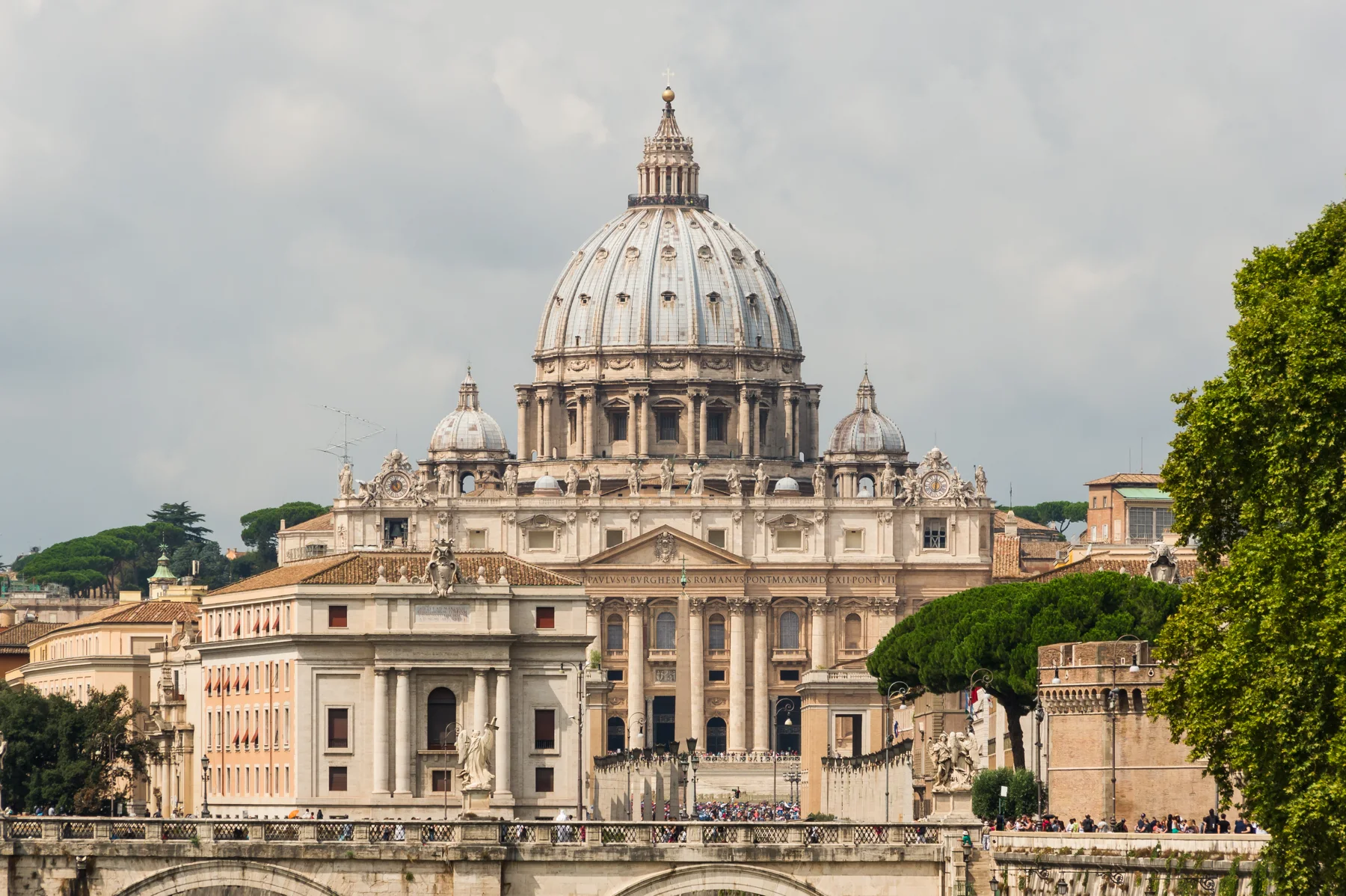
Rome: St. Peter's Basilica
Vatican CityWhy it belongs
The Church's teaching rests on Peter's confession of faith, and American Catholic school leaders on pilgrimage in the 2025 Jubilee began here. In the square outside, on 1 November 2025, Pope Leo XIV proclaimed St. John Henry Newman a Doctor of the Church; the Pope's letter of that week declared him co-patron of the Church's educational mission together with St. Thomas Aquinas.
What you would do there
The pilgrim would enter the basilica built over the tomb of the apostle and be given protected time to pray there, attending a public Mass if the schedule permits. This would be the place to begin praying for one's students by name, and to read Matthew 23:8, "You have but one teacher," before anything else is seen.
- 2
Rome: the great basilicas (St. John Lateran, St. Mary Major, St. Paul Outside the Walls)
ItalyWhy it belongs
The Classic's Roman days connect the story of the city with its liturgical life, and for a teacher they are days of being a pupil again in the Church that sends teachers out. St. Mary Major gives the journey its Marian prayer: Mary is invoked in the Litany of Loreto as Seat of Wisdom, the title Catholic schools and universities have long made their own.
What you would do there
The pilgrim would visit St. John Lateran and St. Mary Major on one day and St. Paul Outside the Walls on another, with the remainder of each day kept flexible. A faculty could pray the Litany of Loreto together at St. Mary Major and read a short text of Newman or Aquinas aloud, such as "Lead, Kindly Light" or Newman's meditation on a definite service.
- 3
Rome: the Sanctuary of St. John Baptist de La Salle (only if the Brothers can receive a group)
ItalyWhy it belongs
St. John Baptist de La Salle founded the Brothers of the Christian Schools, and in 1950 Pope Pius XII declared him the principal heavenly patron of all teachers of children and young people. His relics have been venerated at the Brothers' Generalate in Rome since they were brought from Belgium in January 1937. Of the great teaching saints, he is the one whose relics lie in Rome.
What you would do there
The relics rest in the apse of the Generalate's church, the Sanctuary of St. John Baptist de La Salle. The Generalate is a working religious house and publishes no visiting arrangements, so this visit would be included only if the Brothers can receive a group; where they can, teachers would pray there for their own schools and leave their students' written intentions before the patron of their work.
- 4
Assisi: the Sanctuary of the Renunciation (Santa Maria Maggiore)
ItalyWhy it belongs
St. Carlo Acutis rests here. He was a pupil of Catholic schools in our own century who taught catechism to the children of his parish, and he shows teachers what holiness can look like in a student of their own time. An American educators' pilgrimage prayed at his tomb on its closing retreat day in Assisi.
What you would do there
The pilgrim would wait in the queue that often forms at the tomb and pray there for particular students, the difficult ones included. The sanctuary marks the place of St. Francis's renunciation, so the visit would also be a moment to ask what a teacher needs to lay down.
- 5
Assisi: a day of recollection with Francis and Clare
ItalyWhy it belongs
The second base of the Classic is where this journey would stop moving. A day of recollection away from the school calendar, among colleagues, is the purpose of the whole route, and a published educators' pilgrimage kept its closing retreat day here.
What you would do there
The Classic's Assisi days visit the Basilica of St. Francis, the Basilica of St. Clare and Santa Maria degli Angeli in the valley, with free afternoons. For a faculty those afternoons could hold silence, unhurried conversation about why the school exists, and the choosing of one concrete thing to bring back to the classroom.
Prayer and the sacraments
Mass would be planned where the schedule permits and a priest accompanies the group; clergy arrangements are confirmed for each departure, and Confession would be offered where confessors are available. The group could pray the Rosary or the Liturgy of the Hours in common, and spend time in Eucharistic adoration with the hymns traditionally attributed to St. Thomas Aquinas.
Pilgrim’s Time
Pilgrim's Time would be the open afternoons the Classic already protects in Rome and Assisi. A teacher could use them to return alone to a church already visited, to write down the names being prayed for, to rest, or to talk with a colleague without a meeting agenda.
Pilgrim Pace
Most of the route is city churches and basilicas reached on foot over paved but uneven streets, with standing in security queues at St. Peter's and in the queue at the tomb of St. Carlo Acutis, and steep streets and steps in Assisi. School groups often travel in summer, when Italy is hot.
How Pilgrim Pace worksIf you can stay longer
A theology department or a school in the Dominican tradition could add a day at Fossanova Abbey, south of Rome, where St. Thomas Aquinas died in 1274.
Other ways to make this pilgrimage
- Emmitsburg: a faculty day or weekend with Mother Seton. An American faculty with little time could go to the National Shrine of St. Elizabeth Ann Seton in Maryland, where her remains are entombed beneath the Altar of Relics and the Stone House and White House she lived in still stand, with no passport needed.
- Turin: in the school of Don Bosco. Schools in the Salesian tradition, or any staff who work with adolescents, could go to Valdocco and the Basilica of Mary Help of Christians, which St. John Bosco built where his oratory began and where his remains lie at the altar dedicated to him.
- Newman's England. University faculty and campus ministers could follow St. John Henry Newman from Oxford to Littlemore, where he was received into the Catholic Church, and on to the Oratory he founded in Birmingham.
No dated departures are currently announced. This is a journey Bold Pilgrim is considering, described so you can picture it. Dates, priest, Gateway Airport and price are published on a departure itself, and only when confirmed.
UNDERSTANDING THIS PILGRIMAGE
Those who spend their working lives forming others can go, as pilgrims, to the places of Christ and of the saints who taught, and be formed there themselves. A Catholic educators' pilgrimage is a journey of prayer made by teachers, principals, catechists, campus ministers and teaching parents, usually together as a faculty or a diocesan group. Its purpose is formation of the teacher rather than training in technique: the Mass, confession, shared prayer and the witness of saints such as St. John Baptist de La Salle, St. Thomas Aquinas, St. John Henry Newman, St. John Bosco and St. Elizabeth Ann Seton. Those who make it go as disciples first, so that they return to their students as witnesses.
What this pilgrimage means
A Catholic educators' pilgrimage is made by those who teach in the Church's name, so that they may sit again at the feet of Christ the Teacher and pray where the Church's great teaching saints lived, taught and are venerated. It is prayer and the sacraments first. It differs from a study tour, a conference or a staff outing.
A pilgrimage is one of the oldest ways the Church gives that formation. It does not replace study or a retreat. It takes people who teach the faith to the places where the faith was lived and handed on, and lets them pray there.
Why educators are drawn to it
Teachers give out all year. Many who work in Catholic schools were hired for a subject and discovered only later that they were also expected to be witnesses. Some carry real fatigue. Some teach doctrines and saints they have studied for years in places they have never seen. A theology teacher from Cincinnati, about to leave on an archdiocesan educators' pilgrimage to Italy, said he had long taught Church history, architecture and the saints without ever standing where they happened.
Others come as a body. Dioceses, universities and school networks now use pilgrimage as mission formation for staff: a way to pray together, to meet the founder whose name is over the door, and to speak honestly with colleagues about why the school exists. The Lasallian and Salesian families send their educators to the places of their founders for the same reason.
The Catholic foundation: one Teacher
Jesus told his disciples, "You have but one teacher, and you are all brothers" (Matthew 23:8). Everything the Church says about education starts there. The Second Vatican Council calls parents "the primary and principal educators" of their children, describes the work of those who help them in schools as a vocation that is "beautiful indeed and of great importance," and asks teachers to "bear witness to Christ, the unique Teacher" by their lives as much as by their lessons (Gravissimum Educationis 3, 5, 8).
The Holy See's 1982 document on lay teachers puts it in a heading: teaching in a Catholic school is "a vocation, rather than a profession." It adds that "conduct is always much more important than speech," and that a teacher needs a mature spiritual life and religious formation that keeps growing (Lay Catholics in Schools 32, 37, 60, 62). In 2025 Pope Leo XIV wrote that the formation of teachers, "scientific, pedagogic, cultural and spiritual," is decisive, and that an educator's responsibility "goes beyond the work contract" (Drawing New Maps of Hope 5.2).
The teaching saints, stated exactly
Four saints anchor this pilgrimage, and the Church's words about each are specific. In 1950 Pope Pius XII declared St. John Baptist de La Salle the principal heavenly patron of all teachers of children and young people. In 1880 Pope Leo XIII named St. Thomas Aquinas patron of universities, academies, lyceums and Catholic schools. In 2025 Pope Leo XIV proclaimed St. John Henry Newman a Doctor of the Church and declared him, together with Aquinas, co-patron of the Church's educational mission. Pope St. John Paul II proclaimed St. John Bosco "father and teacher of youth" in 1989, a title of honor and not a patronage.
St. Elizabeth Ann Seton belongs with them for American educators. Pope Paul VI, canonizing her in 1975, tied her Sisters of Charity to the beginnings of parochial schools in the United States. She is honored by custom as a patroness of Catholic schools. That is a custom and not a papal declaration: Paul VI's homily declares no patronage, and the page of her national shrine on its basilica claims none. This page therefore describes her connection and gives her no formal title.
Pope Leo XIV's letter names other founders the same tradition produced, and a single journey cannot visit them all. Of the places where these five saints are venerated, only Rome lies on the Rome and Assisi route, and a visit to the relics of St. John Baptist de La Salle there has to be arranged with the Brothers. Toulouse, Turin, Birmingham and Emmitsburg are separate journeys, and no dated departures to them are currently announced.
Questions pilgrims ask
What is a Catholic educators' pilgrimage?
It is a pilgrimage made by people who teach in the Church's name: Catholic school teachers and leaders, catechists, campus ministers, university faculty and parents who teach at home. They travel, often as a faculty or diocesan group, to pray at the places of Christ and of the Church's teaching saints. The aim is the teacher's own formation in faith, which the Church calls decisive, so that he or she can "bear witness to Christ, the unique Teacher." It is prayer and sacraments first, and it differs from a study tour or a professional conference.
Who is the patron saint of teachers?
St. John Baptist de La Salle: on 15 May 1950 Pope Pius XII declared him the principal heavenly patron of all teachers of children and young people. St. Thomas Aquinas is patron of universities, academies, lyceums and Catholic schools (Leo XIII, 1880), and in 2025 Pope Leo XIV declared St. John Henry Newman co-patron of the Church's educational mission together with him. St. John Bosco and St. Elizabeth Ann Seton are widely invoked by educators, by title and by custom and not by a papal declaration of patronage.
Is St. John Henry Newman a Doctor of the Church?
Yes. Pope Leo XIV proclaimed him a Doctor of the Church on 1 November 2025, and in the apostolic letter Drawing New Maps of Hope declared him "co-patron of the Church's educational mission together with Saint Thomas Aquinas." He joins Aquinas in that patronage and does not replace him.
Is teaching a vocation in the Catholic Church?
Yes. The Second Vatican Council calls the work of those who help parents by teaching in schools a vocation that is "beautiful indeed and of great importance." The Holy See's 1982 document on lay Catholic teachers says the same under the heading "A Vocation, rather than a Profession": professional skill is required, but the work "cannot be reduced to professionalism alone." For catechists, Pope Francis instituted a formal lay ministry in 2021 and said it has "a definite vocational aspect."
Which pilgrimage is best for Catholic school teachers?
Rome and Assisi is the route several American educators' groups have taken: St. Peter's, the major basilicas, and Assisi, where St. Carlo Acutis rests. For a faculty with little time, the National Shrine of St. Elizabeth Ann Seton in Emmitsburg, Maryland, is the natural domestic choice. Schools in a particular tradition often go to their founder: Turin for Don Bosco, Rome for St. John Baptist de La Salle, Birmingham and Oxford for Newman. These are Catholic pilgrimage places, not Bold Pilgrim departures. No dated departures are currently announced.
Can a Catholic school or diocese organize a pilgrimage for its faculty and staff?
Yes. Dioceses, universities and school networks do this as mission formation: the Archdiocese of Cincinnati's Catholic Schools Office has led educators to Italy, and Seton Hall University has taken employees to the Seton Shrine. A lay administrator may organize the journey; a priest is needed for Mass and confession. It should be offered as an invitation, since a pilgrimage is an act of prayer.
Full answer: How do I organize a pilgrimage for my parish?
How do schools pay for a faculty pilgrimage, and does it count as professional development?
There is no single rule. In published examples, teachers were sponsored by a parent association, by benefactors, and by a school that offered sponsorship through its fundraising gala, with teachers applying to their administration for a place. Whether the journey is credited as faith formation or professional development is decided by the school or the diocesan schools office, so ask before enrolling. Pope Leo XIV calls the formation of teachers, spiritual formation included, decisive.
Is this pilgrimage also for catechists and homeschooling parents?
Yes. The Church calls parents "the primary and principal educators" of their children, and Pope Leo XIV repeated in 2025 that the family remains the first place of education. Catechists hold what Pope Francis called a ministry with "a definite vocational aspect"; more than 20,000 of them registered as pilgrims for the Jubilee of Catechists in Rome in September 2025. The saints and places of this pilgrimage belong to anyone who hands on the faith, with or without a classroom.