Why make this pilgrimage
Often this pilgrimage begins with a book. You have read the Confessions, or the letters of St. Ignatius of Antioch, or you have heard the Fathers quoted in the Office of Readings, and you want to know that these were real men in real cities. Or it begins with a harder question: is what I believe really what the first Christians believed, and can I go and stand where they taught it?
A pilgrim goes to the Fathers to pray at their tombs and to read them again in the churches where they are buried, so that the faith professed on Sunday is received as something handed down from the Apostles. Every one of them points beyond himself. St. Ambrose never tired of saying that to us Christ is everything, and a journey among the Fathers is made in order to hear that from the men who first taught it.
THE JOURNEY
The Fathers in Italy: Rome, Milan and Pavia
- Where
- Italy, Vatican City
- Length
- About a week
- Status
- Under consideration
This journey would begin in Rome and end at the tomb of St. Augustine in Pavia, with Milan between them. The order follows the Fathers themselves. Rome would come first because it holds the earliest of them, St. Ignatius of Antioch, a bishop of the generation after the Apostles, and the two papal Fathers buried in St. Peter's. The journey would then go north by rail to St. Ambrose in Milan, to the font identified with his baptism of Augustine, and last to Augustine's relics, so that the teacher is met before the man he baptized. Two bases would be enough, Rome and Milan, and every stop is a church with a tomb to pray at and a page to read.
The route, and why each place belongs
- 1
Rome: the Basilica of San Clemente
ItalyWhy it belongs
San Clemente keeps the relics of Pope St. Clement and St. Ignatius of Antioch, by a tradition of long veneration. Ignatius, martyred in Rome in the early second century, is the first writer known to call the Church "catholic", which makes this the place where the line from the Apostles to the Fathers begins.
What you would do there
A pilgrim would pray in the present church and, where access allows, go down to the fourth-century basilica and the first-century buildings beneath it, descending from the twelfth century to the first. A passage from one of Ignatius's letters, written on his way to martyrdom in this city, could be read here.
- 2
St. Peter's Basilica: the altars of St. Leo the Great and St. Gregory the Great
Vatican CityWhy it belongs
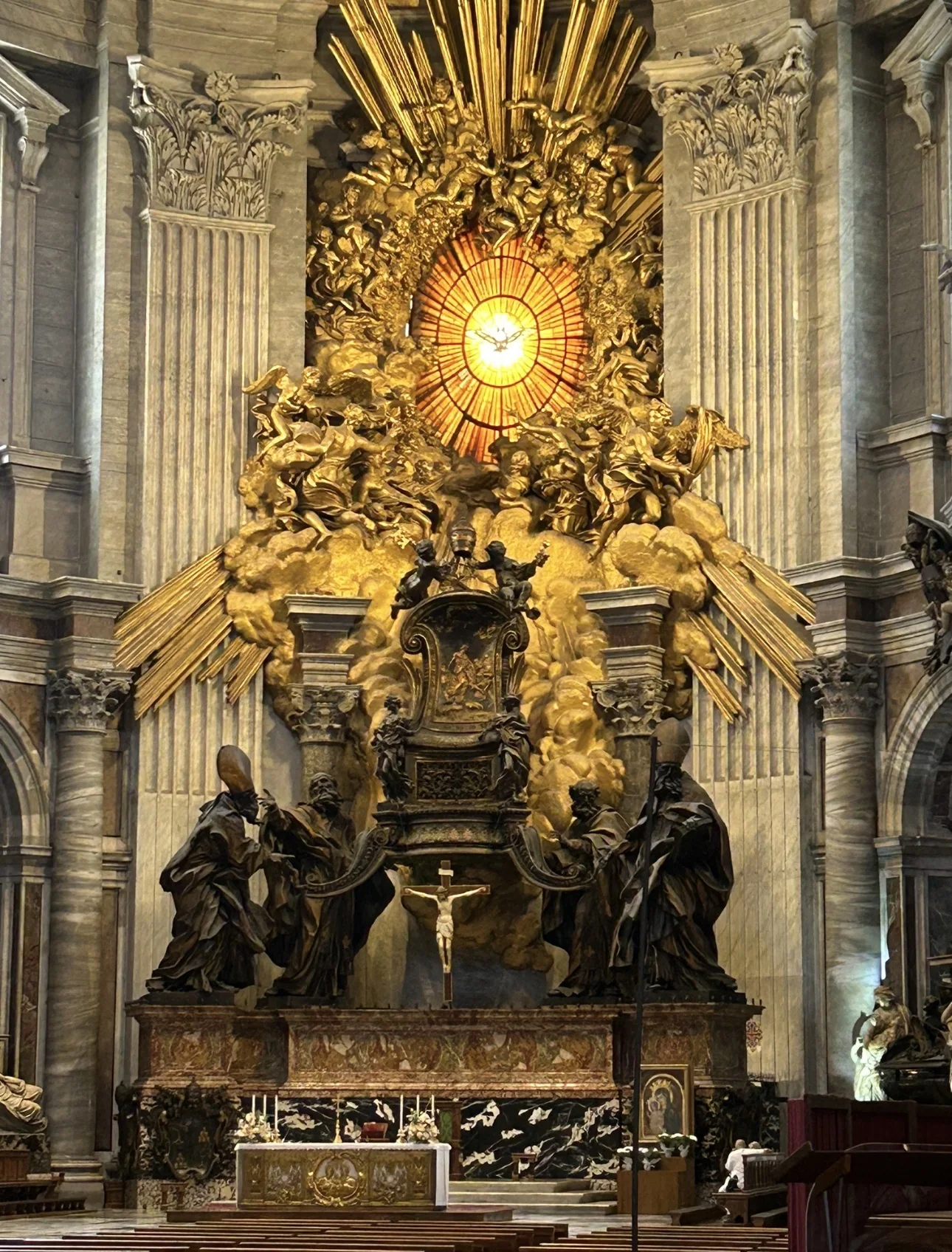
Two papal Fathers lie beneath their own altars here: St. Leo, whose teaching on Christ was acclaimed at the Council of Chalcedon with the words "Peter has spoken through the mouth of Leo", and St. Gregory, monk, pope and the last of the four great Latin Fathers. Relics of St. John Chrysostom rest in the Choir Chapel, and Bernini's Chair of Peter in the apse is carried by statues of Ambrose, Augustine, Athanasius and John Chrysostom.
What you would do there
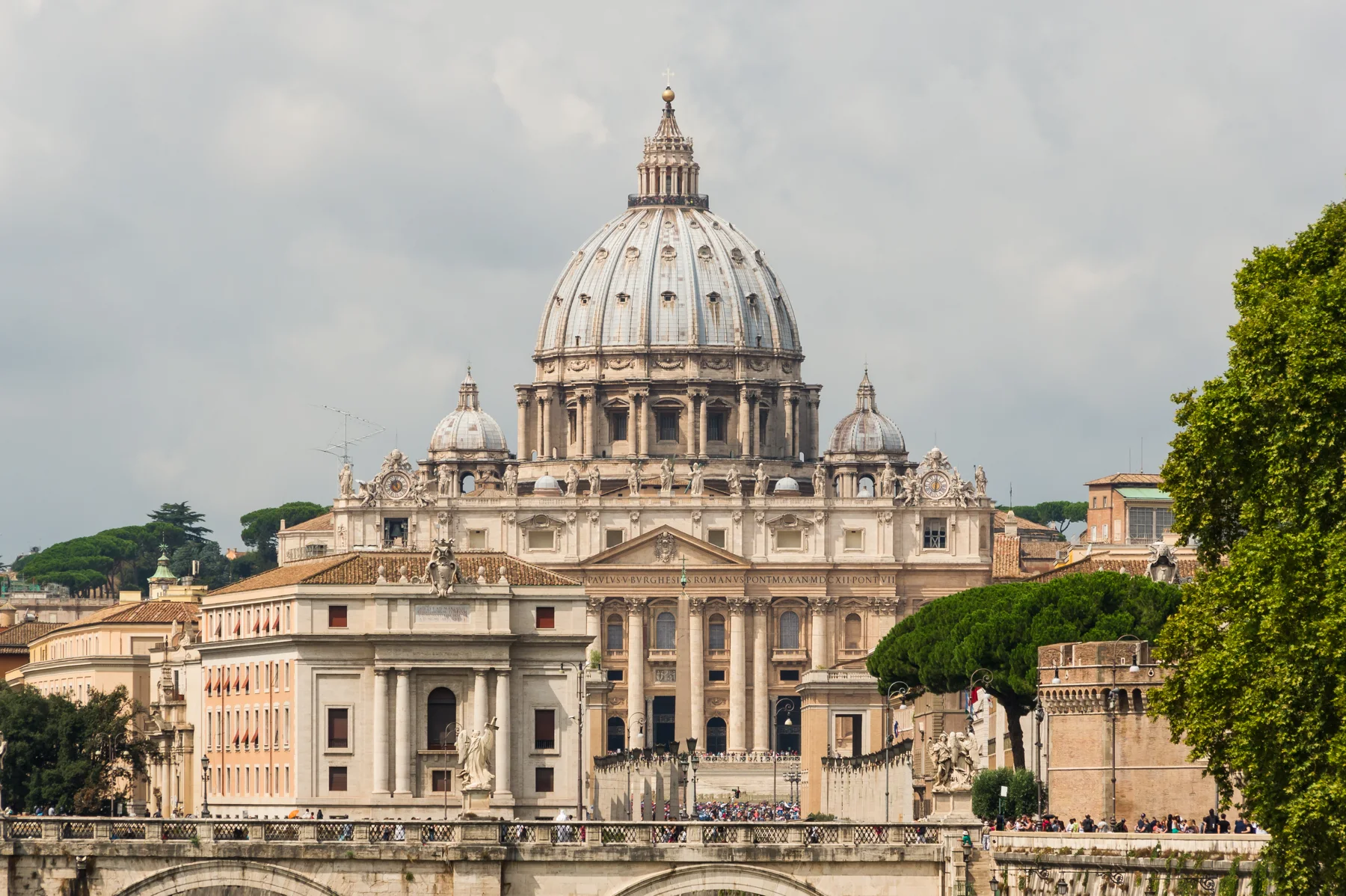
None of these tombs is signposted, and many visitors pass St. Gregory's altar without knowing who is there. A pilgrim would find the altar of St. Leo beneath Algardi's marble relief of his meeting with Attila, pray at St. Gregory's altar, look into the Choir Chapel, and stand before the four Fathers under the Chair. A paragraph of St. Leo on the Incarnation could be read at his altar; access to particular altars varies with the basilica's liturgies.
- 3
Rome: the Basilica of St. Mary Major
ItalyWhy it belongs
This is Rome's great church of the Mother of God, the title the Fathers defended and the Council of Ephesus upheld in 431 in order to protect the truth about who Christ is. The basilica also lists the remains of St. Jerome among its relics, by a tradition first attested long after his death and not certain.
What you would do there
A pilgrim could pray to Our Lady under the title the Fathers gave the Church, and ask St. Jerome's prayers without treating the place of his relics as settled. It would be a fitting place for a slow reading of Scripture, since it was Jerome who said that ignorance of Scripture is ignorance of Christ.
- 4
Milan: the Basilica of Sant'Ambrogio
ItalyWhy it belongs
The relics of St. Ambrose rest in the crypt beneath the high altar of the basilica that bears his name, with those of the martyrs Sts. Gervasius and Protasius. Ambrose was a Roman governor acclaimed Bishop of Milan while still a catechumen, and it was his preaching and the prayer of his church that moved Augustine toward the faith.
What you would do there
After the rail journey north, a pilgrim would go down the steps to the crypt and pray before the relics of the bishop and the two martyrs. Benedict XVI's short catechesis on St. Ambrose could be read there, with its line that to us Christ is everything.
- 5
Milan: the Baptistery of San Giovanni alle Fonti, beneath the cathedral
ItalyWhy it belongs
This excavated baptistery is identified with the Easter Vigil of 387, when Ambrose baptized Augustine. The identification is a historical judgment, not a Church definition, and it is the one place on the route where two Fathers meet.
What you would do there
A pilgrim would go down into the archaeological area under the cathedral and stand at the octagonal font, which can still be seen. The baptism scene from the Confessions could be read at its edge, and pilgrims could renew the promises of their own baptism where it can be arranged.
- 6
Pavia: the Basilica of San Pietro in Ciel d'Oro
ItalyWhy it belongs
The relics of St. Augustine, whom Benedict XVI called the greatest Father of the Latin Church, are venerated here in the marble Arca, in a church served by Augustinian friars. By tradition they came from Hippo by way of Sardinia and reached Pavia in the early eighth century. Benedict XVI prayed here in 2007 and Pope Leo XIV, an Augustinian, in June 2026.
What you would do there
Pavia is an ordinary rail journey from Milan, and the journey would end here. A pilgrim would pray before the Arca and stay a while in the basilica with a few pages of the Confessions, then say the Creed slowly as a last act of the pilgrimage, with the Fathers who defended it.
Prayer and the sacraments
The Fathers were above all pastors who preached at the altar, so Mass at or near their tombs would be sought where the schedule permits; it depends on each church's permission, and clergy arrangements are confirmed for each departure. Each day could be prayed with the Office of Readings, which sets a passage from the Fathers and other Church writers beside Scripture, with a page of each Father read at his own tomb, the Nicene Creed recited there, and Confession where confessors are available.
Pilgrim’s Time
This is a reader's pilgrimage, and protected Pilgrim's Time would be kept in both Rome and Milan for reading and for going back. It could be used to return alone to one altar in St. Peter's, to sit in a quiet church with the Confessions, or in Rome to visit the Basilica of Sant'Agostino, where the relics of St. Monica, Augustine's mother, are enshrined.
Pilgrim Pace
These are city churches reached on foot and by rail or coach, with long basilica floors, security queues at St. Peter's and some cobbled streets. The main physical consideration would be the stairs down to crypts and excavated levels at San Clemente, Sant'Ambrogio and the Milan baptistery, along with one longer transfer between Rome and Milan.
How Pilgrim Pace worksIf you can stay longer
A pilgrim drawn to St. Jerome could look separately to Bethlehem, where he lived and died beside the Grotto of the Nativity; any journey there would be subject to conditions at the time.
Other ways to make this pilgrimage
- The Rome & Assisi Classic. The Classic's Rome days include St. Peter's and St. Mary Major, so a pilgrim who asks for it could pray at the altars of St. Leo and St. Gregory and near the relics of St. John Chrysostom without changing the route, though the sample itinerary names the basilicas and not these altars.
- Rome of the Fathers alone. A pilgrim who has already seen Rome's major basilicas could make a shorter second visit from a single base, built on the Fathers' altars in St. Peter's, St. Mary Major and San Clemente, with a text of each Father read at his tomb.
- Ambrose and Augustine: Milan and Pavia. The northern part could stand alone as a short journey for readers of the Confessions: Sant'Ambrogio, the baptistery under the cathedral and the Arca in Pavia.
No dated departures are currently announced. This is a journey Bold Pilgrim is considering, described so you can picture it. Dates, priest, Gateway Airport and price are published on a departure itself, and only when confirmed.
WHAT YOU MAY EXPERIENCE
What a pilgrim might experience
This is a quieter pilgrimage than most. There are no processions at these tombs, and at the altar of St. Gregory the Great many visitors walk past without knowing who is there. What the pilgrim does is simple: pray at the tomb, and read a page of the man buried there. A paragraph of St. Leo on the Incarnation at his altar, the baptism scene from the Confessions at the font in Milan.
It helps to read a little before leaving home. St. Augustine's Confessions, especially Books VIII and IX on his conversion, his baptism and his mother's death, is the obvious first book. Pope Benedict XVI's Wednesday catecheses on the Fathers, given in 2007 and 2008 and published on the Vatican website, are short enough to read at each tomb.
Where a priest accompanies a group, Mass at or near these tombs gives the visit its proper center, since the Fathers were above all pastors who preached at the altar. That depends on each church's permission and on the schedule, and should never be assumed.
It is also an honest pilgrimage about what is and is not known. Some of these relics have a well-documented history; others rest on tradition, and one or two are disputed. A good Church Fathers pilgrimage says which is which, and loses nothing by it.
In practice
- Praying at the tombs of St. Leo the Great and St. Gregory the Great in St. Peter's
- Reading a page of each Father in the church where he is buried
- Standing at the font in Milan identified with Augustine's baptism by Ambrose
- Praying before the Arca of St. Augustine in Pavia
- Descending through San Clemente from the twelfth century to the first
- Reciting the Nicene Creed with the Fathers who defended it
Who it may be for
It suits readers, converts and those in the process of becoming Catholic, clergy and seminarians, catechists and Catholic educators, and anyone who has already seen the major shrines of Rome and wants to go deeper into the same city. It also suits Catholics and Orthodox or Protestant Christians travelling together, because the Fathers belong to the undivided Church of the first millennium and are loved across those divisions.
It may not be the right first pilgrimage for someone who wants a strong devotional atmosphere, large liturgies or a single sanctuary to settle into. Those pilgrims are better served by a Marian shrine or by Assisi, with a day among the Fathers in Rome added if they wish.
Purpose-built Church Fathers pilgrimages are rare, and Bold Pilgrim has no dated departures announced for this pilgrimage. Most pilgrims make it by adding the Fathers' tombs to a Rome journey and, if time allows, Milan and Pavia.
- Converts and people in OCIA who came to the Church through reading the early Christians
- Catechists, deacons, clergy and seminarians
- Catholic teachers and students of theology or history
- Pilgrims who have already visited Rome's major basilicas and want a second, deeper visit
- Catholics travelling with Orthodox or Protestant family and friends
- Readers of St. Augustine, including those drawn to him by Pope Leo XIV
A spiritual purpose has no Pilgrim Pace rating; the actual itinerary determines the pace. The places typically involved are city churches in Rome, Milan and Pavia, reached on foot and by rail or coach, with long basilica floors, some cobbled streets, and stairs down to crypts and excavated levels (San Clemente, Sant'Ambrogio, the Milan baptistery). Those stairs are the main physical consideration for anyone with limited mobility.
UNDERSTANDING THIS PILGRIMAGE
A Church Fathers pilgrimage is a Catholic pilgrimage to the churches, tombs and cities of the early bishops and teachers who handed on the faith of the Apostles, made so that you can pray where they taught and hear for yourself what they taught. Most of it can be made in Italy: Rome holds St. Leo the Great and St. Gregory the Great, Milan holds St. Ambrose and Pavia holds St. Augustine. The pilgrim goes to pray at their tombs and to read them again, because every one of them points to Jesus Christ.
What it means: witnesses of a living Tradition
The Fathers of the Church are the bishops and teachers of the early centuries, from the generation after the Apostles onward, whom the Church reads as witnesses of the faith she received. The Second Vatican Council says that "the words of the holy fathers witness to the presence of this living tradition," and the Catechism lists, among the places where the Church knows the Holy Spirit, "the Tradition, to which the Church Fathers are always timely witnesses."
That is the reason to go and pray where they are buried. The Fathers are not an optional historical interest. They preached the Creed while it was being defined, explained the Scriptures to the newly baptized, and in some cases died for what they taught. St. Ignatius of Antioch, a bishop martyred in Rome in the early second century, is the first writer known to call the Church "catholic." St. Irenaeus learned the faith from St. Polycarp, who had learned it from the Apostle John, and he argued that the true Gospel is the one handed on by bishops in an unbroken line from the Apostles. A pilgrimage to the Fathers is a pilgrimage along that line.
The line leads to a person. St. Ambrose, Pope Benedict XVI recalled, never tired of saying "Omnia Christus est nobis": to us Christ is everything. St. Jerome put it more sharply: ignorance of Scripture is ignorance of Christ. A pilgrimage that stops at the Fathers has missed what they were saying.
Why someone is drawn to it
Some pilgrims come because they have been reading. A convert has worked through St. Ignatius of Antioch or the Confessions and wants to see that these were real men in real cities. A cradle Catholic has heard the Fathers quoted in the Office of Readings or the Catechism and wants to know who they were. A catechist, deacon, seminarian or teacher wants the faith he or she hands on to have faces and places attached.
Others come because of St. Augustine in particular. Pope Leo XIV is an Augustinian who called himself a son of St. Augustine on the night of his election, and many Catholics have started asking where Augustine's places are and whether an ordinary pilgrim can go.
And some come with a harder question: whether the Catholic Church today is the Church of the first centuries. The Fathers do not answer that with a slogan. They answer it with a bishop, an altar, the Scriptures read aloud and the Eucharist celebrated, which is what you still find in the churches built over their graves.
The places: Rome first, then Milan and Pavia
Rome is the natural base. In St. Peter's Basilica the remains of Pope St. Leo the Great and Pope St. Gregory the Great lie beneath their own altars, relics of St. John Chrysostom are kept in the Choir Chapel, and Bernini's bronze Chair of Peter in the apse is carried by statues of four Fathers, two Latin and two Greek. St. Mary Major has claimed the relics of St. Jerome since the Middle Ages, by a tradition that is not certain. San Clemente keeps the relics of Pope St. Clement and St. Ignatius of Antioch above a fourth-century church you can walk down into.
Northern Italy holds the two Fathers most pilgrims ask about. In Milan, the relics of St. Ambrose rest in the crypt of the basilica that bears his name, and the baptistery identified with his baptism of Augustine lies under the cathedral. In Pavia, St. Augustine's relics are venerated in the marble Arca in San Pietro in Ciel d'Oro, a church served by Augustinian friars.
Beyond Italy, St. Jerome's own place is Bethlehem, where he lived and died beside the Grotto of the Nativity, and St. Augustine's is Hippo, today's Annaba in Algeria. Few pilgrims will reach both, and none of them needs to.
Questions pilgrims ask
What is a Church Fathers pilgrimage?
A Church Fathers pilgrimage is a Catholic pilgrimage to the tombs, churches and cities of the early bishops and teachers who handed on the faith of the Apostles, such as St. Augustine, St. Ambrose, St. Leo the Great and St. Gregory the Great. It is usually centered on Rome, Milan and Pavia. Pilgrims pray at the Fathers' tombs and read their words in the places where they preached, in order to receive more deeply the faith in Jesus Christ that they taught.
Who are the Church Fathers?
The Church Fathers are the bishops and teachers of the early Christian centuries whom the Church reads as witnesses of her Tradition; the Catechism calls them "always timely witnesses" (no. 688). The period is usually taken to run from the generation after the Apostles to St. Gregory the Great (died 604) in the West and St. John Damascene (eighth century) in the East, which is a convention of scholars, not a Church definition. The best known are the four great Latin Fathers (Ambrose, Jerome, Augustine and Gregory the Great) and four Greek Fathers (Athanasius, Basil, Gregory Nazianzen and John Chrysostom).
What is the difference between a Father of the Church and a Doctor of the Church?
A Father of the Church belongs to the early centuries. A Doctor of the Church is a saint of any century on whom the Church has formally conferred that title for his or her teaching. Some saints are both: Augustine, Ambrose, Jerome, Gregory the Great, John Chrysostom and Irenaeus, whom Pope Francis declared a Doctor by decree in 2022, are Fathers and Doctors. Later Doctors such as St. Catherine of Siena or St. Thérèse of Lisieux are not Fathers.
Where can I visit the tombs of the Church Fathers?
Mostly in Italy. In Rome, St. Leo the Great and St. Gregory the Great lie beneath their own altars in St. Peter's Basilica, relics of St. John Chrysostom are in its Choir Chapel, and San Clemente keeps the relics of St. Ignatius of Antioch and Pope St. Clement. St. Ambrose's relics rest in the crypt of Sant'Ambrogio in Milan, and St. Augustine's are venerated in San Pietro in Ciel d'Oro in Pavia.
Full answer: Which Church Fathers are buried or have relics in Rome, and where can pilgrims visit them?
Where is St. Augustine buried, and can pilgrims visit Hippo?
St. Augustine died in 430 at Hippo, today's Annaba in Algeria. Benedict XVI recounts that his body was taken to Sardinia and, in about 725, to Pavia in northern Italy, where his relics are venerated in the marble Arca of the Basilica of San Pietro in Ciel d'Oro, served by Augustinian friars. The ruins of ancient Hippo survive at Annaba, where there is also a Basilica of St. Augustine. Pope Leo XIV, an Augustinian, visited the ruins and the basilica in April 2026 and prayed at the tomb in Pavia that June. Pavia is an ordinary rail journey from Milan; anyone planning to go to Annaba should check Algeria's current entry requirements with official sources. Bold Pilgrim has no dated departure to either place.
Where did St. Ambrose baptize St. Augustine?
In Milan, at the Easter Vigil of 387. The baptistery identified with that night, San Giovanni alle Fonti, lies in the archaeological area beneath Milan's cathedral and can be visited.
Full answer: Where was St. Augustine baptized?
Were the Church Fathers Catholic?
The Catholic Church receives the Fathers as her own teachers. The Second Vatican Council teaches that "the words of the holy fathers witness to the presence of this living tradition" (Dei Verbum, no. 8), and the Catechism calls them "always timely witnesses" of the Tradition (no. 688). Benedict XVI noted that St. Ignatius of Antioch, martyred in Rome in the early second century, was the first Christian writer to call the Church "catholic." The Fathers lived before the divisions between East and West, and Orthodox and many Protestant Christians honor them too.
Is there an organized Church Fathers pilgrimage or tour?
Purpose-built Church Fathers pilgrimages are rare. Most pilgrims make one by adding the Fathers' tombs to a Rome journey and, if time allows, Milan and Pavia. Bold Pilgrim has no dated departures announced for this pilgrimage; its Rome & Assisi sample journey visits St. Peter's and St. Mary Major, where a pilgrim can ask to pray at the Fathers' altars.