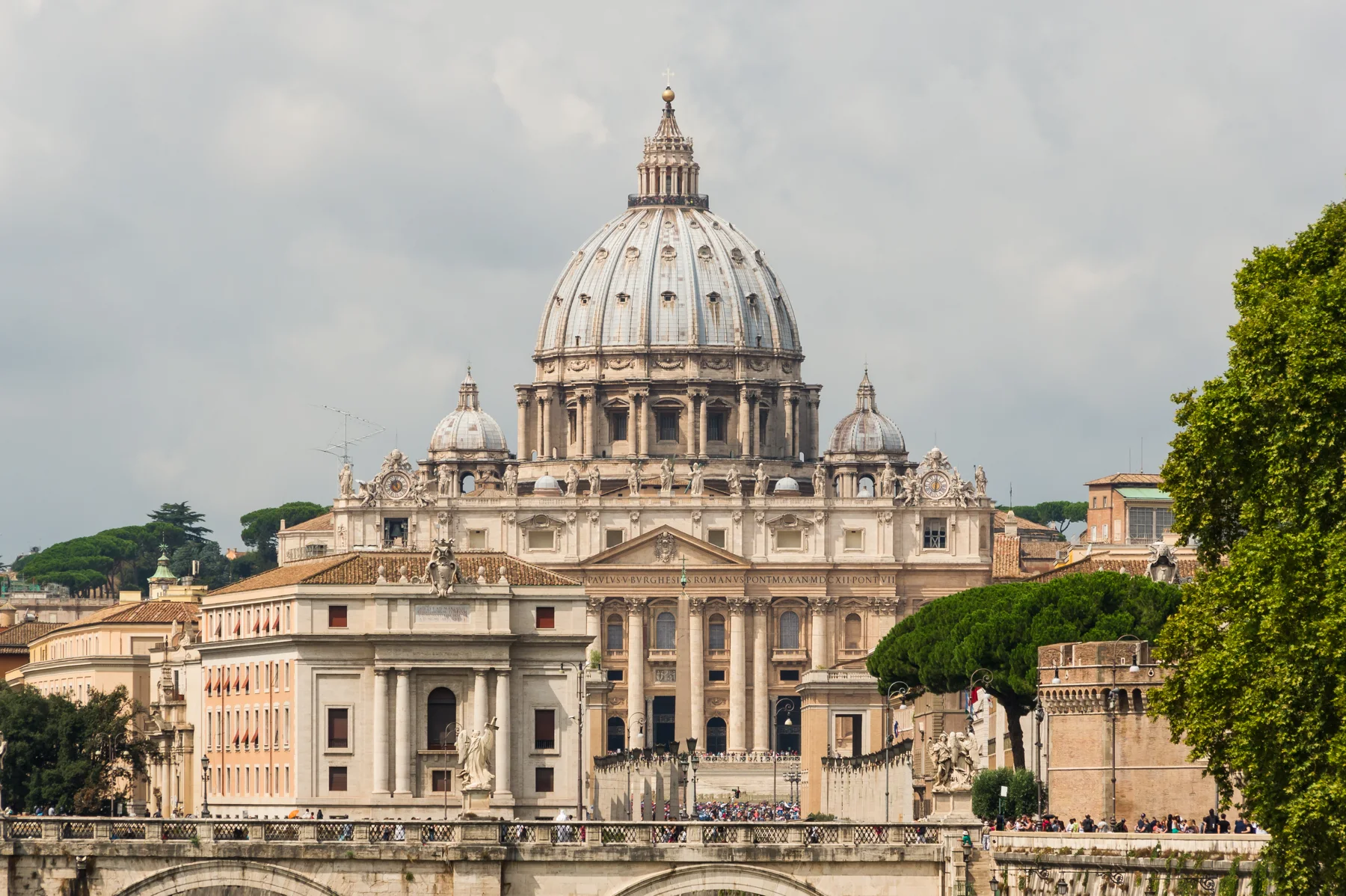
Why make this pilgrimage
You stand in a cathedral, or you read about the monks who copied books and cleared fields, and a question forms: where did all of this come from, and is the faith that built it still alive for me? Some people come to that question through history, some through beauty, and some because their own faith crossed an ocean from these places and they want to see where it began.
The Church has already given the question a human shape. The popes have named six saints as patrons of Europe: a monk, two missionary brothers, a mother, a laywoman and a Carmelite philosopher. This pilgrimage would not survey a continent. It would go to the places of four of those patrons in one country, pray where they prayed and where they are buried, and ask their intercession for the faith they served.
THE JOURNEY
The Patrons of Europe in Italy: Rome, Subiaco, Monte Cassino and Siena
- Where
- Italy
- Length
- About eight to ten days
- Status
- Under consideration
This journey would stay in central Italy, where four of Europe's six patrons lived, prayed or died. It would begin with several days in Rome, at the burial place of St. Cyril in San Clemente, the tomb of St. Catherine of Siena in Santa Maria sopra Minerva, and the square where St. Bridget of Sweden spent her last years. From Rome it would go out to St. Benedict's cave at Subiaco and his abbey at Monte Cassino, and then turn north to end in Siena, Catherine's own city. The order keeps Rome as a long first base, so that the two Benedictine places are reached from it, and leaves a single move north for the close. St. Methodius and St. Teresa Benedicta of the Cross have no place on Italian soil, and the journey would say so and remember them in prayer.
The route, and why each place belongs
- 1
Rome: Basilica of San Clemente
Why it belongs
St. Cyril, who with his brother Methodius carried the Gospel to the Slavs and was named co-patron of Europe in 1980, died in Rome on 14 February 869 and was buried here at his brother's request.
What you would do there
The pilgrim would go down through the layers of the basilica, which stands on a fourth-century church and first-century buildings, and pray at the place of Cyril's burial. The basilica's own account says his relics were lost after the French Revolution and that a small fragment recovered in the 1960s was placed here by Paul VI. It would be a fitting place to pray for the unity of Christians, East and West.
- 2
Rome: Santa Maria sopra Minerva
Why it belongs
This church holds the tomb of St. Catherine of Siena, co-patroness of Europe since 1999 and a Doctor of the Church, the lay Dominican who urged Pope Gregory XI to return from Avignon and who died in Rome in 1380.
What you would do there
The pilgrim would pray at her tomb, where her body rests, and could ask her intercession for the Church and for peace, the two causes she spent herself on. Her head is venerated in Siena, which is why the journey would end there.
- 3
Rome: Piazza Farnese and the Roman years of St. Bridget
Why it belongs
St. Bridget of Sweden, a wife and mother of eight and co-patroness of Europe, came to Rome for the Jubilee of 1350 and died here in 1373, in the house on Piazza Farnese. From Rome she went on pilgrimage to Assisi and to the Holy Land.
What you would do there
The pilgrim would come to Piazza Farnese, where the Holy See's Jubilee booklet on St. Bridget says two of her rooms are preserved as chapels, and pray there where a visit can be arranged. Around it, the Roman days would include the great basilicas of the city she came to as a Jubilee pilgrim.
- 4
Subiaco: the Sacro Speco and the Monastery of St. Scholastica
Why it belongs
St. Benedict, declared principal patron of all Europe by Paul VI in 1964, lived three years as a hermit in a cave above the Aniene valley here and first gathered disciples into small monasteries. The monks who followed his Rule did not set out to build a culture; their aim was to seek God, and this is where that search began.
What you would do there
The Monastery of St. Benedict is built into the cliff around the cave itself, with two churches one above the other and frescoed chapels cut into the rock, where the pilgrim could pray in silence. A short distance below stands the Monastery of St. Scholastica, where the group could join the community's prayer if the monks are able to receive it.
- 5
Monte Cassino Abbey
Why it belongs
Benedict founded this abbey around 529, wrote the Rule here and died here. From this hill his pattern of prayer, reading and work spread across the West, which is why Paul VI spoke of the cross, the book and the plough.
What you would do there
The pilgrim would go up to the hilltop abbey and pray at the tomb venerated as that of Sts. Benedict and Scholastica, in the abbey church rebuilt after the bombing of 1944 and consecrated by Paul VI in 1964. An abbey destroyed and rebuilt is a sober place to pray for Europe.
- 6
Siena: Basilica of San Domenico and the house of St. Catherine
Why it belongs
Siena is Catherine's home city, where she joined the Dominican Third Order as a laywoman. Ending here would bring the pilgrim from her tomb in Rome back to the streets where her life of prayer began.
What you would do there
The pilgrim would visit the house of St. Catherine and pray in the Basilica of San Domenico, where her head is venerated. The last full day could be kept quiet, with time in the basilica to gather the intentions carried from each patron's place.
Prayer and the sacraments
Mass would be planned for each day where the schedule permits, ideally in the churches of the patrons themselves, and clergy arrangements are confirmed for each departure. At Subiaco the group could join Vespers or another Hour sung by the monastic community where the house welcomes visitors to it, and Confession would be offered where confessors are available. At each tomb there would be time simply to pray, for one's own intentions and for the peoples the patron served.
Pilgrim’s Time
Pilgrim's Time would fall mostly on the open afternoons in Rome and on the last day in Siena. It could be used to return alone to a tomb that held you, to sit in a Roman church at an hour when it is quiet, or to rest.
Pilgrim Pace
The days would involve long periods of standing and slow walking on stone floors, steps down into the lower levels of San Clemente, stairs between the churches at the Sacro Speco, a hilltop abbey, and Siena's steep cobbled streets. Subiaco, Monte Cassino and Siena lie in different directions from Rome, so there would be road transfers, kept tolerable by a long first stay in Rome.
How Pilgrim Pace worksIf you can stay longer
Pilgrims with more time could add Assisi, where St. Bridget herself went on pilgrimage from Rome, or Norcia, the birthplace of St. Benedict.
Other ways to make this pilgrimage
- The Rome and Assisi Classic with the patrons in view. The sample Rome and Assisi journey keeps afternoons in Rome open, and San Clemente and Santa Maria sopra Minerva could be visited in them, although neither is on that route as written.
- Cathedrals and the way of beauty. A different pilgrimage could go north to Notre-Dame de Paris, Chartres and Cologne, approaching each cathedral through its liturgy first and its art second; Bold Pilgrim does not currently travel to these places.
- Auschwitz, for St. Teresa Benedicta of the Cross. The sixth patron, Edith Stein, has no tomb; she is remembered at Auschwitz-Birkenau in Poland, where she was killed, a place that needs its own time and silence and would belong to a separate journey.
No dated departures are currently announced. This is a journey Bold Pilgrim is considering, described so you can picture it. Dates, priest, Gateway Airport and price are published on a departure itself, and only when confirmed.
Who it may be for, and what it is not
This pilgrimage may suit readers of history, lovers of sacred art and music, teachers, students, converts who want to know the family they have joined, and Catholics who want to give thanks for what they received. It asks for patience with long buildings and long centuries more than for physical strength.
It is not an exercise in nostalgia, and it is not an argument about present-day Europe. The patrons the Church chose were not conquerors: a monk, two missionary brothers who gave a people its alphabet and prayed in its language, a mother, a peacemaker, and a Carmelite philosopher who died at Auschwitz. Of her John Paul II said at her canonization, "Because she was Jewish, Edith Stein was taken with her sister Rosa and many other Catholic Jews from the Netherlands" to the camp, and that she "has become a saint and martyr". His own summary for the continent was that Christ is the source of hope for Europe and for the whole world. The cathedrals were built to hold an altar. The pilgrimage is finished when it has brought a person to what happens there.
- Catholics who love history and want to pray where it happened
- People drawn by sacred art, architecture and music
- Teachers, students and lifelong learners
- Converts and the newly Catholic who want to know the family they have joined
- American Catholics tracing the European roots of their faith
- Parish groups looking for a pilgrimage with strong teaching content
- Thoughtful non-Catholics who are moved by the cathedrals and want to understand them
A spiritual purpose has no Pilgrim Pace rating; the actual itinerary determines the pace. Places typical of this pilgrimage involve long periods of standing and slow walking on stone floors, steps into crypts and towers, cobbled old towns, and hilltop abbeys with steep approaches. Journeys that cross several countries also add long transfer days, which tire people more than the walking does. Fewer bases and longer stays keep the demand moderate.
UNDERSTANDING THIS PILGRIMAGE
The cathedrals, monasteries and saints of Europe came from the Catholic faith, which over many centuries built a Christian civilization there, and that faith is still prayed in most of the churches it raised. A Catholic Europe pilgrimage is a journey of prayer through those places: the monasteries that taught a continent to pray and work, the cathedrals raised for the liturgy, the schools that grew into universities, the pilgrim roads, and the tombs of the six saints the popes have named patrons of Europe. It is not a heritage tour. The buildings are still churches, and the pilgrim goes to them for the reason they were built: to worship Jesus Christ.
The Catholic foundation
The Catechism says that pilgrimages evoke our earthly journey toward heaven and are traditionally special occasions for renewal in prayer (CCC 2691). That is the foundation of every pilgrimage, and it applies here. What makes this kind distinct is its subject: the long work of the Gospel in one continent, read in the places it left behind.
The Church herself has given that subject a shape. In 1964 Paul VI declared St. Benedict principal patron of all Europe, saying that he and his monks brought Christian civilization to its peoples by the cross, the book and the plough. In 1980 John Paul II added Sts. Cyril and Methodius, the brothers from Thessalonica who carried the Gospel to the Slavs, and described Europe as the fruit of two currents of Christian tradition, one from Rome and one from Constantinople. In 1999 he named three women co-patronesses: St. Bridget of Sweden, St. Catherine of Siena and St. Teresa Benedicta of the Cross (Edith Stein).
One caution comes from the same teaching. Speaking in Paris in 2008, Benedict XVI said the monks who shaped Western culture did not set out to create a culture, or even to preserve one. Their aim was to seek God. The libraries, the chant, the schools and the farms followed from that search. A pilgrim who keeps the order straight, God first and the culture as its fruit, has understood what he is looking at.
What the faith built
Monasteries came first. Benedict's Rule gave communities a pattern of prayer, reading and manual work that spread from Subiaco and Monte Cassino across the West. The Catechism still describes monasteries as places that help the faithful share in the Liturgy of the Hours and find the solitude that deeper prayer needs.
Cathedrals followed. Benedict XVI devoted a general audience to them in 2009. The great abbey churches, he said, were built so that the liturgy could be celebrated with dignity; the upward thrust of the Gothic was meant as an invitation to prayer and was itself a prayer; the sculpture turned the buildings into 'stone Bibles', and in this common house, he said, the unlettered and the learned alike were instructed in the faith. He called this the way of beauty, a path by which a person can approach the mystery of God.
The schools that arose beside the great cathedrals grew into something new. Benedict XVI called the university one of the characteristic inventions of the Christian Middle Ages, and John Paul II wrote that the Catholic university was born from the heart of the Church and stands in a tradition that goes back to the very origin of the university as an institution.
And there were the roads. At Santiago de Compostela in 1982, John Paul II recalled the saying attributed to Goethe that the consciousness of Europe was born on pilgrimage, and said that pilgrimage to the tomb of St. James drew peoples together and united them. To travel between these places as a pilgrim is to use Europe in the way it was first stitched together.
Six patrons, one map
The six patrons give the pilgrimage its geography. Benedict belongs to central Italy: Norcia, Subiaco, Monte Cassino. Cyril died in Rome on 14 February 869 and was buried in the Basilica of San Clemente; his brother Methodius died in 885, by tradition at Velehrad in Moravia. Bridget, a Swedish wife and mother of eight, walked to Santiago, came to Rome for the Jubilee of 1350, went on pilgrimage to Assisi and the Holy Land, and died in Rome in 1373; her children carried her body home to Sweden.
Catherine of Siena, a lay Dominican, urged Pope Gregory XI to return from Avignon to Rome and died there in 1380. Edith Stein was born into a Jewish family in Breslau in 1891, was baptized in 1922, entered Carmel in Cologne in 1933, and was arrested in the Netherlands on 2 August 1942. She was killed at Auschwitz, probably on 9 August. She has no grave.
No sensible itinerary visits all of these in one journey. The value of the map is that it keeps the pilgrimage honest. It runs from the Mediterranean to Scandinavia and from the Latin West to the Slavic East, it includes a wife and mother, a laywoman and a philosopher, and it ends at Auschwitz. Europe's Christian story is not only a story of achievement.
Why someone is drawn to it
Some people come to this through history. They have read about Cluny or the building of Chartres and want to stand there. Some come through beauty, and are not sure yet whether what moves them in a Gothic nave is art or something more. Some are Catholics, often American, who want to see where their own faith came from before it crossed the ocean. And some have heard that the churches of Europe are empty and want to know for themselves.
All of these are honest starting points. The pilgrimage does not ask a person to have sorted out his motives. It asks him to go to these places as a worshipper as well as a visitor: to be at Mass in a cathedral and not only walk around it, to pray at a saint's tomb and not only photograph it.
Questions pilgrims ask
What is a Catholic Europe pilgrimage?
It is a journey of prayer through the places where the Christian faith shaped European life: monasteries, cathedrals, the towns of the first universities, the old pilgrim roads and the tombs of the patron saints of Europe. The places overlap with a cultural tour; the purpose does not. The pilgrim goes to them as working churches, for Mass, the Liturgy of the Hours and prayer at the saints' tombs, and takes the history and the art seriously as the fruit of faith. The Catechism describes pilgrimage as an image of our journey toward heaven and a special occasion for renewal in prayer (CCC 2691).
Who are the patron saints of Europe?
There are six. Paul VI declared St. Benedict principal patron of all Europe in 1964; John Paul II added Sts. Cyril and Methodius as co-patrons in 1980 and, in 1999, three co-patronesses: St. Bridget of Sweden, St. Catherine of Siena and St. Teresa Benedicta of the Cross (Edith Stein). The full answer gives the documents, the dates and the places where each is honored.
Why did medieval Christians build such large cathedrals?
For worship. Benedict XVI explained in 2009 that the great Romanesque abbey churches were built so the liturgy could be celebrated with dignity and solemnity, and that the Gothic cathedrals which followed used height and light as an invitation to prayer; the upward thrust, he said, was itself a prayer. Their sculpture made the buildings 'stone Bibles', and the windows were suited to instructing the people in the faith, the unlettered and the learned alike. He called this the way of beauty, a path toward the mystery of God.
Did monks really save European civilization?
Monasteries did preserve books, run schools and cultivate land across Europe, and Paul VI credited St. Benedict and his monks with bringing Christian civilization to its peoples by the cross, the book and the plough. But Benedict XVI added an important correction in Paris in 2008: the monks did not intend to create a culture or to preserve one from the past. Their aim was to seek God. The culture was a fruit of that search, not its purpose.
Did the Catholic Church found the first universities?
The university arose in medieval Catholic Europe. Benedict XVI called it one of the characteristic inventions of the Christian Middle Ages and traced its forerunners to the schools that grew up beside the great cathedrals. Popes granted many of the early charters and privileges, and John Paul II wrote in Ex Corde Ecclesiae that the Catholic university was 'born from the heart of the Church'. The details differ from city to city: some universities grew by custom without any charter, and emperors, kings and the scholars themselves also played their part.
Do I have to pay to enter Europe's cathedrals?
Sometimes, as a sightseer; not to worship. Canon law says entry to a church is to be free during sacred celebrations (canon 1221), and churches that charge visitors at other times generally keep a free entrance for prayer. Rules change, so check each cathedral's own website; the full answer covers Cologne and Notre-Dame de Paris.
Full answer: Do you have to pay to enter churches and cathedrals in Europe?
Is a multi-country European pilgrimage too rushed?
It can be. An itinerary that crosses several countries in under two weeks means long days on the road and short visits. A pilgrimage needs time for Mass, for silence and for staying in a church after the explanation ends. The usual remedy is fewer bases and a tighter theme: one region, or the places of one or two patrons, in place of a survey of the continent. Pilgrim Pace on any real itinerary depends on these choices.