THE JOURNEY
Rome of the Apostles: Peter's Tomb, the Lateran, the Twelve Apostles, the Catacombs and St. Paul Outside the Walls
- Where
- Italy, Vatican City
- Length
- About five or six days
- Status
- Under consideration
This journey would stay in one city, Rome, where the two strongest cases among the Apostles' tombs lie and where the first Christian generations buried their dead. It would begin with Peter at the Vatican, move to the cathedral of the Bishop of Rome and to the lesser-known Apostles venerated in the city, then go out along the Appian Way to the catacombs, and end at the tomb of Paul on the road to Ostia. The order follows the purpose: first the witnesses, then the Church they left behind them, then the Apostle who was sent to the nations, so that the last stop would face outward and homeward. In Rome much of this pilgrimage lies underground, and a single base would leave time to pray at each place instead of passing through it.
The route, and why each place belongs
- 1
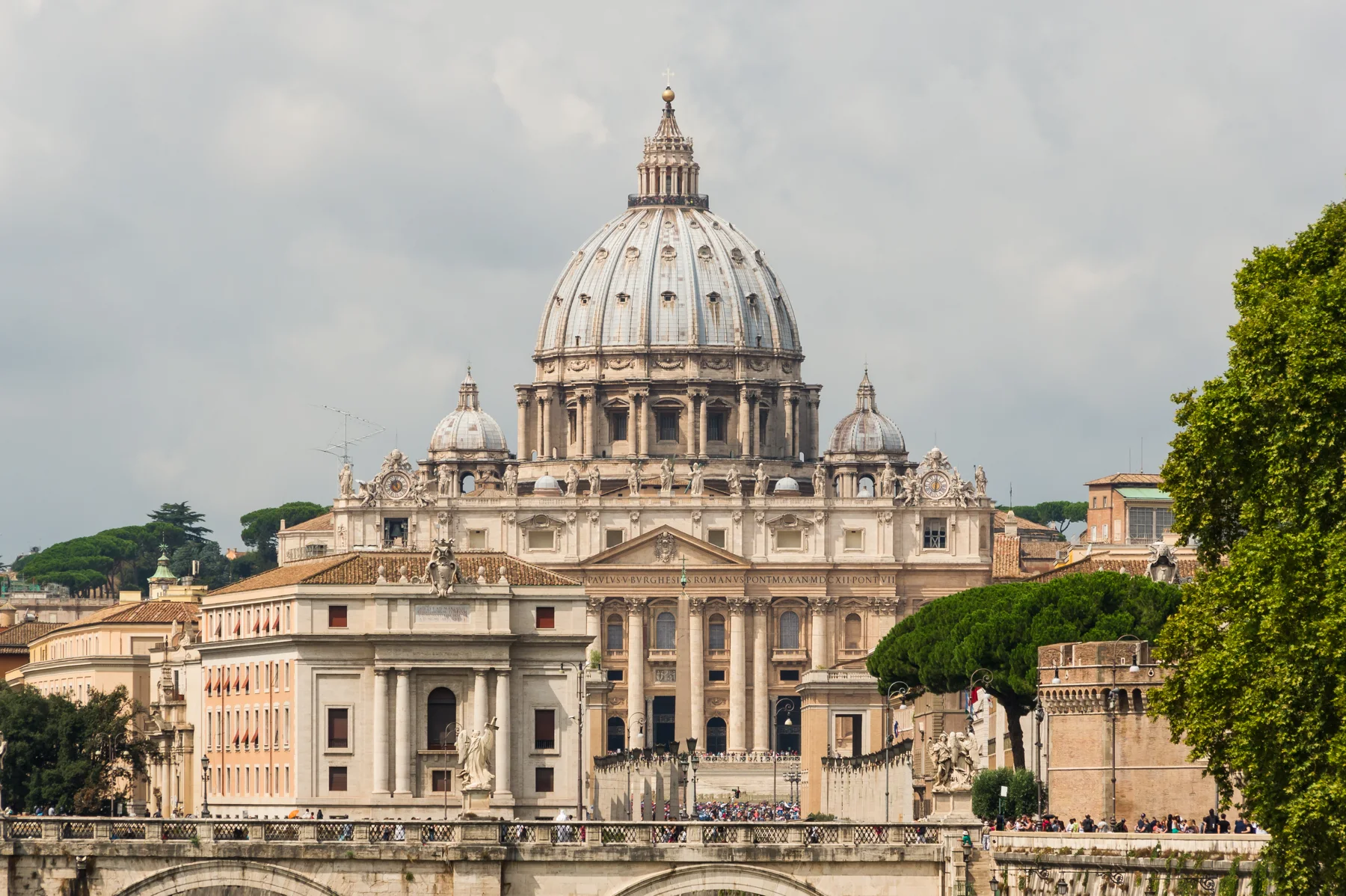
St. Peter's Basilica
Vatican CityWhy it belongs
The grave venerated as Peter's since the earliest centuries lies beneath the high altar, and the basilica stands where it does because of that grave. Sts. Simon and Jude are venerated under the same roof, at the altar of St. Joseph.
What you would do there
A pilgrim could pray at the Confessio above the tomb and profess the Creed there, a long-standing act of pilgrims in this place, then find the altar of St. Joseph, which most visitors pass by. A public Mass in the basilica could be attended where the schedule permits.
- 2
The Vatican Necropolis (Scavi), beneath St. Peter's
Vatican CityWhy it belongs
The necropolis lies between three and eleven metres under the nave. The case for the site of Peter's tomb is strong, and the popes have spoken of the bones with care: in 1968 Paul VI judged the identification convincing while saying that research and debate would continue.
What you would do there
If reservations allow, the visit would follow an ancient street of tombs toward the Apostle's grave. Entry is only by advance reservation through the basilica and cannot be assumed, so the day would be planned to stand on its own, with prayer at the Confessio above, if the necropolis is not available.
- 3
Archbasilica of St. John Lateran
ItalyWhy it belongs
This is the cathedral of the Bishop of Rome, the successor of Peter, and so the place where the word "apostolic" has a living address. Statues of the Twelve line the nave.
What you would do there
A pilgrim could walk the nave from Apostle to Apostle and pray before the papal altar, above which, by long-standing tradition, are the reliquaries venerated as the heads of Peter and Paul. It would be a fitting place to pray for the Pope and the bishops.
- 4
Basilica of the Twelve Holy Apostles (Santi Apostoli)
ItalyWhy it belongs
The basilica has kept the relics venerated as those of Sts. Philip and James the Less since the sixth century. It is also where a pilgrim would learn to tell history from tradition without losing reverence for either: a 2021 study dated the femur attributed to James to AD 214-340, so that bone is not his, and the remains attributed to Philip could not be dated.
What you would do there
A quiet visit to a church many pilgrim groups pass by, with time to pray to two Apostles who are seldom sought out and to read the Gospel passages in which they appear.
- 5
The catacombs of the Appian Way (St. Callixtus)
ItalyWhy it belongs
The catacombs are the cemeteries the Christians of Rome began digging in the second century and used until the early fifth. St. Callixtus, the official cemetery of the Church of Rome in the third century, held around half a million burials, among them martyrs and sixteen popes.
What you would do there
A pilgrim would walk a catacomb gallery with a guide from the community that keeps it, past the crypt where popes of the third century were buried and the symbols scratched in the plaster: a fish, an anchor, a shepherd. Prayer for the dead would come naturally here, among the first generations who died in this faith.
- 6
Basilica of St. Paul Outside the Walls
ItalyWhy it belongs
Paul's sarcophagus lies beneath the papal altar of this papal basilica on the road to Ostia. Benedict XVI said in 2009 that carbon-14 dating of bone fragments to the first or second century "would seem to confirm" the tradition that the tomb is his.
What you would do there
The journey would end at Paul's tomb, with time to pray before the papal altar and to read Acts 28 and the Letter to the Romans in the city they were written to. From the grave of the Apostle to the nations a pilgrim could ask to be sent home as the Apostles were sent.
Prayer and the sacraments
The Eucharist would be the centre of each day where the schedule permits; whether a group could celebrate at a particular altar depends on that basilica's arrangements, and clergy arrangements are confirmed for each departure. The Creed could be said slowly at the tombs of Peter and Paul, with lectio divina on the Acts of the Apostles through the week, prayer for the Pope and the bishops, and Confession where confessors are available.
Pilgrim’s Time
Rome rewards a pilgrim who goes back, so protected Pilgrim's Time could be used to return alone to one basilica before the crowds arrive, to sit with Acts or a letter of Paul, or to look into one of the city's early churches such as San Clemente. Nothing would be scheduled into those open parts of the day.
Pilgrim Pace
The Vatican necropolis and the catacombs involve stairs, narrow passages, uneven floors and enclosed, humid spaces, and are not suited to everyone; the basilicas mean long distances on stone and cobbles, security queues and standing. With the underground visits kept optional, a Rome-centred journey like this could be made gently from a single base.
How Pilgrim Pace worksOther ways to make this pilgrimage
- The Rome & Assisi Classic. The Classic's Rome days already include St. Peter's, St. John Lateran and St. Paul Outside the Walls, so the two Apostles of Rome are its spine, though the necropolis and the catacombs are not part of the sample itinerary.
- From Galilee to Pentecost. A Holy Land journey could follow the Apostles as they lived it, from the call at the Sea of Galilee and Capernaum to Jerusalem and the Cenacle, subject entirely to conditions in the region at the time.
- To the shrine of St. James. A pilgrim drawn to walk toward an Apostle could look to the Camino and the Cathedral of Santiago de Compostela, whose main chapel is built over the tomb venerated as that of St. James the Greater.
No dated departures are currently announced. This is a journey Bold Pilgrim is considering, described so you can picture it. Dates, priest, Gateway Airport and price are published on a departure itself, and only when confirmed.
Who it may be for
It suits pilgrims who want substance: people who read, ask questions and like to know what is certain and what is tradition. It suits those entering or recently received into the Church, catechists, deacons and their wives, OCIA (formerly RCIA) and Bible-study groups, and anyone preparing to hand on the faith to children or grandchildren. It also suits Christians of other traditions and honest inquirers, because the ground it covers is common ground: the New Testament and the first centuries.
It is less suited to someone looking mainly for a Marian shrine's rhythm of processions and devotions, or for a single place to stay still. An Apostles pilgrimage tends to move, and it asks for some reading beforehand. The Acts of the Apostles is the natural preparation.
- Converts and those recently received into the Church
- People exploring Catholicism who want to see its origins for themselves
- Readers of Scripture and Church history
- Catechists, deacons, teachers and OCIA (formerly RCIA) or Bible-study groups
- Parishes named for an Apostle
- Christians of other traditions travelling with Catholic family
- Catholics whose faith has grown thin and who want to return to its foundations
A spiritual purpose has no Pilgrim Pace rating; the actual itinerary determines the pace. Typical physical considerations for these places: the Vatican necropolis and the catacombs involve stairs, narrow passages, uneven floors and enclosed, humid spaces, and are not suited to everyone; Rome's basilicas mean long distances on stone and cobbles; Holy Land sites involve heat, open archaeological ground and long transfers. A Rome-centred journey can be made gently if the underground visits are optional.
UNDERSTANDING THIS PILGRIMAGE
The Catholic faith came to us through the Apostles, and a pilgrim can still stand where they lived, preached, died and are venerated. An Early Church or Apostles pilgrimage, often described as walking in the footsteps of the Apostles, is a journey to the places tied to the Twelve and the first Christian generations: the tombs of Sts. Peter and Paul in Rome, the catacombs, the Galilee and Jerusalem of the Gospels, and the shrines that venerate the other Apostles, such as Santiago de Compostela. Its purpose is not archaeology for its own sake. The Church calls herself apostolic because she is built on these witnesses, and a pilgrim goes to their graves to pray, to profess the same faith, and to be sent home as they were sent.
What it means: a Church built on witnesses
Every Sunday Catholics profess a Church that is one, holy, catholic and apostolic. The Catechism explains the last word in three ways: the Church was built on the foundation of the Apostles, the witnesses Christ himself chose and sent; she keeps and hands on their teaching; and she continues to be taught and guided by their successors, the bishops in union with the successor of Peter (CCC 857). The role of the Twelve as eyewitnesses of the Resurrection cannot be repeated or passed on. What they handed on can be, and has been (CCC 860-862).
This is why their graves have mattered since the first centuries. Benedict XVI, opening his catecheses on the Apostles in 2006, put it in one sentence: "Through the Apostles, we come to Jesus himself." He called the Twelve the clearest sign that between Christ and his Church there is no opposition. An Apostles pilgrimage takes that sentence literally. You go to the men who knew him, and you find they point away from themselves.
The Church counts the veneration of relics, visits to sanctuaries and pilgrimages among the legitimate expressions of popular piety (CCC 1674). They are devotions, not obligations, and they are meant to extend the Church's liturgical life, not replace it. The centre of a day at an Apostle's tomb is still the Mass, where the faith they died for is celebrated.
What the Church claims about these places, and what she does not
This kind of pilgrimage asks for honesty about evidence, because the places differ. Some rest on history and archaeology, some on ancient and continuous tradition, some on later tradition that historians dispute. A careful pilgrim can hold all three without embarrassment, provided each is called what it is.
Rome is the strongest case. The grave venerated as Peter's lies in a Roman necropolis beneath the high altar of St. Peter's Basilica, and the basilica was built where it is because of that grave. In 1968 Paul VI announced that he judged the identification of St. Peter's relics convincing, and added in the same address that research and debate would not end there. The reliquary of bone fragments he kept is inscribed with deliberate restraint: bones "considered to be those of Blessed Peter the Apostle." At St. Paul Outside the Walls, Benedict XVI reported in 2009 that carbon-14 testing of fragments from the sarcophagus pointed to a person of the first or second century, which he said "would seem to confirm the unanimous and undisputed tradition" that the tomb is Paul's.
Other shrines stand on tradition. Benedict XVI described the link between St. James the Greater and Spain as a later tradition, and the cathedral at Santiago itself says "the tradition narrates" how his body came to Galicia. Leo XIII declared the relics there to be those of St. James in 1884, and historians still debate how the body could have reached Spain. The relics long venerated in Rome as St. James the Less were tested in 2021 and the femur dated to the third or fourth century, which means that bone is not his. St. Thomas is honoured both at Chennai in India and at Ortona in Italy. None of this is hidden by serious Catholic sources, and none of it empties the pilgrimage. Veneration is directed to the Apostle, who is alive in Christ, and prayer at a shrine where Christians have honoured him for a thousand years is real prayer whatever a laboratory later says about a particular bone.
Why someone is drawn to it
Often the pull begins with a question about foundations. A convert wants to see whether the Church he entered is the one in the Acts of the Apostles. A lifelong Catholic realises she has recited "apostolic" for fifty years without thinking about it. A reader of history wants to stand where the first Christians buried their dead. Someone whose faith has thinned wants to know whether the first witnesses really staked their lives on what they said they saw.
The Apostles answer that last question in the only way open to them. Peter, who denied Christ, is buried a short walk from where tradition says he was crucified. Paul, who persecuted the Church, lies outside the walls on the road to Ostia. Thomas doubted, and by ancient tradition carried the Gospel as far as India. These were not impressive men when Christ called them. A pilgrimage among their tombs is a long look at what grace made of them.
Questions pilgrims ask
What is an Apostles pilgrimage?
An Apostles pilgrimage, sometimes called an Early Church pilgrimage or a pilgrimage in the footsteps of the Apostles, is a journey to the places where the Twelve and the first Christians lived, preached, died and are venerated. Rome is its usual heart, with the tombs of Sts. Peter and Paul and the catacombs. The Holy Land, Santiago de Compostela and the early Christian cities of Greece and Türkiye extend it. The purpose is to pray where the Church's first witnesses lie and to renew the faith they handed on, which the Catechism calls apostolic because the Church is built on them.
Which Apostles are buried in Rome?
Tradition places six in Rome, counting St. Paul with the Twelve: Peter beneath the high altar of St. Peter's Basilica, Paul at St. Paul Outside the Walls, Simon and Jude at the altar of St. Joseph inside St. Peter's, and Philip and James the Less at the Basilica of the Twelve Holy Apostles. The church of St. Bartholomew on the Tiber Island also claims that Apostle's relics, a claim shared with Benevento. The evidence is strongest for Peter and Paul; the others rest on tradition.
Full answer: Where are the twelve Apostles buried?
Are the tombs of the Apostles authentic?
It depends on the tomb, and the Church does not treat them alike. The burial places of Peter and Paul in Rome have strong historical and archaeological support, and even there the popes have spoken with care; Santiago, Ortona, Amalfi, Salerno and Trier rest on long tradition and medieval transfers of relics. A 2021 study found that one bone long venerated in Rome as St. James the Less dates from the third or fourth century.
Full answer: Are the tombs and relics of the Apostles authentic?
Is St. James really buried in Santiago de Compostela?
The Church venerates the tomb beneath the main chapel of Santiago Cathedral as that of St. James the Greater, and Leo XIII declared the relics to be his in 1884. How the body came to Galicia is tradition, not documented history: Scripture records only his death by the sword (Acts 12:2), and the cathedral's own account begins, "The tradition narrates."
Full answer: Is St. James really buried in Santiago de Compostela?
Did the early Christians hide in the catacombs?
The catacombs were cemeteries. The custodians of St. Callixtus, on the Appian Way, describe them as the burial grounds the Christians of Rome began digging in the second century and used until the beginning of the fifth, when burial moved above ground and into the basilicas of the martyrs. Martyrs of the persecutions were buried there, and the Pontifical Commission for Sacred Archaeology records the pilgrims who later came to pray at their tombs. Neither account describes Christians living or hiding underground.
Can pilgrims visit the Upper Room where the Church began at Pentecost?
Yes, pilgrims can ordinarily enter the Cenacle on Mount Zion in Jerusalem, venerated as the place of the Last Supper and of Pentecost. It is not a church in Catholic hands. The Franciscans received the site in 1333 and were later expelled under the Ottomans; the building has been under Israeli control since 1948. The Custody of the Holy Land says it has not been possible to celebrate Mass in the room since the Ottoman period, though the friars gather there in prayer at Pentecost and stop there on Holy Thursday. Arrangements can change, so a group should confirm current access and where its Mass will be celebrated before travelling.
What are the Seven Churches of Revelation?
They are the seven Christian communities of the Roman province of Asia to which John is told to write in the Book of Revelation: Ephesus, Smyrna, Pergamum, Thyatira, Sardis, Philadelphia and Laodicea. All lie in what is now western Türkiye, and they are not the Seven Churches of Rome, which is a walking devotion among Roman basilicas. They are places a Catholic may visit as a pilgrim; Bold Pilgrim has no dated departure there at present.
Full answer: Where are the Seven Churches of Revelation today?
Did the Virgin Mary live at Ephesus with St. John?
A tradition holds that St. John brought Mary to Ephesus, and the Church has never ruled on it; an older tradition places the end of her earthly life in Jerusalem. The question, and the shrine connected with it, are treated in the Marian pilgrimage's answer.
Full answer: Did the Virgin Mary really live in Ephesus?