PILGRIMAGE BY SPIRITUAL PURPOSE · THE APOSTLES AND THE STORY OF THE CHURCH
St. Peter & the Papacy Pilgrimage
I want to stand where the Church says it stands on Peter, and find out whether I believe what he said to Jesus: "You are the Christ."
A pilgrimage to the Apostle Peter and to his successor, made to profess the faith Peter professed, to pray at his tomb, and to pray for the Pope and the unity of the Church.
Some people come to Rome because they love the Church and want to see her visible center. Others come unsure about the papacy, or hurt or confused by something in the Church, and want to look at the foundation rather than the headlines. Either way the desire is the same: to stand where the Church says it stands on Peter, and to find out whether you believe what he said to Jesus: "You are the Christ."
Peter is the least intimidating of the great saints. He sank in the water, fell asleep in Gethsemane and denied the Lord three times in one night, and Christ still asked him, "Do you love me?" and entrusted the flock to him. This pilgrimage goes to his grave to say the Creed with him, and to pray for the man who now carries his task.
THE JOURNEY
To the Thresholds of the Apostles: Rome with St. Peter
Where
Vatican City, Italy
Length
About five or six days
Status
Under consideration
This journey would stay in one city, Rome, and would be built around one grave. It would begin at the Confessio of St. Peter's Basilica and go down beneath the floor toward the Apostle's tomb, then cross the city to the Pope's own cathedral at St. John Lateran, to the chains venerated as Peter's, and to the tomb of St. Paul, the other Apostle of Rome. The order follows the logic of the faith rather than a map: first the fisherman who died here, then the chair and the office that continue from him, then the visit to both Apostles' tombs that canon law asks of every diocesan bishop. It would close with prayer for Peter's successor, and with an audience or liturgy with the Pope only where tickets and the calendar allow.
The route, and why each place belongs
1
St. Peter's Basilica: the Confessio and the Chair of Peter
Vatican City
Why it belongs
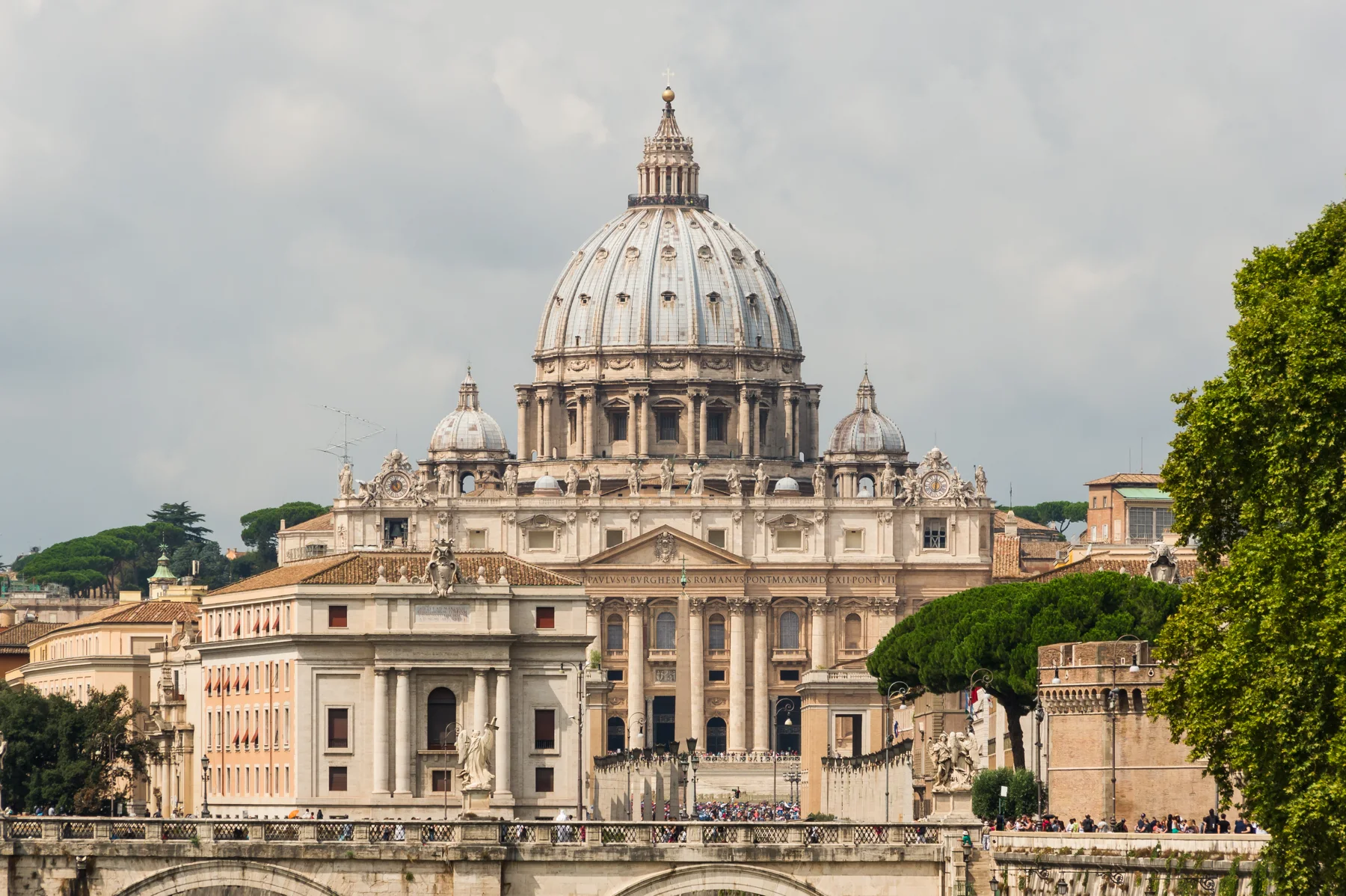
The basilica stands over the place venerated since antiquity as Peter's grave, and it describes the site in its own words: "Here, Saint Peter was crucified and buried." The papal altar, the canopy and the dome rise in a single line above that grave.
What you would do there
The first act of the pilgrimage would be the simplest: to stand at the Confessio, as near the Apostle's grave as the basilica floor allows, and pray the Creed and the Our Father. From there pilgrims could walk the length of the nave to Bernini's monument of the Chair of Peter in the apse, the sign of the teaching office given to him, and pray at the tomb of Pope St. John Paul II.
2
The Vatican Grottoes and the Necropolis
Vatican City
Why it belongs
Beneath the basilica floor lie the tombs of many popes, and beneath those the ancient cemetery where, as Pius XII announced in 1950, the tomb of the Apostle was found. Of the bones, Paul VI said in 1968 that they had been identified "in a way that we can hold to be convincing," and Pope Francis wrote in 2019 that they "can quite reasonably be considered those of the Apostle Peter"; scholars still discuss the question.
What you would do there
In the Grottoes pilgrims would pass the papal tombs, Pius XII's among them, and pause before the Niche of the Pallia, which the basilica calls the place closest to Peter's tomb. If a reservation is granted, a small guided group could go lower still and follow the old cemetery road to the tomb itself. A pilgrim who cannot obtain a place has still made the essential visit.
3
Archbasilica of St. John Lateran
Italy
Why it belongs
The Pope is first of all the Bishop of Rome, and this, not St. Peter's, is his cathedral: the church that holds his cathedra. Its facade names it mother and head of all the churches of the city and the world, and the popes lived beside it for about a thousand years.
What you would do there
Pilgrims would stand before the Pope's chair and pray for the unity of the Church and for the bishops in communion with him. The same day could continue, as the Rome & Assisi Classic does, to St. Mary Major, the city's great Marian basilica, recalling that the Apostles, Peter first among them, persevered in prayer with Mary.
4
San Pietro in Vincoli (St. Peter in Chains)
Italy
Why it belongs
This fifth-century basilica displays, in a reliquary, the chains venerated as those that bound Peter. The account of two chains, from Jerusalem and from Rome, joining into one is a pious tradition and not something the Church requires anyone to accept.
What you would do there
A shorter, quieter visit: time before the reliquary to pray for those who suffer for the faith, and to read slowly from the Gospel scenes of Peter or from his First Letter.
5
Basilica of St. Paul Outside the Walls
Italy
Why it belongs
Going "to the thresholds of the Apostles" has always meant two tombs, not one. Paul is honored with Peter as founder of the Church of Rome and was martyred in the same city, and the visit to the Apostles is incomplete without his grave.
What you would do there
Pilgrims would pray at the tomb of St. Paul and so complete, in a personal way, the visit that every diocesan bishop is bound to make. The rest of the day could be left flexible, as it is in the Classic.
6
The Vatican: prayer with and for Peter's successor
Vatican City
Why it belongs
Peter's office continues in a living man, as of October 2026 Pope Leo XIV, and praying for the Pope at Peter's tomb is the most traditional act of this pilgrimage. It is possible whatever the papal calendar holds.
What you would do there
Where tickets and the calendar allow, pilgrims could attend a general audience, the Sunday Angelus or a papal liturgy, hear the Pope speak and receive his blessing; the day would be set by his calendar, not by the route, and nothing about it could be promised in advance. The journey would then end where it began, at the Confessio, with the Creed and a prayer for him by name.
Prayer and the sacraments
Mass would be sought in the basilicas where the schedule permits, and clergy arrangements are confirmed for each departure. Confession in St. Peter's Basilica could be part of the days at the Vatican where confessors are available, and each visit to an Apostle's tomb would be given time for the Creed, the Our Father and a prayer for the Pope.
Pilgrim’s Time
Pilgrim's Time would be kept free on the Vatican days above all, so that anyone who wishes could go back to the Confessio alone, without a group around them. It could also be used for lectio divina with Peter's Gospel scenes (Matthew 16, Luke 22, John 21) or simply for rest.
Pilgrim Pace
This is a city pilgrimage: long security queues and much standing at the Vatican, large distances inside St. Peter's, and Roman cobblestones between sites. The necropolis is underground and confined, with steps and narrow passages, and a papal audience can mean hours seated or standing outdoors.
Rome is a working city and the Vatican is crowded, so pilgrims who want stillness afterwards could continue to Assisi, as the Rome & Assisi Classic does, for a quieter close in Umbria.
Other ways to make this pilgrimage
From the lake to the tomb: Galilee and Rome. A longer journey could follow Peter's life in order, from Capernaum, Tabgha and Caesarea Philippi to Jerusalem and then Rome, subject to conditions in the Holy Land at the time.
The feast of Sts. Peter and Paul in Rome. The same Roman route could be timed around 29 June, the solemnity of the city's two Apostles, with papal liturgies and access verified for the year.
Within the Rome & Assisi Classic. The Classic's Rome days already hold St. Peter's with protected prayer time, St. John Lateran and St. Mary Major, and St. Paul Outside the Walls, though a necropolis visit and a papal audience are not part of its sample route.
No dated departures are currently announced. This is a journey Bold Pilgrim is considering, described so you can picture it. Dates, priest, Gateway Airport and price are published on a departure itself, and only when confirmed.
WHAT YOU MAY EXPERIENCE
What a pilgrim might experience
The heart of it is simple: to stand at the Confessio in St. Peter's, as near the Apostle's grave as the basilica floor allows, and pray the Creed and the Our Father. The Church's Manual of Indulgences (grant 33) attaches a plenary indulgence, under the usual conditions, to a devout visit to one of Rome's four papal basilicas with those two prayers, made on pilgrimage with others or at least with an expression of filial devotion to the Pope; read the current norms before you travel. Around that center a pilgrim might add the Grottoes and the papal tombs, the necropolis if a reservation is granted, confession in the basilica, and Mass where the schedule permits.
Then there is the living successor. As of October 2026 the reigning Pope is Leo XIV, elected on 8 May 2025. Pilgrims may be able to attend a general audience, the Sunday Angelus or a papal liturgy when one is scheduled; tickets issued by the Prefecture of the Papal Household are always free, and nothing about the Pope's calendar can be promised in advance. What is always possible is to pray for him. Praying for the Pope at Peter's tomb is the most traditional act of this pilgrimage.
For those who travel to the Holy Land, the same story is told at its source: the excavated house venerated as Peter's at Capernaum, the rock at Tabgha where tradition places the breakfast by the lake and the words "Feed my sheep," the cliff and springs of Caesarea Philippi, and in Jerusalem the church that remembers his denial and his tears.
In practice
Praying the Creed at the Confessio above the Apostle's tomb
Walking through the Vatican Grottoes among the tombs of the popes
Standing before the Pope's cathedra at St. John Lateran
Hearing the Pope speak and receiving his blessing, if his calendar allows
Reading John 21 on the shore at Tabgha, for those who travel to Galilee
Confession in St. Peter's Basilica
Who it may be for
This pilgrimage suits people who want their faith to be more consciously Catholic: adults received into the Church, parents and godparents, catechists and teachers, those discerning a vocation, and anyone who has only ever known the Pope as a figure in the news. It suits the honest questioner too, including Christians of other traditions who want to understand what Catholics actually claim about Peter and to see the evidence in place.
It is less suited to someone who wants a quiet, rural retreat. Rome is a working city and the Vatican is crowded. What it offers is of another kind: to say "I believe" in the place where the Church has said it, without interruption, since the fisherman from Galilee died there for the Lord who had asked him, "Do you love me?"
Adults recently received into the Church, and those preparing to be
Catholics who want to understand the papacy from its foundation rather than from the news
Christians of other traditions, and the curious, who want to see what Catholics claim about Peter
Catechists, teachers, parents and godparents
Parish groups making a first pilgrimage to Rome
People returning to the Church who identify with Peter's fall and restoration
A spiritual purpose has no Pilgrim Pace rating; the actual itinerary determines the pace. Typical physical considerations for these places: long security queues and much standing at the Vatican, large distances inside St. Peter's, and Roman cobblestones. The necropolis visit is underground and confined, with steps and narrow passages; check the basilica's current rules on age and access before requesting a place. A papal audience can mean hours seated or standing outdoors. In the Holy Land, lakeside and archaeological sites have uneven ground.
The basilica stands over the place venerated since antiquity as Peter's grave; the Confessio before the papal altar is the nearest point of prayer open to everyone, and Bernini's Chair of Peter fills the apse. The Holy See states that the tomb was found (Pius XII, 1950). The wooden chair inside Bernini's monument is venerated as a sign of the Petrine office, with no claim that Peter used it.
The ancient cemetery beneath the Grottoes, where a guided visit follows the old road to the Apostle's tomb. Access is limited and by reservation only. On the bones, Paul VI (1968) called the identification "convincing" and Pope Francis (2019) said they "can quite reasonably be considered" Peter's; the question is still discussed by scholars.
The tomb of the other Apostle of Rome; the visit to the Apostles' tombs is incomplete without it.
The Vatican Grottoes and the papal tombs
The level beneath the basilica floor holds the tombs of many popes, Pius XII among them, and the Niche of the Pallia, which the basilica calls the place closest to Peter's tomb. · Vatican City pilgrimage hub
San Pietro in Vincoli (St. Peter in Chains)
A fifth-century basilica where chains venerated as those that bound Peter are displayed in a reliquary. The account of two chains, from Jerusalem and from Rome, joining into one is a pious tradition, not a claim the Church requires anyone to accept. · Rome pilgrimage hub
Capernaum: the house venerated as St. Peter's
The lakeside town of Jesus' Galilean ministry; beneath a modern memorial church are the remains of a first-century house turned into a place of Christian gathering and later an octagonal church. The Custody of the Holy Land bases the identification on archaeology together with early pilgrim accounts: a strong ancient tradition, not a defined fact. · The Holy Land pilgrimage hub
Church of the Primacy of St. Peter, Tabgha
A small Franciscan church on the shore of the Sea of Galilee built around a rock venerated by tradition as the place where the risen Jesus fed the disciples and said to Peter, "Feed my sheep" (John 21). · The Holy Land pilgrimage hub
Caesarea Philippi (Banias)
The district where Peter confessed Jesus as the Christ and received the promise of the keys (Matthew 16); today a nature reserve at a spring beneath a great rock face, with remains of the shrine of Pan. The Gospel names the district, not a precise spot, and there is no functioning church on the site. · The Holy Land pilgrimage hub
Honored with Peter as founder of the Church of Rome and martyred in the same city; the tradition of visiting the Apostles' tombs has always meant both.
A successor of Peter in living memory, buried in St. Peter's Basilica, who wrote on the Petrine ministry as a service to Christian unity.
Devotions and practices
Profession of faith at the tomb of the Apostle
Praying the Creed and the Our Father at the Confessio of St. Peter's is the classic act of a Roman pilgrimage; the Church's Manual of Indulgences attaches these two prayers to a visit to Rome's papal basilicas.
Prayer for the Pope
Praying for the reigning Pope and for his intentions, at the tomb of the Apostle whose task he carries. It is possible whatever the papal calendar allows.
Visit to the tombs of the Apostles (ad limina Apostolorum)
Praying at St. Peter's and at St. Paul Outside the Walls, the same visit canon law asks of every diocesan bishop (canon 400).
Solemnity of Sts. Peter and Paul (29 June)
The feast of the two Apostles of Rome, when the bronze statue of St. Peter in the basilica is dressed in papal vestments.
The Papal (Apostolic) Blessing
The Pope's blessing. The Manual of Indulgences (grant 4) attaches a plenary indulgence, under the usual conditions, to the blessing given Urbi et Orbi and received devoutly, even by live broadcast.
Lectio divina with Peter
Praying slowly through the Petrine Gospel scenes (Matthew 16, Luke 22, John 21) and the First Letter of Peter in the places connected with them.
Our Lady and this pilgrimage
After the Ascension the Apostles, Peter first among them, persevered in prayer with Mary the mother of Jesus (Acts 1:14), a scene the Church recalls when it honors her as Mother of the Church. In Rome that bond is visible at St. Mary Major, the city's great Marian basilica and one of the four papal basilicas.
UNDERSTANDING THIS PILGRIMAGE
A St. Peter and the Papacy pilgrimage is a journey of prayer to the places of the Apostle Peter and of the office Christ entrusted to him: above all his tomb beneath St. Peter's Basilica in Rome, the Pope's cathedral at St. John Lateran, and, where possible, an audience or liturgy with the reigning Pope. Some pilgrims begin further back, on the Sea of Galilee, where Peter was called, confessed Christ and was told "Feed my sheep." Its purpose is not to admire an institution but to renew, with Peter, faith in Jesus Christ, and to pray for the man who now carries Peter's task.
What this pilgrimage is: a grave, a chair and a cathedral
Catholics have gone to Rome since antiquity for one reason before any other: the Apostles Peter and Paul bore their final witness there. The Church still calls this going "to the thresholds of the Apostles." Canon law asks every diocesan bishop to come to Rome periodically "to venerate the tombs of the Blessed Apostles Peter and Paul" and to present himself to the Pope (canon 400). A lay pilgrim who prays at the two tombs is doing, in a personal way, what the bishops are bound to do.
St. Peter's Basilica is built over the place the basilica itself describes in these words: "Here, Saint Peter was crucified and buried." The papal altar, the canopy and the dome stand in a single vertical line above the grave. Below the floor are the Vatican Grottoes, with the tombs of many popes, and below those the ancient necropolis, visited in small guided groups by advance reservation.
In the apse of the basilica is Bernini's monument of the Chair of Peter. A chair, cathedra, is the sign of a bishop's teaching office, and the feast of the Chair of Peter (22 February) has been kept in Rome since the fourth century. The Pope's actual cathedral, though, is not St. Peter's. It is the Archbasilica of St. John Lateran, across the city, whose facade names it mother and head of all the churches of the city and the world. A pilgrimage about the papacy that leaves out the Lateran has missed the Pope's own church.
Why someone is drawn to it
Some come because they love the Church and want to see her visible center. Some come because they are unsure about the papacy, or have been hurt or confused by something in the Church, and want to look at the foundation rather than the headlines. Some are entering the Church, or returning, and want to say the Creed where Peter is buried.
And many come because of Peter himself. He is the least intimidating of the great saints. He sank in the water, argued with the Lord, fell asleep in Gethsemane and denied Jesus three times in one night. Benedict XVI, preaching on him, said that "the school of faith is not a triumphal march but a journey marked daily by suffering and love, trials and faithfulness," and summed up Peter's answer by the lake as: "Lord, I love you as I am able to love you." People who know their own weakness recognize themselves in him, and find in his story that Christ builds on forgiven men.
The Catholic foundation: what Christ gave to Peter
The pilgrimage rests on three Gospel scenes. At Caesarea Philippi, Simon confesses Jesus as "the Christ, the Son of the living God," and Jesus answers with a new name and a promise: "You are Peter, and on this rock I will build my Church," with the keys of the Kingdom and the authority to bind and loose (Matthew 16:13-19). At the Last Supper, Jesus tells him he has prayed that his faith may not fail, so that he can strengthen his brothers (Luke 22:31-32). By the lake after the Resurrection, the risen Lord asks him three times "Do you love me?" and three times entrusts the flock to him (John 21:15-17).
From these the Church teaches, as doctrine, that Christ placed Peter at the head of the college of the Twelve and that this office continues in the Bishop of Rome. The Catechism says the Lord made Simon alone the "rock" of his Church (no. 881) and calls the Pope the "perpetual and visible source and foundation of the unity" of the bishops and of the faithful (no. 882), language taken from the Second Vatican Council (Lumen Gentium 18, 23).
What the Church has, and has not, said about Peter's tomb and bones
Pius XII ordered excavations beneath St. Peter's, and in his Christmas message of 1950 he announced: "The tomb of the Prince of the Apostles has been found." In the same message he said that bone fragments found beside the tomb could not be proved with certainty to be the Apostle's. Pope Francis, in a letter of 2019, recounted that the excavations later led, in 1952, to a funerary niche covered with early graffiti, holding bones that "can quite reasonably be considered those of the Apostle Peter." On 26 June 1968 Paul VI said the relics of St. Peter had been "identified in a way that we can hold to be convincing," and added that research, verification, discussion and controversy would not end with his announcement.
So the honest summary is this. The Holy See states that the tomb has been found. The popes have called the identification of the bones convincing and reasonable; they have not called it certain or defined it as a matter of faith, and scholars continue to debate it. A pilgrim's prayer at the Confessio does not depend on a laboratory result: it rests on the Church's unbroken memory, from the first centuries, that Peter gave his life for Christ in this city and was buried on this hill. The fuller account, with the popes' own words, is in the answer on St. Peter's bones linked from this page.
Questions pilgrims ask
What is a St. Peter and the Papacy pilgrimage?
It is a pilgrimage to the places of the Apostle Peter and of the office Christ gave him. In Rome that means praying at his tomb beneath St. Peter's Basilica, visiting the Pope's cathedral at St. John Lateran, and, if the calendar allows, seeing the reigning Pope at an audience or liturgy. Some pilgrims add Galilee, where Peter was called and told "Feed my sheep." The aim is to renew faith in Jesus Christ with Peter and to pray for his successor.
Why do Catholics have a Pope?
Because Catholics believe Christ gave Peter a lasting office. Jesus named him the rock on which he would build his Church, promised him the keys of the Kingdom (Matthew 16:18-19), prayed that he would strengthen his brothers (Luke 22:32) and told him to feed his sheep (John 21). The Catechism teaches that this office continues in the Bishop of Rome, the "perpetual and visible source and foundation of the unity" of the Church. As Benedict XVI said, it remains "Christ's Church, not Peter's."
Is St. Peter really buried under St. Peter's Basilica?
The Holy See says his tomb is there: Pius XII announced in 1950 that the tomb of the Apostle had been found beneath the high altar. On the bones, Paul VI said in 1968 that the relics had been identified "in a way that we can hold to be convincing," and acknowledged that study and debate would continue. The full account is in the linked answer.
Can I pray at St. Peter's tomb without a Scavi ticket?
Yes. Anyone inside St. Peter's Basilica can pray at the Confessio, the sunken area in front of the papal altar directly above the tomb, and the Vatican Grottoes beneath the floor bring you before the Niche of the Pallia, which the basilica describes as the place closest to the tomb. Only the ancient necropolis below the Grottoes requires a reservation, and a pilgrim who cannot obtain a place has still made the essential visit.
Can I see the Pope on a pilgrimage to Rome?
Often, but it can never be guaranteed. When he is in Rome the Pope normally holds a weekly general audience and leads the Sunday Angelus, and tickets, where needed, are issued by the Prefecture of the Papal Household and are always free. The papal calendar changes, so confirm it for your dates.
Why is St. John Lateran the Pope's cathedral instead of St. Peter's?
Because the Pope is first of all the Bishop of Rome, and a bishop's cathedral is the church that holds his chair, the cathedra. Rome's cathedral has been the Lateran since the fourth century, while St. Peter's is the great shrine over the Apostle's tomb.
Which places in the Holy Land are connected with St. Peter?
Four stand out. At Capernaum, a modern church is raised over the excavated house venerated as Peter's since the first centuries. At Tabgha, the Franciscan Church of the Primacy of St. Peter encloses the rock where tradition places the risen Jesus' words "Feed my sheep." Caesarea Philippi (Banias), about 40 km north of the lake, is the district of Peter's confession and is now a nature reserve with no active church. In Jerusalem, St. Peter in Gallicantu commemorates his denial and repentance. No dated Bold Pilgrim departures to the Holy Land are currently announced.
Church documents are cited for doctrine and discipline; shrine and diocesan pages for institutional facts. Where a claim rests on tradition or private revelation, the page says so.
The sample Rome days already hold the essentials of this purpose: a basilica visit to St. Peter's with protected prayer time, the day at St. John Lateran and St. Mary Major, and St. Paul Outside the Walls, the second Apostle's tomb. A necropolis visit and a papal audience are not part of the sample route.
Classic Pilgrimages begin with the place. They are sample itineraries; confirmed departures and prices have not been announced.
Upcoming departures
No dated departures are currently announced.
Dates, priest, Gateway Airport, price and availability are published on the departure itself, and only when confirmed. This page describes a reason for going, not a departure.
St. Peter & the Papacy Pilgrimage: I want to stand where the Church says it stands on Peter, and find out whether I believe what he said to Jesus: "You are the Christ." | Bold Pilgrim