THE JOURNEY
Rome through the Centuries: San Clemente, the Lateran, the Minerva, the churches of the Catholic Reformation and St. Peter's
- Where
- Italy, Vatican City
- Length
- About a week
- Status
- Under consideration
This journey would stay in Rome and take the city in the order of its centuries instead of by neighbourhood. It would begin underground at San Clemente, where the first Christian centuries lie beneath a medieval church, go on to the Pope's cathedral at the Lateran and its councils, pause at the tomb of St. Catherine of Siena for the years the popes spent at Avignon, pray at the tombs of the saints who renewed Rome after the Council of Trent, and end at St. Peter's, where the First Vatican Council sat. One city holds every chapter, so the pilgrim could follow the story in sequence from a single base, with no long transfers and with time to go back to a church a second time.
The route, and why each place belongs
- 1
Basilica of San Clemente
ItalyWhy it belongs
A twelfth-century church stands here on the fourth-century basilica it replaced, which in turn stands on first-century Roman buildings, one of them later made into a shrine of Mithras. It is the clearest single place to begin, because the pilgrim can see with his own eyes that the Church in Rome has a depth measured in layers.
What you would do there
The pilgrim would pray first in the upper church, where the relics of Pope St. Clement are venerated beneath the high altar and where St. Cyril, apostle of the Slavs, was buried in 869. The excavations are visited separately, going down by stairs through the older basilica to the Roman level, in the care of the Irish Dominicans who have looked after San Clemente since 1677.
- 2
Archbasilica of St. John Lateran
ItalyWhy it belongs
The Lateran is the Pope's cathedral, and five councils of the Church, held between 1123 and 1517, take their name from it. It would carry the medieval chapters of the story, the centuries in which councils of the Church gathered at the Pope's own cathedral.
What you would do there
The natural prayer of this pilgrimage is the Nicene Creed, and the group could say it slowly here, in a place tied to the councils. A short text from one of the Lateran councils could be read on site, with time afterwards to pray in the cathedral in silence.
- 3
Santa Maria sopra Minerva and the tomb of St. Catherine of Siena
ItalyWhy it belongs
From 1309 the popes lived at Avignon, until St. Catherine of Siena, in Benedict XVI's words, "energetically and effectively urged" Gregory XI to return; he left Avignon in September 1376 and entered Rome in January 1377. Catherine died in Rome in 1380, and her tomb makes this crisis of the papacy something a pilgrim can pray beside.
What you would do there
The pilgrim would pray at her tomb and ask her intercession for the Church and for the Pope. A page of her letters could be read there, which says more about how a saint speaks to a Church in trouble than a long commentary would.
- 4
The Gesù and the Chiesa Nuova
ItalyWhy it belongs
The Council of Trent answered the Protestant Reformation by clarifying doctrine and reforming the clergy, and saints carried that reform out. The Gesù is the mother church of the Society of Jesus and keeps the tomb of St. Ignatius of Loyola; the Chiesa Nuova is the church of the Oratory of St. Philip Neri, who came to Rome after the Sack of 1527 and has been called an apostle of the city.
What you would do there
The two churches stand in the historic centre and could be visited on foot in one day. The pilgrim would pray at the tomb of St. Ignatius and before the remains of St. Philip Neri, and this would be a fitting day for an examination of conscience, and for Confession where confessors are available.
- 5
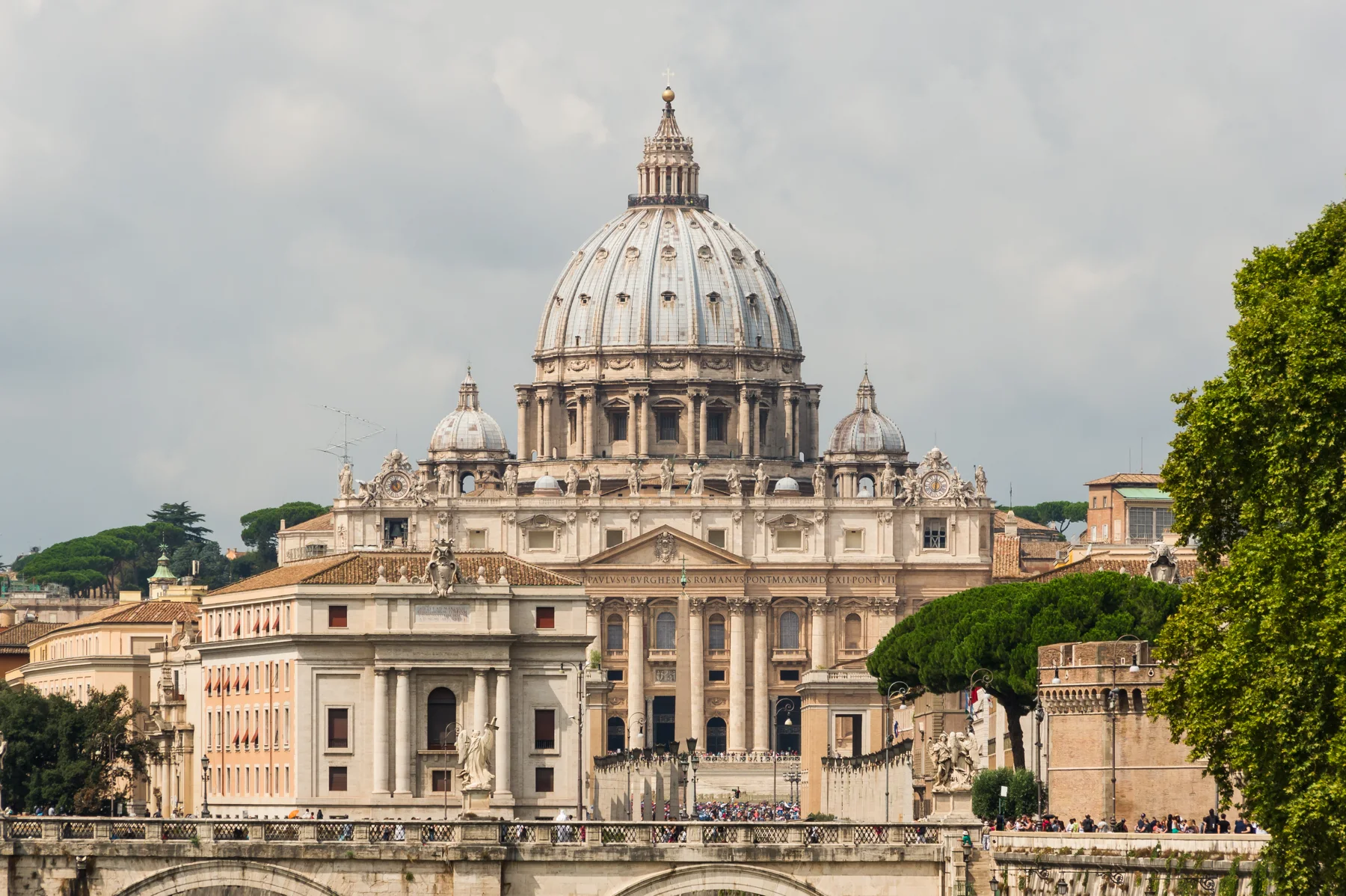
St. Peter's Basilica
Vatican CityWhy it belongs
The First Vatican Council sat in the north transept of the basilica in 1869 and 1870, and the basilica gathers the tombs of popes from many centuries. The journey would end here because the whole story, from the first centuries to the modern Church, is gathered under one roof.
What you would do there
The pilgrim would pray in the basilica where the council met and at the tombs of the popes, and could attend a public Mass where the schedule permits. It would be the place to give thanks for what St. John Paul II called "a wonderful harvest of holiness" and to pray, in his words, "Let us forgive and ask forgiveness."
Prayer and the sacraments
Mass would be sought in these historic churches where the schedule permits, and clergy arrangements are confirmed for each departure. The Nicene Creed could be prayed together at the Lateran or at St. Peter's, a short reading from the period could open each visit, and time would be kept for an examination of conscience and for Confession where confessors are available.
Pilgrim’s Time
History takes a while to settle, so Pilgrim's Time would be protected on this journey for going back alone to a tomb or a church already visited, for reading, or simply for rest. With a single base in Rome, an unscheduled afternoon could be spent a short walk from where the morning was prayed.
Pilgrim Pace
The days would be spent on foot in Rome's historic centre, with cobbles, steps and a good deal of standing, and with security queues and long walking inside St. Peter's. The lower levels of San Clemente are reached by stairs, so anyone unable to manage them would remain in the upper church, and that would need to be agreed beforehand.
How Pilgrim Pace worksIf you can stay longer
Trento, in the far north of Italy, could be added as a deliberate detour for those who want to pray where the Council of Trent met: its solemn sessions were held in the cathedral of St. Vigilius, and the general congregations of its last period in the nearby church of Santa Maria Maggiore. Both are Catholic churches a pilgrim can enter today, and Mass there would be sought where the schedule permits.
Other ways to make this pilgrimage
- The Rome & Assisi Classic, read as history. Its Rome days already include St. Peter's and the Vatican, St. John Lateran, St. Mary Major and St. Paul Outside the Walls, and a flexible afternoon could be given to San Clemente, the Gesù or the Chiesa Nuova, which are not on the sample route.
- Catholic beginnings in America. A domestic journey could pray at Mission Nombre de Dios in St. Augustine, Florida, the site associated with the Mass of thanksgiving of 8 September 1565, and then in Maryland at St. Clement's Island, St. Mary's City and the Baltimore Basilica.
- The popes away from Rome: Avignon and Siena. A journey could pair the Palace of the Popes at Avignon, a historic monument visited as such and not a shrine, with the Siena of St. Catherine and her tomb in Rome, telling the story of the papacy's absence and return.
No dated departures are currently announced. This is a journey Bold Pilgrim is considering, described so you can picture it. Dates, priest, Gateway Airport and price are published on a departure itself, and only when confirmed.
UNDERSTANDING THIS PILGRIMAGE
The faith reached you through real people in real places, one generation handing it to the next, and a Catholic history pilgrimage is a journey of prayer through those places: the cities of the Church's councils, the scenes of her crises and reforms, and the roads her missionaries took after the age of the Apostles. Rome is its centre; Trent, Avignon, Nicaea, England and the mission churches of the Americas and Asia are its further chapters. The pilgrim goes to pray in those places, to look at the whole record without fear, and to meet Jesus Christ, whom the Church calls the Lord of history.
The Catholic foundation: a faith that happened
The Catechism says that pilgrimages evoke our earthly journey toward heaven and are traditionally very special occasions for renewal in prayer (CCC 2691). A history pilgrimage adds one conviction to that: the Catholic faith is not a set of ideas that could have been worked out anywhere. It rests on things God did at particular times and in particular places, and it has been handed on since by real people in real cities. St. John Paul II put it in a sentence: "In Christianity time has a fundamental importance." In the same letter he calls Christ "the Lord of time" and "the Lord of history."
St. Bede the Venerable, the eighth-century monk of Wearmouth and Jarrow who is remembered above all as a historian, built his work on that claim. Benedict XVI recalled that for Bede "the true reference point, the centre of history, is the Birth of Christ," and that Bede's chronology, which reckons the years from the Incarnation, became the basis of the calendar the world now uses. Every date carved on a church wall quietly repeats what Bede believed.
The Second Vatican Council describes the Church herself as a pilgrim who, "like a stranger in a foreign land, presses forward amid the persecutions of the world and the consolations of God" (Lumen Gentium 8). A Catholic history pilgrimage is that sentence walked: you go to the places where the persecutions and the consolations happened, and you pray there as a member of the same Church.
The whole record, read honestly
The same paragraph of the Council says the Church is "at the same time holy and always in need of being purified." Both halves matter on this kind of pilgrimage. Leo XIII, writing in 1883 to three cardinals, among them the heads of the Vatican's library and archive, gave Catholic historians their rule: the first law of history is not to dare to say anything false, nor to keep silent about anything true.
St. John Paul II applied that rule to the Church's own past. "Acknowledging the weaknesses of the past is an act of honesty and courage," he wrote before the Great Jubilee, naming among other things intolerance and the use of violence in the service of truth. On the Day of Pardon in March 2000 he said, "Let us forgive and ask forgiveness," and in the same breath praised God for "a wonderful harvest of holiness" in the Church.
The theologians who prepared that day warned against two opposite mistakes: "an apologetics that seeks to justify everything and an unwarranted laying of blame." To understand what people did, they wrote, "we need therefore to enter into the world of those who did them." That is a fair description of what a pilgrim does at Avignon, at Walsingham or at a mission church in the Americas. You do not have to defend everything you see, and you do not have to be ashamed of everything either. You can tell the truth, give thanks for the saints, pray for the dead, and ask to be more faithful than you have been.
The chapters you can stand inside
The councils. In 325 the bishops gathered at Nicaea, now İznik in Türkiye, and professed the Son "consubstantial with the Father"; Pope Leo XIV took part in an ecumenical prayer service there in November 2025, near the excavated remains of an ancient basilica. Five councils between 1123 and 1517 take their name from the Lateran in Rome. The Council of Trent opened in the choir of Trento's cathedral in December 1545 and closed in 1563. The First Vatican Council sat in the north transept of St. Peter's Basilica from December 1869.
Crisis and reform. From 1309 the popes lived at Avignon, until St. Catherine of Siena, in Benedict XVI's words, "energetically and effectively urged" Gregory XI to return to Rome. Two centuries later Trent answered the Protestant Reformation by clarifying doctrine and reforming the clergy, and saints carried the reform out. St. Charles Borromeo entered Milan in 1565 as its first resident archbishop in eighty years and spent the rest of his life applying the council there through synods, visitations and seminaries. In Rome, St. Ignatius of Loyola is buried at the Gesù and St. Philip Neri at the Chiesa Nuova.
The missions. The relics of St. Francis Xavier are kept at the Basilica of Bom Jesus in Old Goa. In Florida, Mission Nombre de Dios marks the Mass of thanksgiving celebrated at St. Augustine on 8 September 1565; in Maryland, St. Clement's Island recalls a Mass celebrated there in 1634. The twenty-one California missions belong to this chapter too, and their history, including what it meant for Native Californians, needs a fuller account than this page gives. Tepeyac in Mexico City, the shrine of Our Lady of Guadalupe, belongs here as well.
The faith under pressure. The shrine of Our Lady at Walsingham in England was destroyed in 1538; today the Catholic National Shrine stands at the Slipper Chapel a mile outside the village, and a separate Anglican shrine stands in the village itself. Poland's twentieth century can still be walked in and around Kraków. The first Christian centuries, the Fathers, and the monasteries and cathedrals of Europe have pilgrimages of their own, described on separate pages; this one begins where they leave off and keeps the long view.
Why someone is drawn to it
Some people come to the faith, or come back to it, through history. St. John Henry Newman, whom Pope Leo XIV declared a Doctor of the Church in 2025, wrote while still an Anglican that "to be deep in history is to cease to be a Protestant." That was his own conclusion, reached through years of study, and many converts say something similar in their own words.
Others are lifelong Catholics who know the Creed by heart and have never been told where it was written, or why there was a Council of Trent, or how the faith reached their own country. Others again have been shaken by scandal, past or present, and want to know whether the Church can bear being looked at closely. This pilgrimage is for all three. It does not answer every objection, but it puts you in the rooms where the events took place, and that can change the questions you ask.
Questions pilgrims ask
What is a Catholic history pilgrimage?
It is a pilgrimage through the places where the Church's story was lived after the Apostles: where councils met, where the Church was reformed, where missionaries first said Mass. Rome is the centre; Trento, Avignon, Nicaea, England and the early Catholic sites of the Americas are further chapters. It differs from a history tour in its purpose. The pilgrim goes to pray, to see the Church's past truthfully, and to grow in faith in Jesus Christ, whom St. John Paul II called the Lord of history. The journeys described on this page are possibilities under consideration, not departures. No dated departures are currently announced.
Can I make a Church history pilgrimage without leaving Rome?
Yes, and it is the best place to begin. In one city you can go down through the levels of San Clemente, pray in the Pope's cathedral at the Lateran, visit the tombs of St. Ignatius of Loyola and St. Philip Neri, and pray in St. Peter's, where the First Vatican Council met. Trent, Avignon, Nicaea and the missions need journeys of their own.
Full answer: What are the must-see Catholic sites in Rome?
Which Church councils met in places a pilgrim can visit?
Several. Nicaea (325 and 787) is İznik in Türkiye, where the remains of an ancient basilica can be seen. Five councils from 1123 to 1517 are named for the Lateran in Rome. The Council of Trent (1545 to 1563) held its solemn sessions in the cathedral of Trento and the general congregations of its last period in the church of Santa Maria Maggiore there. The First Vatican Council (1869 to 1870) sat in the north transept of St. Peter's Basilica. Not every site is a working Catholic church, so check what can be visited and where Mass can be celebrated. Trento and Nicaea each have a fuller answer of their own.
What lies beneath the Basilica of San Clemente in Rome?
Three levels of Rome, one above another: the twelfth-century church entered from the street, the fourth-century basilica it replaced, and first-century Roman buildings, one of which became a shrine of Mithras. The relics of Pope St. Clement are venerated beneath the high altar, and St. Cyril, apostle of the Slavs, was buried here in 869.
Full answer: What is underneath the Basilica of San Clemente in Rome?
How should a Catholic pilgrim face the dark chapters of Church history?
Truthfully. The Second Vatican Council teaches that the Church is "at the same time holy and always in need of being purified." St. John Paul II wrote that acknowledging the weaknesses of the past "is an act of honesty and courage," and in 2000 he publicly asked God's pardon for the sins of the Church's members. The theologians who prepared that act warned against both an apologetics that justifies everything and unwarranted blame, and asked that people of the past be understood in their own world. A pilgrim can tell the truth, give thanks for the saints, and pray for mercy.
Where can I visit the saints of the Catholic Reformation in Rome?
At the Gesù, the mother church of the Jesuits, which keeps the tomb of St. Ignatius of Loyola; the rooms where he lived can also be visited. At the Chiesa Nuova (Santa Maria in Vallicella) the remains of St. Philip Neri lie in a chapel to the left of the main altar. St. Catherine of Siena, an earlier reformer, lies beneath the high altar of Santa Maria sopra Minerva, as Bold Pilgrim's answer on her relics explains. Pope Francis marked the fourth centenary of St. Ignatius's canonization at the Gesù in 2022. Visiting arrangements for the saints' rooms vary; check with each church.
Why did the popes live in Avignon, and is the Palace of the Popes a place of pilgrimage?
From 1309 Pope Clement V and his six successors lived at Avignon in southern France instead of Rome. The Catholic Encyclopedia attributes the choice to his attachment to France and to fear of disorder in Italy, and notes that it left the papacy exposed to the French crown. St. Catherine of Siena urged Gregory XI to return; he left in 1376 and entered Rome in January 1377. The palace, begun in 1335 according to the regional tourism board, is visited as a historic monument. It is not a shrine, so plan Mass and prayer in a church in the city.