THE JOURNEY
From Vilnius to Kraków: the Divine Mercy story, from the first image to St. Faustina's tomb
- Where
- Lithuania, Poland
- Length
- About eight to ten days
- Status
- Under consideration
The journey would begin in Vilnius, Lithuania, before the first Divine Mercy image, continue south to Płock, where St. Faustina recorded the vision asking for the image and the feast, and end in Kraków at the convent where she died and is buried. The order follows the map from north to south rather than the strict calendar, since Płock in 1931 came before her Vilnius years, but it lets the pilgrimage move from the image, to the request behind it, to the tomb and the confessionals of Łagiewniki. It would end where her life ended, with the longest and quietest days kept for last.
The route, and why each place belongs
- 1
Shrine of Divine Mercy, Vilnius
LithuaniaWhy it belongs
This is the home of the first Divine Mercy image, painted in the mid-1930s by Eugeniusz Kazimirowski under St. Faustina's direction and venerated here since 2005. Many pilgrims assume the original is in Kraków; it is here.
What you would do there
The pilgrim would pray before the first painting of the merciful Jesus, with time to stay in silence rather than only to look. It would be the natural place to pray the chaplet together for the first time on the journey.
- 2
House of St. Faustina and the Gate of Dawn, Vilnius
LithuaniaWhy it belongs
St. Faustina lived in Vilnius from 1933 to 1936 and met her confessor, Bl. Michael Sopoćko, there. The Sisters date the chaplet to the small convent house in September 1935, and the image was first shown publicly at the Gate of Dawn, the city's Marian shrine, on the Sunday after Easter 1935.
What you would do there
A walk through the old town could link the convent house and the Marian gate, with passages of the Diary read in the city where they were written. At the Gate of Dawn the pilgrim could entrust the journey to the Mother of Mercy.
- 3
Shrine of Divine Mercy, Old Market Square, Płock
PolandWhy it belongs
In the convent on this square, on 22 February 1931, St. Faustina recorded the vision in which she was asked to have the image painted and the feast kept. It is the starting point of the devotion, received by the Church as private revelation.
What you would do there
The pilgrim would pray at the convent site, now a shrine, and could keep a time of Adoration there. A new church at the shrine was still being completed when this page was researched, so what is open would be confirmed before any itinerary.
- 4
Divine Mercy Sanctuary, Kraków-Łagiewniki
PolandWhy it belongs
St. Faustina spent her last years in this convent and died here on 5 October 1938. Her remains rest in the convent chapel, and beside it stands the basilica that St. John Paul II dedicated on 17 August 2002, the day he entrusted the world to Divine Mercy.
What you would do there
The pilgrim would kneel at the tomb, a small white marble coffin beneath the side altar that holds Adolf Hyła's painting of the merciful Jesus, and would return more than once across several days. Those days would hold Confession where confessors are available, the chaplet and silent prayer at the Hour of Mercy, the hour of the Lord's death, and time in the basilica.
- 5
Sanctuary of St. John Paul II, Kraków
PolandWhy it belongs
It stands a short walk from the Łagiewniki convent. St. John Paul II canonized St. Faustina, named Divine Mercy Sunday for the whole Church, and recalled in 2002 that as a young man he worked at the Solvay factory nearby and used to come to the convent.
What you would do there
An afternoon visit on foot from Łagiewniki would let the pilgrim hold the saint of the Diary and the pope of mercy together, and give thanks for the feast he gave the Church before the journey closes.
Prayer and the sacraments
Mass would be sought at the shrines where the schedule permits, and clergy arrangements are confirmed for each departure. Confession, which the Diary calls the "tribunal of mercy," would be given real room at Łagiewniki where confessors are available, alongside the chaplet, a pause at the Hour of Mercy, Adoration in the shrines' chapels and silence before the image.
Pilgrim’s Time
Pilgrim's Time would be protected above all at Łagiewniki, so that each person could go back alone to the tomb, wait in a confession line without watching a clock, or sit with the Diary. In Vilnius it could simply mean returning to the first image a second time.
Pilgrim Pace
The Łagiewniki complex is large but mostly level, with some stairs and slopes between the convent chapel and the basilica, and the old towns of Vilnius and Kraków mean cobblestones underfoot. Linking Vilnius, Płock and Kraków involves several long days of road or rail travel, so the days between cities would need to be kept light.
How Pilgrim Pace worksIf you can stay longer
An extra day or two in Kraków at the end, with nothing arranged, could give time to rest after the long transfers and to return once more to Łagiewniki before going home.
Other ways to make this pilgrimage
- Kraków as a single base. A shorter pilgrimage could stay in Kraków throughout, with unhurried repeat visits to Łagiewniki and the neighbouring Sanctuary of St. John Paul II, and a day in Wadowice.
- Divine Mercy Sunday at Łagiewniki. A journey could be built around the novena and the feast on the Second Sunday of Easter, with realistic planning for very large crowds and long standing, since feast programmes change each year and would be verified with the shrine.
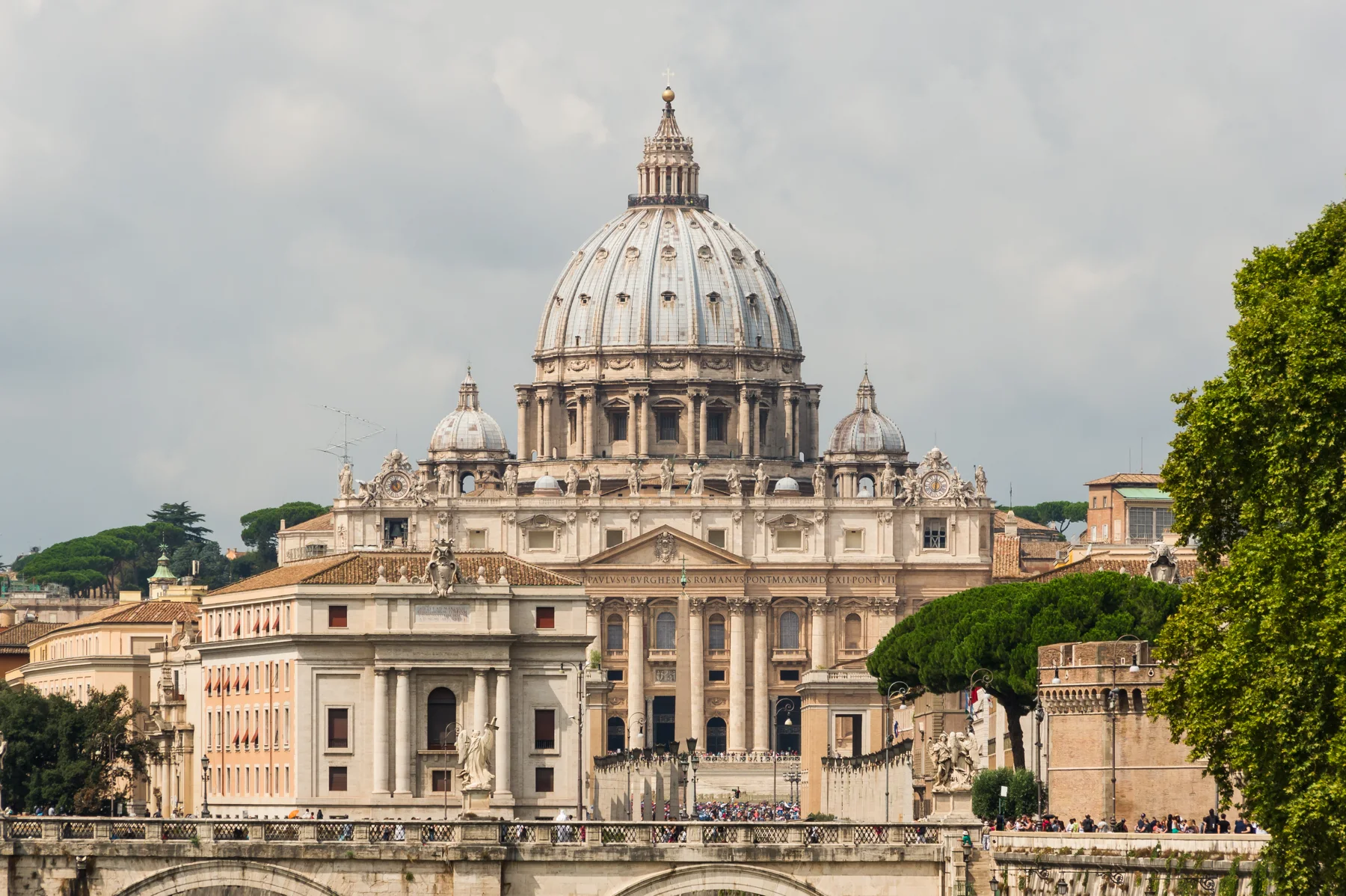
- The Divine Mercy thread in Rome. The Classic Rome & Assisi pilgrimage is not a Divine Mercy itinerary, but its Rome days include St. Peter's and an open afternoon, and Santo Spirito in Sassia, Rome's center of Divine Mercy spirituality, is a short walk away for a visit in free time.
No dated departures are currently announced. This is a journey Bold Pilgrim is considering, described so you can picture it. Dates, priest, Gateway Airport and price are published on a departure itself, and only when confirmed.
UNDERSTANDING THIS PILGRIMAGE
The Gospel's answer is that God's mercy is offered to everyone who turns to Him, and a Divine Mercy pilgrimage goes to learn that trust in the places tied to the message St. Faustina Kowalska recorded in her Diary in the 1930s: above all the Divine Mercy Sanctuary at Kraków-Łagiewniki, where she is buried, and often Płock and Vilnius, where the image and the chaplet began. Pilgrims go to pray before the image inscribed "Jesus, I trust in You," to go to Confession, to receive the Eucharist, and to pray at three in the afternoon, the hour of Christ's death. Its purpose is not to collect sites but to come home trusting Jesus more and showing more mercy to others.
What a Divine Mercy pilgrimage means
A Divine Mercy pilgrimage is for learning to trust Jesus. It goes to the places where the message of His mercy was entrusted to St. Faustina Kowalska, and it seeks that mercy where the Church gives it, in Confession and the Eucharist. The prayer on the image, "Jesus, I trust in You," is the whole purpose in five words.
Why someone is drawn to it
Most people who look for a Divine Mercy pilgrimage are not looking for a tour of Poland. They pray the chaplet, or they keep an image of the merciful Jesus at home, or they read the Diary during a hard year and want to stand where it was written. Others come because of St. John Paul II, who said at Łagiewniki in 1997 that this message had always been near and dear to him and in a sense formed the image of his pontificate.
And some come because trust is exactly what they find difficult. They believe God forgives in general and doubt that He forgives them. The devotion answers with five words rather than an argument: Jesus, I trust in You. A pilgrimage gives those words a place, a tomb, a confessional and several unhurried days.
The Catholic foundation: mercy is the Gospel, not a new message
The mercy of God is public revelation. It runs from the Psalms to the parable of the prodigal son to the pierced side of Christ on the Cross. St. John Paul II opened his 1980 encyclical Dives in Misericordia with St. Paul's phrase "God, who is rich in mercy," and Pope Francis began the Jubilee of Mercy with the sentence "Jesus Christ is the face of the Father's mercy." A Divine Mercy pilgrimage stands on that ground first.
The particular form of the devotion comes from St. Faustina Kowalska (1905–1938), a sister of the Congregation of the Sisters of Our Lady of Mercy who lived in convents in Warsaw, Płock, Vilnius and Kraków. Her Diary records what she understood as Christ's requests: an image with the words "Jesus, I trust in You," a feast on the Sunday after Easter, a chaplet, prayer at the hour of His death, and mercy shown in deeds. These are private revelation. The Catechism (n. 67) says that such revelations "do not belong, however, to the deposit of faith"; their role is to help the faithful live the Gospel more fully in a particular period of history.
The Church has received this devotion in stages. A 1959 notification of the Holy Office placed prohibitions on it; in 1978 the Congregation for the Doctrine of the Faith declared those prohibitions no longer binding. Faustina was beatified in 1993 and canonized on 30 April 2000, when John Paul II announced that the Second Sunday of Easter would from then on be called Divine Mercy Sunday throughout the Church. In the same homily he said the message of mercy "is not a new message." That is the key for a pilgrim: the devotion leads back to the Gospel.
The places that authentically serve it
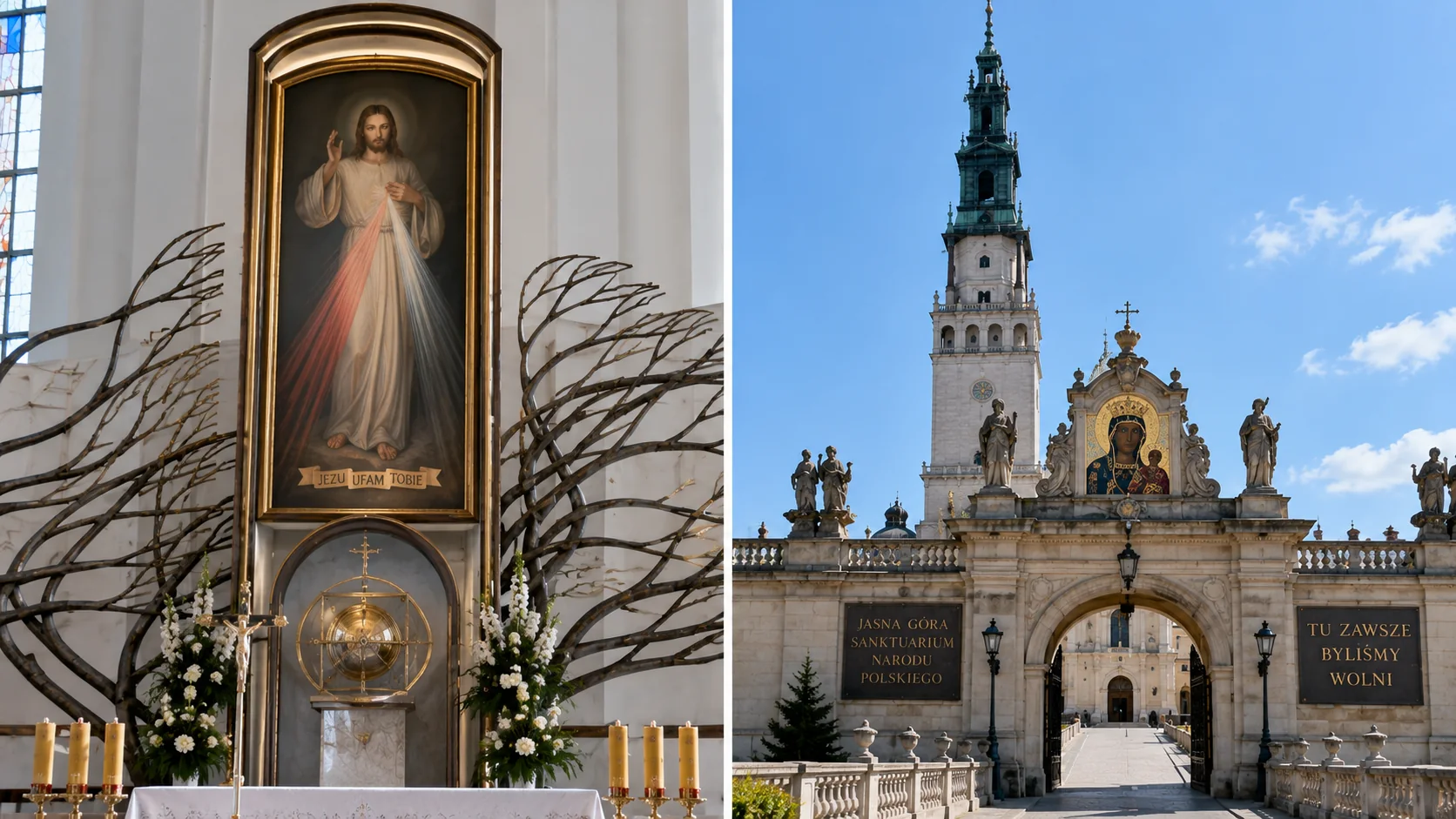
Kraków-Łagiewniki is the center. Faustina spent her last years in the convent there and died in it on 5 October 1938. Her remains rest in the convent chapel, in a small white marble coffin beneath the side altar that holds Adolf Hyła's painting of the merciful Jesus. Beside the convent stands the modern basilica that John Paul II dedicated on 17 August 2002, the day he entrusted the world to Divine Mercy, and a short walk away is the Sanctuary of St. John Paul II.
Two other cities belong to the story. In Płock, on 22 February 1931, Faustina recorded the vision in which she was asked to have the image painted; the convent site on the Old Market Square is now a shrine. In Vilnius, Lithuania, where she lived from 1933 to 1936 and met her confessor, Bl. Michael Sopoćko, the first image was painted by Eugeniusz Kazimirowski under her direction, and the Sisters date the chaplet to September 1935. That first painting is venerated today in the Shrine of Divine Mercy in Vilnius. Many pilgrims assume the original is in Kraków. It is not, and a serious Divine Mercy pilgrimage is honest about the difference.
In Rome, the church of Santo Spirito in Sassia, a short walk from St. Peter's, has been a center of Divine Mercy spirituality since 1994. For Americans who cannot cross the ocean, the National Shrine of The Divine Mercy in Stockbridge, Massachusetts, is a place of pilgrimage for the same devotion.
Where it all points
The image shows the risen Christ with one hand raised in blessing and the other at His heart, from which two rays come; John Paul II, citing the Diary, said they represent blood and water. That is the Gospel of the Second Sunday of Easter in one picture: Jesus standing among frightened disciples, showing His wounds, breathing peace, and giving the Church the power to forgive sins. A Divine Mercy pilgrimage is finally a pilgrimage to Him. St. Faustina, St. John Paul II and the Mother of Mercy are companions on the road, not its destination.
Questions pilgrims ask
What is a Divine Mercy pilgrimage?
A Divine Mercy pilgrimage is a journey to the places connected with the message of God's mercy recorded by St. Faustina Kowalska: chiefly the Divine Mercy Sanctuary at Kraków-Łagiewniki, where she is buried, and often Płock and Vilnius. Pilgrims pray before the image inscribed "Jesus, I trust in You," go to Confession, receive the Eucharist and pray at the hour of Christ's death. The aim is deeper trust in Jesus and a more merciful life, not a list of sites.
Where is St. Faustina buried?
St. Faustina is buried in the convent chapel of the Sisters of Our Lady of Mercy at Kraków-Łagiewniki, now part of the Divine Mercy Sanctuary, not in the modern basilica beside it. Her remains rest in a small white marble coffin beneath the side altar that holds Adolf Hyła's painting of the merciful Jesus.
Is the Divine Mercy image in Kraków the original?
No. The first image was painted in Vilnius in the mid-1930s by Eugeniusz Kazimirowski under St. Faustina's direction, and it is venerated today in the Shrine of Divine Mercy in Vilnius, Lithuania. The painting over her tomb at Kraków-Łagiewniki is a later work by Adolf Hyła, blessed in 1944, and is the version most widely reproduced.
Full answer: Where is the original Divine Mercy image?
Is the Divine Mercy devotion approved by the Catholic Church?
Yes. In 1978 the Congregation for the Doctrine of the Faith declared the prohibitions of a 1959 Holy Office notification no longer binding; St. Faustina was canonized in 2000, when St. John Paul II named the Second Sunday of Easter Divine Mercy Sunday. Her Diary remains private revelation, which the Catechism (n. 67) says does not belong to the deposit of faith.
Full answer: Is the Divine Mercy devotion approved by the Catholic Church?
What was the connection between St. Faustina and St. John Paul II?
They never met; Faustina died in 1938, when Karol Wojtyła was eighteen. During the occupation he worked at the Solvay plant near Łagiewniki and, as he recalled in 2002, used to come to the convent then. As Archbishop of Kraków he saw the diocesan stage of her cause concluded in 1967. As pope he wrote Dives in Misericordia (1980), beatified her in 1993, canonized her in 2000, named Divine Mercy Sunday, and in 2002 dedicated the Łagiewniki basilica and entrusted the world to Divine Mercy. He died on the vigil of that feast, 2 April 2005.
What happens in Kraków on Divine Mercy Sunday?
Divine Mercy Sunday is the Second Sunday of Easter, and the sanctuary at Łagiewniki, the devotion's principal shrine, draws very large crowds for it. In recent years the celebration has included a night vigil, a principal Mass at an outdoor altar and confessions in several languages. Programmes change each year, so check the sanctuary's own announcement before planning, and expect crowds, standing and slow movement.
Is a Divine Mercy pilgrimage right for someone who struggles with forgiveness?
It can be, with honest expectations. The whole devotion is addressed to people who doubt that mercy reaches them, and its center is Confession, the sacrament of forgiveness, which the Diary calls the "tribunal of mercy." A pilgrimage gives time, a place and the sacrament; it does not produce a feeling on demand, and forgiving another person is often slow work that continues at home. No one can promise what you will experience. What can be said is that you will not be the only one there carrying something.
How is Divine Mercy different from devotion to the Sacred Heart?
They honour the same love of Christ from different angles. As the Sisters of Our Lady of Mercy explain it, devotion to the Sacred Heart is centered on reparation and is marked by First Fridays and the feast of the Sacred Heart, while the Divine Mercy devotion is centered on trust and is marked by prayer at the hour of Christ's death and the feast on the Sunday after Easter. Their home places differ too: Paray-le-Monial in France for the Sacred Heart; Kraków, Płock and Vilnius for Divine Mercy.