THE JOURNEY
The Road Home: St. Monica and St. Peter in Rome, then a Slow Week in Assisi
- Where
- Italy, Vatican City
- Length
- About nine or ten days
- Status
- Under consideration
This journey would open with a short stay in Rome and then settle in Assisi for the rest of the time: two bases, one move. Rome would come first because it holds the two tombs that speak most directly to someone coming back, St. Monica's at Sant'Agostino and St. Peter's beneath his basilica, and because its basilicas have confessors for pilgrims who have never seen you before. Assisi would come second and last longer, because after the city a returning Catholic often needs quiet more than sights. The order moves from being prayed for, to being restored, to starting over, and then leaves room for all of it to settle before the journey home.
The route, and why each place belongs
- 1
Rome: the Basilica of Sant'Agostino and the tomb of St. Monica
ItalyWhy it belongs
St. Monica prayed for years for her son Augustine, and a bishop told her that "the son of so many tears could not perish." She died at Ostia, and her relics were moved to Rome in the 1400s; parents still come to her tomb to pray for children who have left the Church.
What you would do there
A short walk from Piazza Navona, the journey would begin in a church small enough to sit in quietly on a first day. Those who are coming back could pray here for whoever has prayed for them, since it may well be that somebody has; those making the pilgrimage for a son, a daughter or a spouse would find this is their place.
- 2
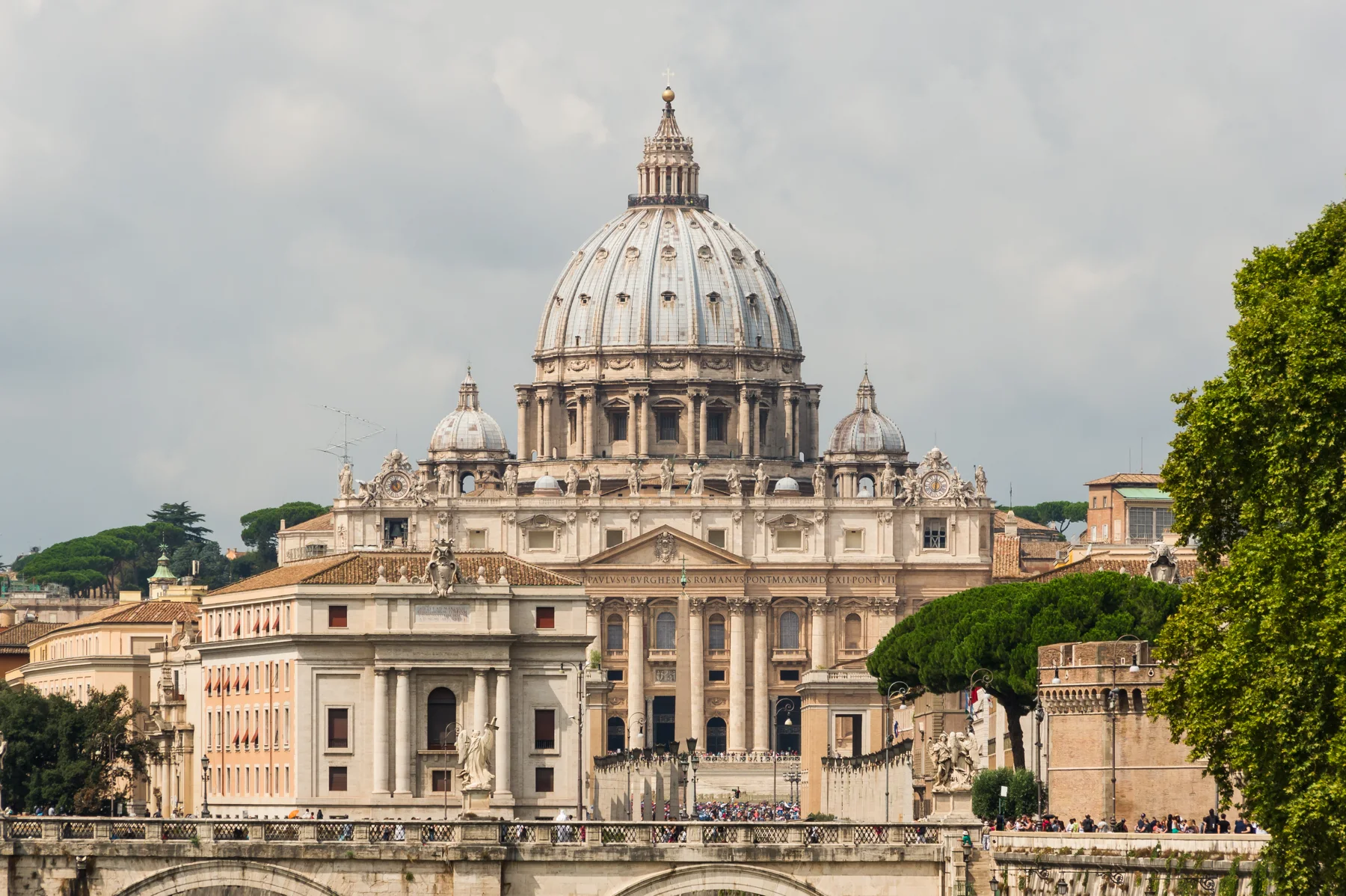
St. Peter's Basilica
Vatican CityWhy it belongs
St. Peter denied knowing Christ three times, wept, and was asked three times by the risen Lord whether he loved Him. The Catechism gives him as the example of the conversion of someone who was already a disciple (CCC 1429), and his tomb is under the basilica that bears his name.
What you would do there
A basilica visit with protected prayer time near the Apostle's tomb, and a public Mass you could simply attend if the schedule permits. The basilica has confessors for pilgrims in several languages, as do the other papal basilicas of Rome; current arrangements would be checked, and the time would be there for anyone who wants it and for no one who does not.
- 3
Assisi: the Sanctuary of the Renunciation (Santa Maria Maggiore)
ItalyWhy it belongs
This church marks the place where the young St. Francis is said to have cast off his rich clothes and begun again. St. Carlo Acutis, who died in 2006 and for whom frequent Confession was an essential practice, rests here; his own mother has said she started going back to Mass because of him.
What you would do there
After the transfer into Umbria and a slow first evening, this would be the first church of the Assisi days: an old beginning and a very recent one in a single building. Pilgrims would pray where Francis is said to have started over and at the tomb of St. Carlo, who was not a Franciscan but is venerated in the town he loved, and could come back alone on later days.
- 4
Assisi: the town of St. Francis, from the basilicas on the hill to the Porziuncola in the valley
ItalyWhy it belongs
St. Francis was a baptized young man of ordinary worldly ambitions who started over completely in his mid-twenties, and Assisi is the town where that happened. Staying here for several days, and not passing through, is the point of this part of the journey.
What you would do there
The days would be spread thinly on purpose: the Basilica of St. Francis and the Basilica of St. Clare on one day, with space for prayer; Santa Maria degli Angeli and the Porziuncola in the valley on another; and whole mornings or afternoons with nothing planned. There would be time to sit in a church with no one expecting anything, to pray a Rosary half remembered, and to read Luke 15 slowly.
Prayer and the sacraments
Mass would be sought where the schedule permits, and anyone could simply be present; clergy arrangements are confirmed for each departure. Confession would never be pressed: time would be left open in Rome and in Assisi where confessors are available, with a confessor of your own choosing, when you are ready and not before. The Rosary and silent prayer before the Blessed Sacrament could be shared with others where a church offers them, as an easy way back into praying alongside other people.
Pilgrim’s Time
Pilgrim's Time, protected free time with nothing scheduled, would be the larger part of the Assisi days and would follow each basilica visit in Rome. On this journey it could be used to rest, to return alone to a tomb, to have a conversation with a priest where one is available, or to decide before leaving which parish the first Sunday home would be spent in.
Pilgrim Pace
Central Rome and the basilicas involve city walking, security lines and standing. Assisi is a steep hill town with cobbled lanes and some steps, and the valley basilica needs a short local transfer; with one hotel change and many open half-days, the route would leave room to go slowly.
How Pilgrim Pace worksIf you can stay longer
Those who want to follow St. Monica's story further could take a quiet half-day from Rome to Ostia Antica, the ancient port where she died while waiting with Augustine for a ship home to Africa. The exact house is not identified.
Other ways to make this pilgrimage
- The Rome & Assisi Classic. The Classic journey already visits St. Peter's with protected prayer time, the other papal basilicas and Assisi from two bases, and its free afternoons would leave room for St. Monica's tomb and the Sanctuary of the Renunciation.
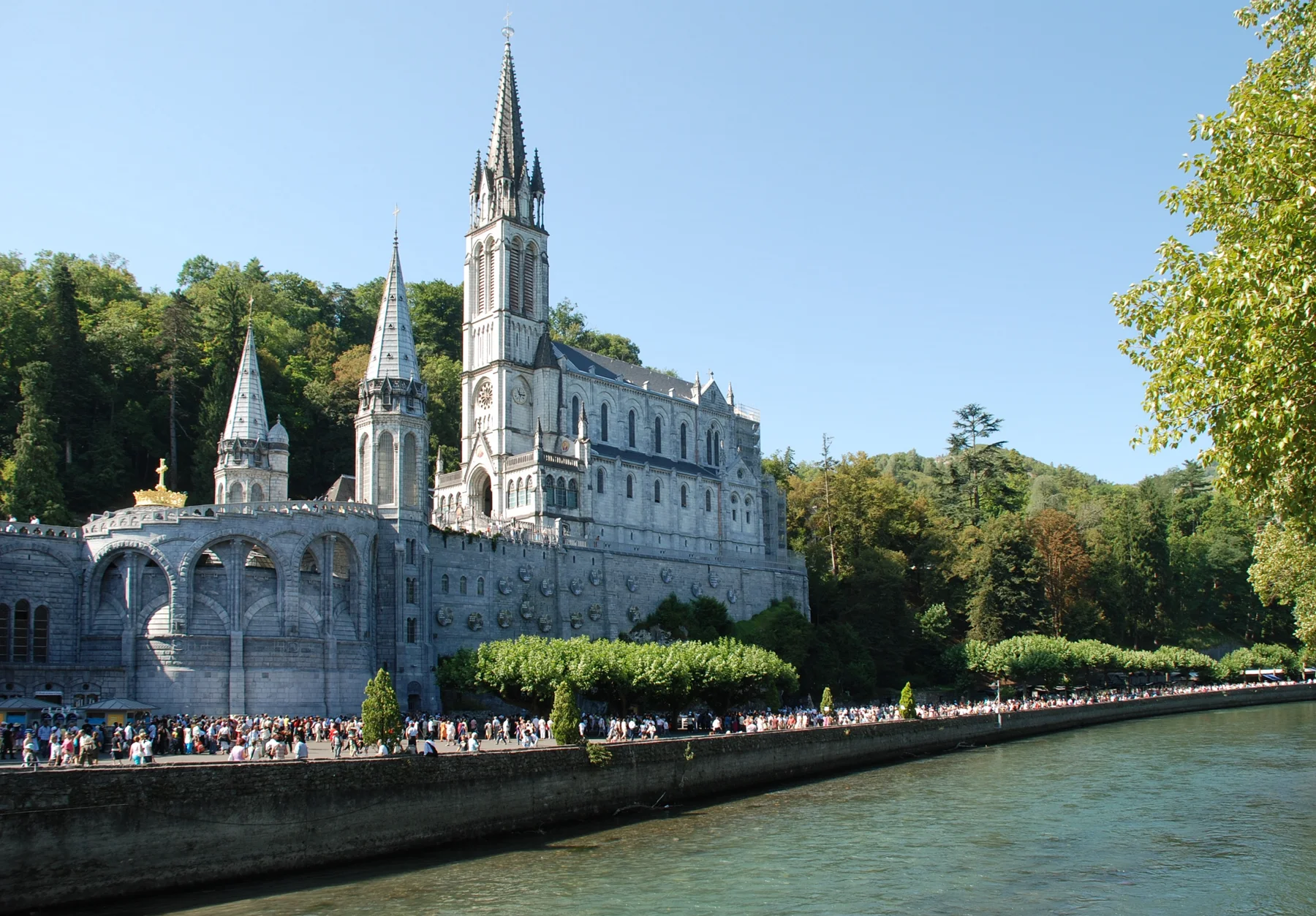
- Lourdes. On the Fatima & Lourdes Classic, the Lourdes days leave time for the Grotto and reflection in a sanctuary whose chaplains are available for Confession in its Chapel of Reconciliation, and which says itself that "penance is not about going on a guilt-trip."
- Mercy in Kraków. A journey to the Shrine of Divine Mercy at Kraków-Łagiewniki, dedicated by St. John Paul II in 2002, could serve someone who needs to hear that it is not too late, and would be shaped together with the Divine Mercy pilgrimage.
No dated departures are currently announced. This is a journey Bold Pilgrim is considering, described so you can picture it. Dates, priest, Gateway Airport and price are published on a departure itself, and only when confirmed.
UNDERSTANDING THIS PILGRIMAGE
Yes, you can start here: a Return to the Faith pilgrimage is a Catholic pilgrimage made by someone who was baptized Catholic, has been away from Mass and the sacraments for a long time, and wants to come back. It is built around the things a returning Catholic needs most: Mass you may simply attend, time for Confession at shrines where confessors are available, when you are ready, and time in places where other people started over. You do not have to be practicing to make one; you only have to be willing to begin.
The Catholic foundation: the road home is already in the Gospel
The Church did not have to invent a theology for people who come back. Jesus gave it in the parable of the lost son: the son rehearses a speech about no longer deserving to be called a son, and "while he was still a long way off, his father caught sight of him, and was filled with compassion. He ran to his son" (Luke 15:20). The Catechism reads the parable as the pattern of every return, with the merciful father at its center (CCC 1439), and it describes repentance as "a return, a conversion to God with all our heart" (CCC 1431).
Two points of doctrine matter to anyone who has been away. First, your Baptism has not been undone. Baptism leaves an indelible mark, and the Catechism says plainly that "no sin can erase this mark" (CCC 1272). Second, the wish to come back is not something you produced alone. "Conversion is first of all a work of the grace of God who makes our hearts return to him," and "God gives us the strength to begin anew" (CCC 1432). The desire that brought you to this page is already part of the return.
Pilgrimage has long been one of the ways the Church expresses that turning. The Catechism lists pilgrimages among the signs of penance (CCC 1438). The Holy See's 1998 document on pilgrimage says that a pilgrimage to a shrine "must be an itinerary of conversion" and calls the shrine "the tent of meeting in reconciliation," where the pilgrim repeats the experience of the prodigal son and knows "the joy of the embrace of the Father, rich in mercy." Pope Francis put the same thing in a sentence: "whenever we take a step towards Jesus, we come to realize that he is already there, waiting for us with open arms" (Evangelii Gaudium 3).
Why people who have been away are drawn to pilgrimage
Walking back into your own parish after fifteen years can feel like walking into a room where everyone knows how long you have been gone. A pilgrimage removes that. At a large shrine nobody knows you, nobody is counting, and the priest in the confessional has never seen you before and is unlikely to see you again. Church law in fact protects that freedom: every Catholic may confess to any approved confessor of his or her choice (canon 991), and what is said there is under an inviolable seal (canon 983).
A journey also gives the return a shape. Most people who drift from the Church did not decide to leave on a particular day, and so there is no obvious day to come back. A pilgrimage supplies one. It has a setting out, a destination and a way home, and it puts several days between you and the routines that made it easy not to think about any of this.
People leave for many reasons: indifference, a move, a marriage, a death, a disagreement, or real harm done by someone in the Church. Nothing on this page assumes which is yours, and none of them has to be settled before you go. If you were hurt, that deserves to be heard by a priest or someone you trust, at your own pace. A pilgrimage does not ask you to pretend it did not happen.
The saints who make sense here
St. Peter denied knowing Christ three times, wept, and was asked three times by the risen Lord whether he loved Him. The Catechism gives him as the example of the conversion of someone already a disciple (CCC 1429). His tomb is under the basilica that bears his name.
Others lost the faith outright and came back. St. Charles de Foucauld lost the faith of his childhood as a young man in military training, was sent by a cousin to a priest who invited him to go to Confession and then receive Communion, and afterward went as a pilgrim to the Holy Land. St. Bartolo Longo gave up the Catholic faith as a law student in Naples, drawn into spiritism, was helped back by a professor and a Dominican priest, and went on to found the Shrine of Our Lady of the Rosary at Pompeii.
Then there is the one who waited. St. Monica prayed for her son Augustine for years; a bishop told her that "the son of so many tears could not perish." Benedict XVI said she is considered the model and patroness of Christian mothers. Her tomb is in the Basilica of Sant'Agostino in Rome, and parents still go there to pray for children who have left. If you are the one coming back, her presence on this page says something simple: it may well be that somebody has been praying for you.
If the saints seem to belong to another age, St. Carlo Acutis is a correction. He was born in 1991, died in 2006, went to Mass daily, and was canonized on 7 September 2025; Pope Leo XIV, in the canonization homily, named frequent Confession as an essential practice for him and for St. Pier Giorgio Frassati. His mother has said she was "not the ideal model of a Catholic mother" and that she started going back to Mass because of her son. He rests at the Sanctuary of the Renunciation (Santa Maria Maggiore) in Assisi, the church that marks the place where St. Francis is said to have cast off his rich clothes and started again.
What a pilgrimage cannot do, and what comes after
A pilgrimage does not forgive sins and does not replace the sacraments. Canon law names individual confession and absolution as the ordinary means by which a Catholic conscious of grave sin is reconciled with God and the Church (canon 960), and a pilgrimage is one good road to it. What returning involves in your own case is something a priest can tell you; ask him.
The real test is the first ordinary Sunday at home. A return that began at a shrine is completed in a parish, with Sunday Mass, Confession from time to time, and people who know your name. It helps to decide before you leave which parish that will be. Everything on a pilgrimage of this kind points past the shrine to the One who is found there and at home alike: Jesus Christ, who told this story about a father running down the road so that no one would be afraid to come back.
Questions pilgrims ask
What is a Return to the Faith pilgrimage?
It is a Catholic pilgrimage for someone who was baptized Catholic, has been away from Mass and the sacraments for a long time, and wants to come back. It is not a separate program or a ceremony. It is an ordinary pilgrimage chosen for that purpose: Mass you can attend without pressure, time for Confession at shrines where confessors are available, time for prayer, and the company of saints such as St. Peter and St. Monica whose stories are about returning. The Catechism calls repentance "a return, a conversion to God with all our heart" (CCC 1431).
Can I go on a Catholic pilgrimage if I haven't been to Mass in years?
Yes. No shrine checks whether you are practicing, and the Catechism lists pilgrimages among the Church's signs of penance, the turning back to God (CCC 1438). You may attend every Mass. Receiving Communion is a separate matter, on which the Catechism speaks directly: anyone aware of having committed a mortal sin must not receive Holy Communion without first receiving sacramental absolution, unless there is a grave reason and no possibility of going to Confession (CCC 1457), and those who deliberately fail in the Sunday obligation "commit a grave sin" unless excused for a serious reason (CCC 2181). This page cannot say how that applies to you; a priest can, and it is a good first conversation to have. The father in the parable ran to his son "while he was still a long way off" (Luke 15:20).
Am I still Catholic if I stopped practicing years ago?
The Catechism's answer is that Baptism cannot be undone. It teaches that Baptism seals a person with an indelible spiritual mark of belonging to Christ, and it says: "No sin can erase this mark" (CCC 1272). Years away from Mass do not cancel it. What coming back involves in practice depends on your own history, for example whether you were confirmed or whether you formally joined another religious community, so tell a priest how things stand and he will explain the way from there.
How do I go to Confession after many years away?
The U.S. bishops' guide to the sacrament speaks to exactly this: for those who have not been in a long time, "we are ready to welcome you," and "If you are unsure what to say, ask the priest for help." What the Church asks is set out in canon law: a Catholic is to confess "in kind and number all grave sins" of which he or she is aware "after diligent examination of conscience" (canon 988 §1). The same law lets you go to an approved confessor "of his or her choice" (canon 991) and holds the seal of Confession inviolable (canon 983 §1). For anything beyond that, the simplest course is the one the bishops give: tell the priest how long it has been and ask him to help you.
Can I attend Mass without receiving Communion?
Yes. Anyone may attend Mass, and no one is obliged to come forward at Communion. The U.S. bishops' Guidelines for the Reception of Communion encourage those who are not receiving "to express in their hearts a prayerful desire for unity with the Lord Jesus and with one another." The same Guidelines ask that a Catholic who receives not be conscious of grave sin, and canon 916 says that a person conscious of grave sin is not to receive the Body of the Lord without previous sacramental confession, unless there is a grave reason and no opportunity to confess. If you are unsure where you stand, ask a priest; it is an ordinary question and he will be glad to answer it.
Will I be judged for having been away?
The fear is reasonable, and the Church's own texts speak to it. The U.S. bishops' guide to Confession tells Catholics who have been away a long time, "we are ready to welcome you." The Catechism puts the merciful father at the center of the parable of every return (CCC 1439): he saw his son "while he was still a long way off" and "ran to his son" (Luke 15:20). Church law lets every Catholic confess to an approved confessor "of his or her choice" (canon 991) and holds the seal of Confession inviolable (canon 983 §1). No one on a pilgrimage needs to know your reasons for coming; if you would like to tell someone, a priest is a good person to tell.
What if I left because I was hurt or angry at the Church?
Then your reasons deserve to be taken seriously, not argued away. Many Catholics stay away because of something that was done or said to them by a person in the Church, and some of those wrongs were grave. You do not have to have resolved it, or stopped being angry, in order to make a pilgrimage or to go to Mass. When you are ready, say it plainly to a priest or to someone you trust. Pope Francis described the Church as called to be "the house of the Father, with doors always wide open," where "there is a place for everyone, with all their problems" (Evangelii Gaudium 47).
Where can I pray for a son or daughter who has left the Church?
Anywhere, but the place most associated with that prayer is the tomb of St. Monica in the Basilica of Sant'Agostino in Rome. She prayed for years for her son Augustine, and Benedict XVI said she invites mothers anguished over their children's paths "not to lose heart." The Church promises no particular outcome of such a prayer.
Full answer: Where is St. Monica's tomb in Rome?