THE JOURNEY
Holy Week in Rome: Palm Sunday, the Triduum and Easter Morning
- Where
- Italy, Vatican City
- Length
- About eight or nine days
- Status
- Under consideration
This journey would stay in one city and follow the days of the liturgy instead of a list of sights. It would begin in Rome before Palm Sunday, keep the first days of Holy Week quietly among the churches of the Lateran quarter, and then give itself wholly to the Triduum: the Mass of the Lord's Supper and the night watch on Holy Thursday, the Cross on Good Friday, the silence of Holy Saturday, the Easter Vigil, and Easter morning in St. Peter's Square. The order is the Church's own, so each day would be planned around one liturgy in a church where the pilgrim can actually take part, with the Way of the Cross and the holy places gathered around it. The Pope's liturgies would be joined only where tickets and the calendar allow, since the arrangements are announced year by year.
The route, and why each place belongs
- 1
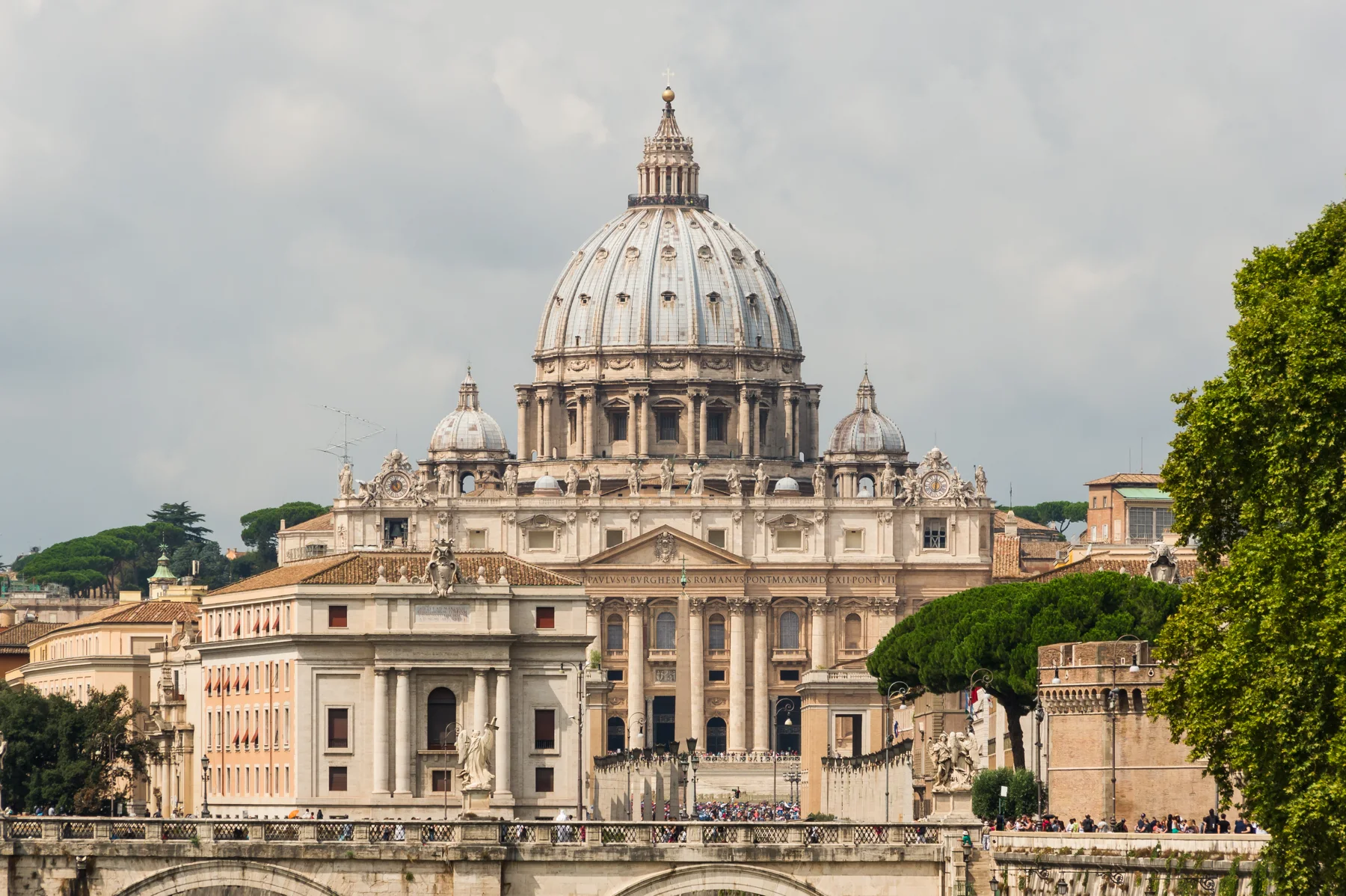
Palm Sunday: St. Peter's Square
Vatican CityWhy it belongs
Holy Week opens with the Lord's entry into Jerusalem and the first reading of the Passion, and St. Peter's Square is the usual setting for the Pope's Palm Sunday Mass. Where each papal liturgy is held, and how access works, is announced each year.
What you would do there
The pilgrim would stand in the Square with a palm or olive branch for the procession and the Passion, where the calendar allows. In 2026 this Mass needed no ticket, though no year can be assumed from another, and it would mean a long morning on your feet in a very large crowd.
- 2
Monday to Wednesday of Holy Week: St. John Lateran, the Holy Stairs and the station churches
ItalyWhy it belongs
These quieter days prepare for the Triduum. St. John Lateran is the Pope's cathedral and the traditional station church for Palm Sunday, Holy Thursday and Holy Saturday, and Rome's old custom of praying each day at a designated station church runs through Holy Week.
What you would do there
The pilgrim would pray at the Lateran and could climb the Holy Stairs on the knees in memory of the Passion; pious tradition holds them to be the steps of Pilate's praetorium, which is not a historical certainty. The English-language station Mass of the Pontifical North American College could be joined on these weekdays, and Confession would be sought before the Triduum where confessors are available.
- 3
Holy Thursday: the Mass of the Lord's Supper and the altars of repose
ItalyWhy it belongs
The Triduum begins with the evening Mass of the Lord's Supper, and from that moment Holy Thursday, Good Friday and the Easter Vigil are one act of worship spread across three days.
What you would do there
The pilgrim would attend the Mass of the Lord's Supper in a parish or an English-speaking church chosen in advance, then go on foot through the night streets from church to church to keep watch in adoration at the altars of repose, a common practice in Rome. In 2026 the Pope celebrated this Mass at the Lateran and tickets were very scarce, so it would not be the plan.
- 4
Good Friday: Santa Croce in Gerusalemme and the Colosseum
ItalyWhy it belongs
Santa Croce is the Good Friday station church, built in the palace of St. Helena to hold relics of the Passion that are venerated by long tradition, though the Church has made no formal declaration that the individual objects are authentic. The Pope customarily leads the Way of the Cross at the Colosseum on the evening of Good Friday.
What you would do there
The day would be kept as a fast. The pilgrim would take part in the celebration of the Lord's Passion and venerate the Cross, at Santa Croce or in the church chosen for the Triduum, and in the evening could join the crowd praying the Way of the Cross at the Colosseum, which needed no ticket in 2026. The liturgy comes first; the Way of the Cross does not replace it.
- 5
Holy Saturday and the Easter Vigil
ItalyWhy it belongs
Holy Saturday is the Church's day of waiting at the tomb, and popular piety has long kept it as the hour of Our Lady, who is seen as keeping vigil for the whole Church. It ends in the Easter Vigil, for which the Lateran is the traditional station.
What you would do there
The day would be left empty on purpose: no visits, only quiet and perhaps a church where one can sit. After dark the pilgrim would be there when the Easter fire is lit and would renew baptismal promises by candlelight, in the same parish or English-speaking church as the days before. The Pope's Vigil would be attended only where tickets allow; in 2026 they were very limited.
- 6
Easter Sunday: St. Peter's Square
Vatican CityWhy it belongs
The pilgrimage is going toward the empty tomb, not stopping at the Cross. The Pope's Easter liturgies are customarily celebrated at the tomb of St. Peter, whose denial, tears and restoration by the risen Lord run through the whole week.
What you would do there
The pilgrim would be in the Square on Easter morning for the Mass of the Resurrection and the Urbi et Orbi blessing given from the central loggia, where the calendar allows; neither needed a ticket in 2026. Later in the day the pilgrim could visit St. Mary Major, the old station church for Easter Sunday, and greet Our Lady with the Regina Caeli.
Prayer and the sacraments
The liturgy would be the prayer of this journey: each day would be built around the one celebration the pilgrim attends, with the watch before the Blessed Sacrament on Holy Thursday night, the Way of the Cross on Good Friday and silence on Holy Saturday gathered around it. Confession would be sought early in the week where confessors are available, and Mass on the days before the Triduum where the schedule permits; clergy arrangements are confirmed for each departure, and the Triduum itself would be kept with the Church in Rome.
Pilgrim’s Time
Pilgrim's Time would be protected on the afternoons of the first days and, above all, through the whole of Holy Saturday. On this journey it is for resting between late nights, for returning alone to a church that held you, or for doing nothing at all while the Church waits.
Pilgrim Pace
Holy Week is among the hardest times of year to be in Rome: long periods standing in crowds and security lines, lengthy liturgies with limited seating and usually not in English, late nights followed by early starts, and streets closed to vehicles so that more is done on foot. Good Friday is a day of fasting, and the Holy Stairs are climbed on the knees by those who choose to.
How Pilgrim Pace worksIf you can stay longer
A pilgrim could stay on independently into the first days of the Easter season to visit what the week left no room for, such as St. Paul Outside the Walls, bearing in mind that Easter Monday is a public holiday in Italy and Rome can stay busy.
Other ways to make this pilgrimage
- Holy Week in Jerusalem. A journey could follow the Latin Church's own celebrations from the palm procession down the Mount of Olives to the Vigil at the Holy Sepulchre on Holy Saturday morning, subject to conditions at the time and only after a fresh security review.
- The Easter season instead of the Triduum. The same holy places with the Easter liturgy still being sung, through to Divine Mercy Sunday, would suit those who cannot manage the crowds, the standing or the late nights of Holy Week.
- Lent in Rome with the station churches. A Lenten week built on the daily station church, the Holy Stairs and the Friday Way of the Cross, ending before Holy Week begins, would keep much of the substance with far less strain.
No dated departures are currently announced. This is a journey Bold Pilgrim is considering, described so you can picture it. Dates, priest, Gateway Airport and price are published on a departure itself, and only when confirmed.
Who it may be for
This pilgrimage suits Catholics who want to give the Triduum their whole attention for once; those received into the Church at an Easter Vigil who want to return to that night; people coming back to the faith who want to begin again at Easter; and those carrying grief, for whom Good Friday and Holy Saturday can give words to pray.
It is harder for those who dislike crowds, need predictable schedules, cannot stand for long periods or are travelling with small children. For them an Easter-season journey, or a Lenten visit built around Rome's station churches, keeps the substance with far less strain. Bold Pilgrim has no Holy Week or Easter journey scheduled. No dated departures are currently announced.
- Catholics who want to keep the whole Triduum without distraction
- Those received into the Church at an Easter Vigil, returning to that night
- People coming back to the sacraments who want to begin again at Easter
- Pilgrims who have already seen Rome or the Holy Land and want to return for the liturgy
- Those in mourning, for whom Good Friday and Holy Saturday give words
- Parish groups and choirs who pray the Triduum together at home
A spiritual purpose has no pace rating; the actual itinerary determines the Pilgrim Pace. Physically, Holy Week is among the harder times to be in these places: long periods standing in crowds and security lines, lengthy liturgies with limited seating, late nights followed by early starts, streets closed to vehicles so that more is done on foot, steep or stepped lanes in Jerusalem's Old City, and a fast on Good Friday. Outdoor Ways of the Cross range from level and accessible (the riverside stations at Lourdes) to steep hill paths (the upper stations at Lourdes, Cross Mountain at Medjugorje). An Easter-season itinerary in the same places is usually much gentler.
UNDERSTANDING THIS PILGRIMAGE
A Holy Week pilgrimage is a journey made to keep the Church's most sacred days, from Palm Sunday through the Easter Triduum to Easter Sunday, in a place bound to the Passion and Resurrection of Jesus Christ: Jerusalem above all, Rome, or a city with a long tradition of Passion devotion such as Seville. Its centre is the liturgy itself; the Way of the Cross, the processions and the holy places are gathered around it. An Easter pilgrimage carries the same journey on into the season of the Resurrection.
The Catholic foundation: one celebration over three days
The Catechism calls Easter "not simply one feast among others, but the 'Feast of feasts,' the 'Solemnity of solemnities,'" and says the whole liturgical year takes its light from the Easter Triduum. The Triduum begins with the evening Mass of the Lord's Supper on Holy Thursday and closes with Evening Prayer on Easter Sunday. The U.S. bishops' liturgy office is blunt about its unity: it would not be appropriate to celebrate only part of it. Holy Thursday, Good Friday and the Easter Vigil are one act of worship spread across three days. The Eastern Churches call Holy Week "the Great Week."
That is what a Holy Week pilgrimage is built to protect. At home the three days compete with work, school and Easter preparations. On pilgrimage there is nothing else to do: you are present at the Lord's Supper, you keep watch, you venerate the Cross, you wait through Holy Saturday, and you are there when the Easter fire is lit.
The Church also keeps the liturgy and popular devotion distinct, and a pilgrim should carry that distinction all week. A procession, a Passion play or a walk along the Via Dolorosa is valuable and can move a pilgrim deeply, but the Holy See's Directory on Popular Piety says that no devotional exercise can substitute for the Good Friday liturgy, and that the two should not be merged.
Liturgy first, devotion gathered around it
Holy Week has produced more popular devotion than any other part of the year, and the Church welcomes most of it. The Directory on Popular Piety encourages the visit to the altar of repose on Holy Thursday night as prolonged adoration, asking only that it not be called or dressed as a "sepulchre." It values the Good Friday procession of the dead Christ, the remembrance of Our Lady of Sorrows, the quiet of Holy Saturday, and the Easter-morning custom in which images of the Risen Christ and His Mother are carried to meet each other.
It also sets limits. Passion plays should not become productions staged for visitors, and penitential practices that go as far as self-crucifixion are not to be encouraged. Read in that light, the great Spanish processions make sense: the brotherhoods of Seville are confraternities of penance making a station at their cathedral, which the cathedral's dean describes as entering the mother church to pray. They are not a parade put on for an audience.
For a pilgrim the practical rule is simple. Plan each day around the liturgy you will attend, in a church where you can actually take part. Then add the Way of the Cross, the procession or the holy place. A week arranged the other way round tends to become spectating.
Jerusalem, Rome and the cities of the Passion
Jerusalem is where it happened, and by custom the Latin Church there keeps the week on the ground itself: the palm procession down the Mount of Olives from Bethphage to the Basilica of St. Anne, the Mass of the Lord's Supper at the Holy Sepulchre and a Holy Hour in Gethsemane on Holy Thursday, the Passion celebrated on Calvary, the Way of the Cross along the Via Dolorosa and a funeral procession in the basilica on Good Friday, and an Easter Vigil at the empty tomb. Because the church is shared under the Status Quo, the Latin Vigil there is celebrated on Holy Saturday morning, something the Custody of the Holy Land says cannot be changed without the consent of all the Churches involved.
Rome keeps the week with the Pope and with its own very old memory. For centuries the Bishop of Rome celebrated in turn at the city's station churches, and the old list still names them: St. John Lateran for Palm Sunday, Holy Thursday and Holy Saturday, Santa Croce in Gerusalemme for Good Friday, St. Mary Major for Easter Sunday. Where the Pope celebrates each liturgy is announced year by year; in 2026 the papal liturgies were held at St. Peter's and the Lateran, with the Good Friday Way of the Cross at the Colosseum. Nearby are the Holy Stairs and the Passion relics kept at Santa Croce, which are honoured by long tradition and are not matters of faith.
Seville, and many other Spanish cities, keep the week in the streets, and at shrines such as Lourdes and Fátima the Passion is prayed along outdoor Ways of the Cross at any season. None of these is a lesser choice. They are different ways of standing near the same Cross.
Easter does not end on Sunday
Good Friday is not the destination. The pilgrimage is going toward the empty tomb, and the Church keeps Easter as a season: in Jerusalem the Franciscans go out to Emmaus on Easter Monday, and the Sunday after Easter is Divine Mercy Sunday.
For many pilgrims the Easter season is the wiser choice: the same holy places and the Easter liturgy still being sung, with more room to pray once Easter week itself has passed. Easter Monday is a public holiday in Italy, and Rome can stay busy through the days that follow. Church law also obliges every Catholic who has made First Communion to receive Holy Communion at least once a year, ordinarily during the Easter season (canon 920), which is why Easter has long been a time for coming back to the sacraments. A pilgrimage in these weeks can be a quiet way to do exactly that.
Questions pilgrims ask
What is a Holy Week pilgrimage?
A Holy Week pilgrimage is a journey made to keep the days from Palm Sunday to Easter in a place tied to Christ's Passion and Resurrection, most often Jerusalem or Rome. Its centre is the Easter Triduum, which the Church celebrates as one liturgy from the Mass of the Lord's Supper on Holy Thursday to Easter Sunday evening. Processions, the Way of the Cross and visits to holy places surround that liturgy; they do not replace it.
Where should a Catholic go for Holy Week: Rome, Jerusalem or Seville?
Jerusalem lets you pray the week where it happened, with the Latin Church's processions on the Mount of Olives and the Via Dolorosa and its Vigil at the empty tomb; access is the least predictable, and in 2026, in wartime, the public could not take part at all. Rome offers the Pope's liturgies, the ancient station churches and the Good Friday Way of the Cross at the Colosseum, with more English-language options. Seville and other Spanish cities keep the Passion in the streets through their penitential brotherhoods. Choose by what you most want to do: stand on the ground itself, pray with Peter's successor, or join a city's public penance. Bold Pilgrim has no dated departure for Holy Week in any of the three.
What happens in Jerusalem during Holy Week?
By custom the Latin Church keeps the week in the places themselves: a palm procession down the Mount of Olives, the Mass of the Lord's Supper and the Good Friday liturgy at the Holy Sepulchre, the Way of the Cross along the Via Dolorosa, and the Easter Vigil at the tomb on Holy Saturday morning. No year can be assumed from another; in 2026, in wartime, the celebrations were held without the public.
Full answer: What happens in Jerusalem during Holy Week?
Do I need tickets for the Pope's Holy Week and Easter liturgies?
For some of them, and tickets are always free. The arrangement is announced each year and differs from one liturgy to the next: in 2026 the liturgies inside the basilicas were ticketed and very scarce, while the Masses in St. Peter's Square, the Urbi et Orbi blessing and the Way of the Cross at the Colosseum needed none.
Full answer: How can I attend Holy Week and Easter with the Pope in Rome?
Are the Holy Week processions part of the liturgy?
No. Processions such as Seville's, the Good Friday procession of the dead Christ and Passion plays are acts of popular devotion. The Church values them, and its Directory on Popular Piety asks that they be kept distinct from the liturgy: no devotional exercise can substitute for the Good Friday celebration of the Lord's Passion, and the two should not be combined. A pilgrim does well to attend the liturgy first and then join the procession as prayer in the street.
Is Holy Week a good time for a pilgrimage, or is it too crowded?
It depends on what you are going for. Holy Week brings very large crowds to Rome and to Jerusalem's Old City, churches close to visitors around the liturgies, and nothing runs to a sightseer's timetable. As a week for seeing places it is a poor choice. As a week for taking part in the Triduum it is the only choice. The Easter season that follows gives the same churches and the Easter liturgy, with more room to pray once Easter week has passed.
Full answer: When is the best time to go to Rome on pilgrimage?
Do Catholic and Orthodox Easter fall on the same day in Jerusalem?
Sometimes. Both follow the rule agreed at the Council of Nicaea in 325, the Sunday after the first full moon following the spring equinox, but they reckon it by different calendars, so the dates often differ by one to five weeks. They coincide in 2028 and 2031 and fall apart in 2027, 2029 and 2030. In Jerusalem this matters: when the dates coincide, every community keeps Holy Week in the same church at once, and pilgrims should expect the heaviest crowds and the tightest access.
Full answer: When is the best time to visit the Holy Land?
Is the week after Easter a good time for a pilgrimage?
For prayer, often yes; for quiet, not always. The Church keeps Easter as a season and the liturgy stays full of the Resurrection, but Easter Monday is a public holiday in Italy and Rome can stay busy in the days after it. In Jerusalem the Franciscans mark Easter Monday at Emmaus, and the Sunday after Easter is Divine Mercy Sunday. Church law obliges Catholics to receive Communion at least once a year, ordinarily in the Easter season (canon 920), so these weeks suit a pilgrimage of return.