Why make this pilgrimage
Some people have prayed the Rosary every day for forty years. Others keep a set of beads in a drawer and have never got past the first decade, or stopped as children and would like to begin again without being examined. Both are drawn by the same desire: to pray this prayer slowly, among other people, in the places where the Church has prayed it most.
The Rosary is a way of looking at Jesus Christ with His Mother: His birth, His public life, His Passion and His Resurrection, one mystery at a time. This pilgrimage seeks the hours and the company to do that well, usually with an intention carried for someone else, and to bring home a prayer that can go on in an ordinary week and in a family.
THE JOURNEY
The Rosary Shrines: Fátima, Lourdes and Pompei
- Where
- Portugal, France, Italy
- Length
- About eleven to thirteen days
- Status
- Under consideration
This journey would go to the three shrines most closely bound to the Rosary and stay long enough at each to pray there, not only to visit. It would begin at Fátima, where the Lady is reported to have named herself the Lady of the Rosary, continue to Lourdes, where St. Bernadette prayed the Rosary at the Grotto, and end at Pompei, the one great shrine founded for the Rosary itself. The order runs from west to east and from the two places of approved private revelation to a shrine with no apparition at all, where the prayer alone is the reason for the church. Each set of mysteries could be given its own place and day along the way.
The route, and why each place belongs
- 1
Fátima: the Sanctuary of Our Lady of the Rosary
PortugalWhy it belongs
The shrine's own name is the Rosary. The three shepherd children reported that in 1917 the Lady asked them at each of the six apparitions to pray the Rosary, and in October said, I am the Lady of the Rosary. It is approved private revelation, which the Church commends and does not require anyone to believe.
What you would do there
The first days would be settled ones: the Chapel of the Apparitions, where the Rosary is prayed daily, the Basilica of Our Lady of the Rosary, where the remains of Sts. Francisco and Jacinta Marto rest, and a quieter visit to Aljustrel and Valinhos, the shepherds' village. The Joyful Mysteries could be prayed here at the start of the journey, and the candlelight Rosary procession joined in the evening when the sanctuary's programme provides it.
- 2
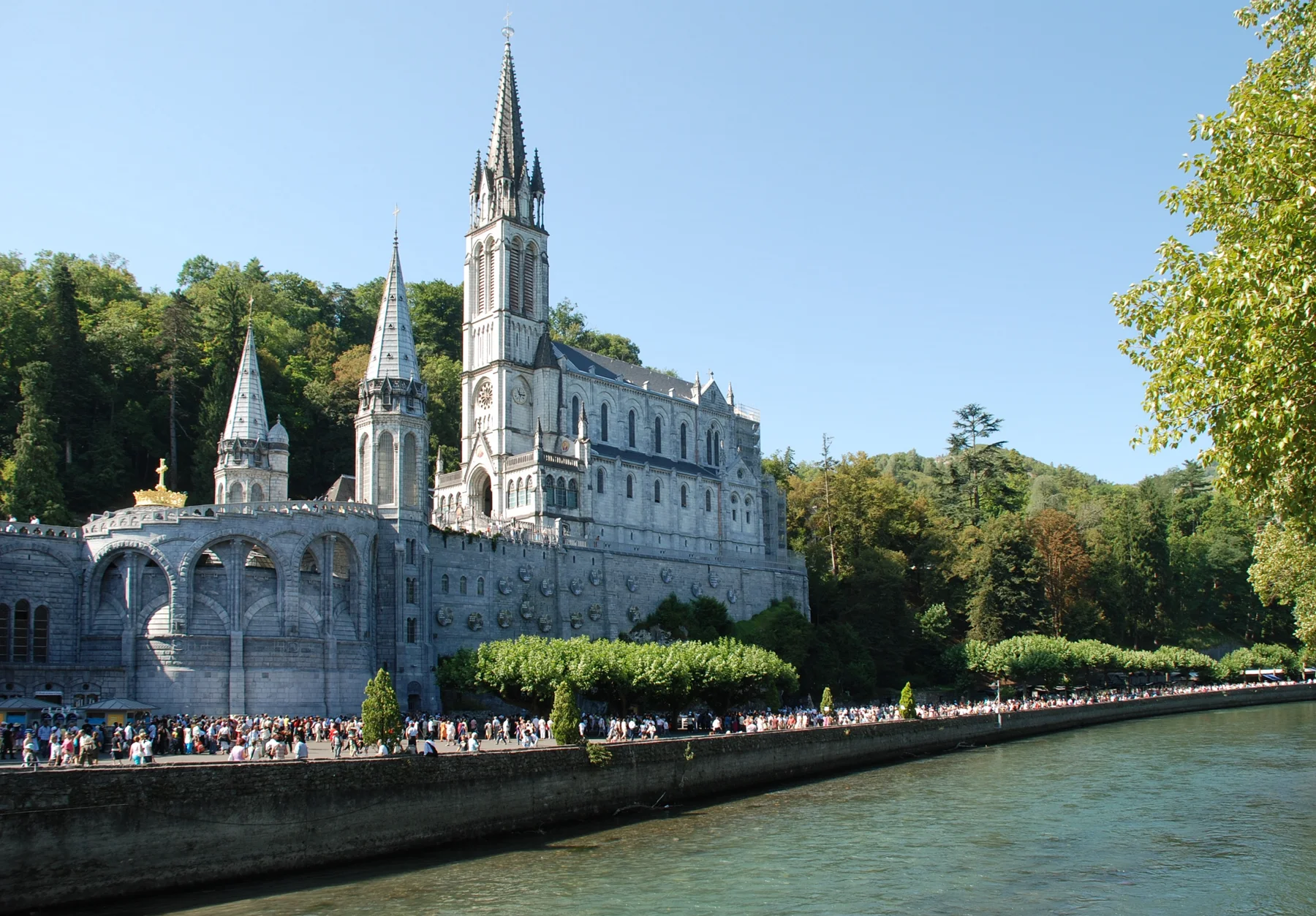
Lourdes: the Grotto and the Rosary Basilica
FranceWhy it belongs
The sanctuary's own account says that at the first apparition in 1858 Bernadette Soubirous made the Sign of the Cross and said the Rosary with the Lady. The apparitions were approved by the bishop in 1862 and remain private revelation; the Rosary is prayed at the Grotto every day, and no healing is promised to any pilgrim.
What you would do there
After a full travel day from Portugal, the days at Lourdes would turn on the Grotto: an unhurried first visit, the story of Bernadette's life, the Rosary Basilica, and a decade prayed aloud in your own language among pilgrims praying in theirs. The Sorrowful Mysteries could be prayed here, with the many intentions for the sick that pilgrims bring to this place, and the torchlight Marian procession joined if it is scheduled.
- 3
Pompei: the Pontifical Shrine of the Blessed Virgin of the Rosary
ItalyWhy it belongs
Pompei has no apparition. St. Bartolo Longo, a lawyer who had lost his faith and found it again, began teaching the Rosary to the poor farmers of the valley in the 1870s and built a church around a worn painting of Our Lady of the Rosary brought from Naples. St. John Paul II called him the Apostle of the Rosary.
What you would do there
The journey would end before the venerated image, which shows Mary handing the beads to St. Dominic, as a long-standing tradition holds, with St. Catherine of Siena beside him. Pilgrims could pray the Glorious Mysteries there and stop at the chapel named for St. Bartolo Longo, where his remains lie beneath the altar. The Supplication he wrote could be prayed quietly as a last act of petition before the return home.
Prayer and the sacraments
The Rosary would give the days their shape, prayed on the road, at each shrine and with the sanctuaries' own public Rosary, and it would lead toward the Mass, never replace it: Mass at the sanctuaries where the schedule permits, with clergy arrangements confirmed for each departure, and Confession where confessors are available. A lay leader could lead the Rosary for the group at any point, and the mysteries of light could be added as the group wishes.
Pilgrim’s Time
Pilgrim's Time would be kept open at each shrine for the thing a schedule cannot hold: going back alone with the beads to the Chapel of the Apparitions, to the Grotto late in the evening, or to the image at Pompei. Nobody could say what that time would hold; the journey would only protect it.
Pilgrim Pace
The three shrines are built around large, mostly level sanctuary grounds, and the Rosary can always be prayed seated; evening processions mean slow walking and standing after dark, sometimes in rain, and could be followed from a seat. The demanding part would be the travel between three countries: two long transfer days with flight connections whose routing would have to be confirmed.
How Pilgrim Pace worksIf you can stay longer
Pilgrims who wish to follow the prayer back to the Order that carried it could add Bologna, the city where St. Dominic died in 1221 and where the Dominican Basilica of San Domenico bears his name. The story that Our Lady gave him the Rosary is a tradition; his Order's part in spreading the prayer is history.
Other ways to make this pilgrimage
- Fátima & Lourdes. The Classic itinerary already gives several days each to the Chapel of the Apparitions and the Grotto, two places where the Rosary is prayed publicly every day, and would serve this pilgrimage without the onward travel to Italy.
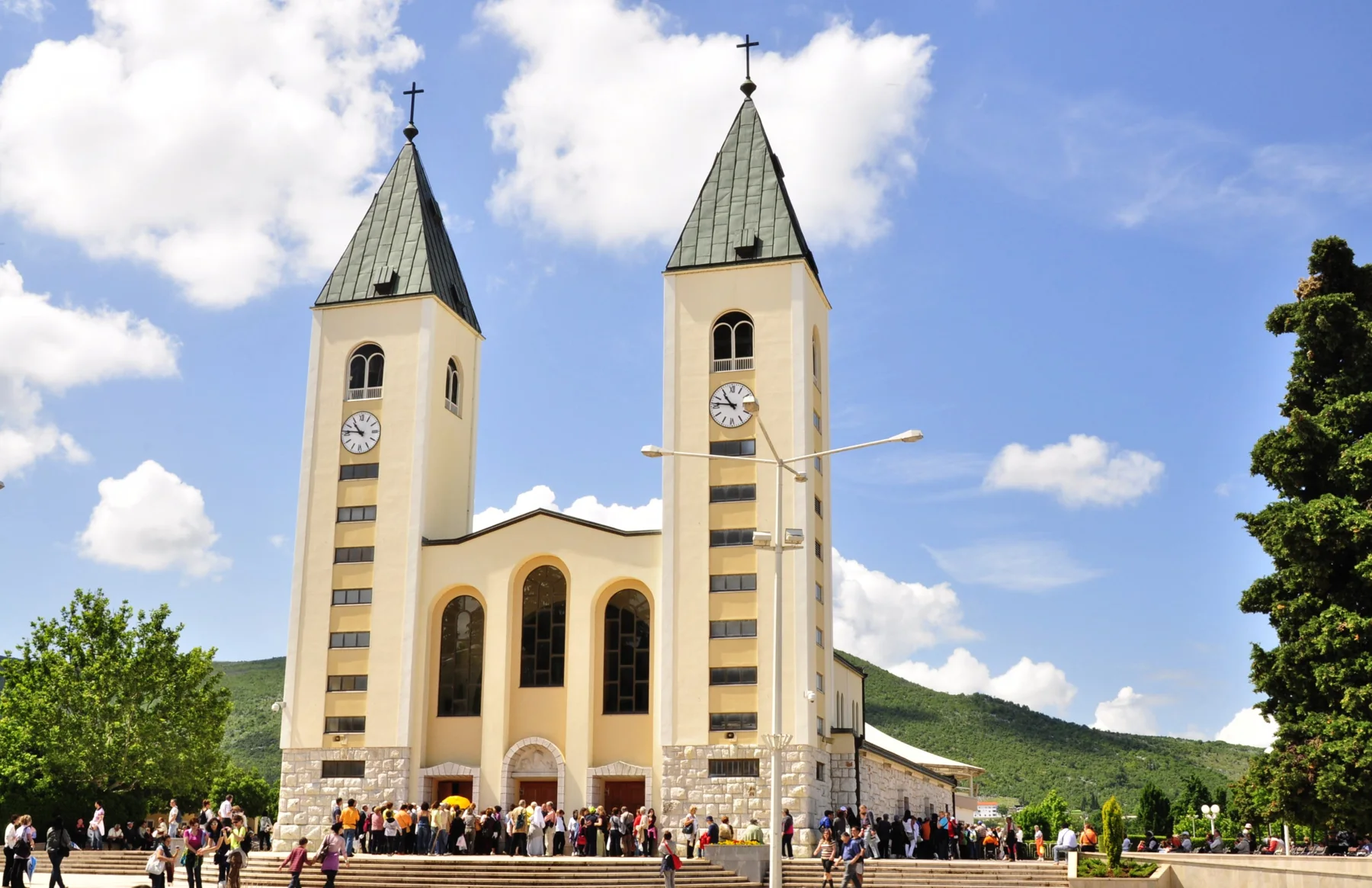
- Medjugorje & Croatia. Settled days around St. James parish would follow a parish prayer programme in which the Rosary is prayed daily, a fruit named in the Holy See's 2024 Note, which permits and encourages pastoral pilgrimage and makes no judgment that the alleged apparitions are supernatural.
- An October Rosary pilgrimage. The same shrines could be visited in the month the Church gives to the Rosary, when the calendar and the shrines' own observances would carry the purpose; each shrine's programme would need to be verified for the year.
No dated departures are currently announced. This is a journey Bold Pilgrim is considering, described so you can picture it. Dates, priest, Gateway Airport and price are published on a departure itself, and only when confirmed.
Who it may be for
People who already pray the Rosary and want to pray it where the Church has prayed it most intensely. People who gave it up as children, or never learned, and would like to begin again without being examined. Families, since popes from Pius XII to John Paul II have asked for the Rosary to be prayed at home above all. Anyone carrying an intention for another person, living or dead. Young people have a recent witness in St. Carlo Acutis, canonized in 2025, who prayed the Rosary every day and put it, with daily Mass, on the short list of habits he recommended to anyone who wanted to become a saint.
It also suits a group without difficulty, because the Rosary is a prayer any baptized person can lead. A lay organizer can gather a group and lead the Rosary on the road. Mass and Confession are a different matter and require a priest; clergy arrangements are confirmed for each journey.
- Catholics who pray the Rosary daily and want to pray it at its great shrines
- People who never learned the Rosary, or who stopped, and want to begin without pressure
- Families, and parents and adult children traveling together
- Parish Rosary groups, Legion of Mary and confraternity members, and Lay Dominicans
- Pilgrims carrying an intention for someone else
- Pilgrims who want a prayerful structure that does not depend on fitness or on a full sightseeing programme
A spiritual purpose has no Pilgrim Pace rating; the actual itinerary determines the pace. The principal Rosary shrines are built around large, mostly level sanctuary grounds, and the Rosary itself can be prayed seated. Evening processions mean slow walking and standing after dark, sometimes in rain, and can be followed from a seat. The hills at Medjugorje are rocky and always optional.
UNDERSTANDING THIS PILGRIMAGE
A Rosary pilgrimage is a Catholic pilgrimage built around one prayer: the Rosary, in which the pilgrim contemplates the life, death and resurrection of Jesus Christ in the company of Mary. It goes to the shrines most closely bound to that prayer, above all Fátima, Lourdes and Pompei, and it prays the mysteries there, alongside the Mass where the schedule permits, rather than only visiting. Its purpose is the one St. John Paul II gave the Rosary itself: to contemplate with Mary the face of Christ.
What a Rosary pilgrimage is: a prayer about Christ, prayed with Mary
The Rosary is a devotion, not a sacrament and not part of the liturgy. The Church commends it strongly and obliges no one to pray it. St. Paul VI wrote that it is an excellent prayer in regard to which the faithful should feel serenely free, and that without contemplation it is a body without a soul (Marialis Cultus 47, 55).
What the Church says about its content is precise. The Catechism calls the Rosary an epitome of the whole Gospel (no. 971). St. John Paul II opened his 2002 letter on the Rosary with the sentence that governs this page: the Rosary, though clearly Marian in character, is at heart a Christocentric prayer. The Hail Marys are the setting; the subject is Jesus, in the mysteries of His Incarnation, His public life, His Passion and His Resurrection. To recite the Rosary, the Pope wrote, is nothing other than to contemplate with Mary the face of Christ.
A pilgrimage is the same movement made with the body. That is why the two belong together so naturally: at Fátima and at Lourdes one of the great public acts of the day, after the Mass, is the Rosary prayed aloud by pilgrims in many languages.
Where the Rosary comes from, and what is tradition
A long-standing tradition holds that Our Lady entrusted the Rosary to St. Dominic in southern France at the beginning of the thirteenth century, and several popes repeated it, Leo XIII among them in 1883. It should be stated as a tradition. According to the Catholic Encyclopedia, the early lives of St. Dominic do not mention the Rosary, the practice of counting Hail Marys on beads is older than he is, and meditation on the mysteries was joined to it in the fifteenth century, when the Dominican Alan de la Roche preached the devotion. St. John Paul II, writing in 2002, did not name Dominic as its author; he said the prayer was used in particular by the Dominicans at a difficult time for the Church.
What is not in doubt is who carried it. The Order of Preachers, which St. Dominic founded, spread the Rosary for centuries; Benedict XVI credited his spiritual sons with the great merit of making the prayer of the Holy Rosary known. That is why Rosary shrines so often show Mary handing the beads to St. Dominic, as the venerated image at Pompei does, with St. Catherine of Siena beside him. The feast of Our Lady of the Rosary on 7 October goes back to St. Pius V, who, as Leo XIII recounts, attributed a great naval victory of his day to the prayer of the Rosary. Leo XIII himself, beginning in 1883 and in the encyclicals that followed, gave the month of October to it.
In 2002 St. John Paul II proposed five mysteries of light, drawn from Christ's public ministry, and left their use to the freedom of individuals and communities.
Why the great Marian shrines are Rosary shrines
At Lourdes in 1858 the first thing Bernadette Soubirous did when she saw the Lady was reach for her rosary; the sanctuary's own account says she made the Sign of the Cross and said the Rosary with the Lady. At Fátima in 1917 the children reported that the Lady asked them at each of the six apparitions to pray the Rosary and in October gave her name: I am the Lady of the Rosary. The sanctuary's official title is the Shrine of Our Lady of the Rosary of Fátima. The Church's local authority judged both in their favour: the Lourdes apparitions were approved by the bishop in 1862, and the Bishop of Leiria declared those of Fátima worthy of belief in 1930. They remain private revelation: a help the Church offers, in Cardinal Ratzinger's words, which one is not obliged to use, and whose value is measured by its orientation to Christ.
Pompei is different: the one great shrine founded for the Rosary itself. There was no apparition. A lawyer who had lost his faith and found it again, Bartolo Longo, began teaching the Rosary to the poor farmers of the valley in the 1870s, brought a worn painting of Our Lady of the Rosary from Naples, and built a church around it. St. John Paul II called him the Apostle of the Rosary and ended his own letter on the Rosary with words from Longo's Supplication. Pope Leo XIV canonized him in October 2025.
Medjugorje belongs here with the care the Church asks for. The Holy See's 2024 Note granted a nihil obstat that recognizes the spiritual fruits and permits pilgrimage and public devotion; it did not declare the alleged apparitions supernatural. Among the fruits the Note observes in the parish is the daily recitation of the Rosary.
Questions pilgrims ask
What is a Rosary pilgrimage?
A Rosary pilgrimage is a Catholic pilgrimage centred on praying the Rosary at the shrines most closely tied to it, chiefly Fátima, Lourdes and Pompei. The pilgrim meditates on the mysteries of Christ's life with Mary, usually alongside Mass and the sanctuary's own Rosary and processions. It differs from a general Marian pilgrimage in that the prayer itself, rather than a list of Marian sites, gives the journey its shape.
Which shrines are most closely associated with the Rosary?
Three stand out. Fátima in Portugal, whose official title is the Shrine of Our Lady of the Rosary and where the Lady is reported to have asked for the daily Rosary. Lourdes in France, where St. Bernadette prayed the Rosary at the Grotto and the Rosary Basilica stands. Pompei in Italy, founded by St. Bartolo Longo as a centre for spreading the Rosary. Bologna, where St. Dominic died, belongs to the prayer's Dominican history.
Did Our Lady give the Rosary to St. Dominic?
A centuries-old tradition says so, and popes including Leo XIII repeated it, but it is a tradition and not an established historical fact: the early accounts of St. Dominic's life do not mention the Rosary. What is certain is that his Order of Preachers spread the prayer across the world.
Full answer: Did Mary give the Rosary to St. Dominic?
Why is Our Lady of Fátima called Our Lady of the Rosary?
Because that is the name the three shepherd children reported she gave. According to the Sanctuary of Fátima, in October 1917 the Lady said, 'I am the Lady of the Rosary,' and told them to continue to pray the Rosary every day. Fátima is approved private revelation, which the Church commends and does not require Catholics to believe.
Full answer: What happened at Fátima in 1917?
Is the Rosary a prayer to Mary or a prayer about Jesus?
Both, in a definite order. The Hail Mary asks Mary to pray for us, and the mysteries meditated are the events of Jesus' life, death and resurrection; St. John Paul II wrote that the Rosary, though clearly Marian in character, is at heart a Christocentric prayer. Catholics do not worship Mary; they ask her prayers and look with her at her Son.
Full answer: Is the Rosary biblical, or is it "vain repetition"?
What is the Rosary Pilgrimage in Lourdes?
The Rosary Pilgrimage (Pèlerinage du Rosaire) is a large annual pilgrimage to Lourdes organized by the Dominican family since 1908 and held over several days in early October, around the feast of Our Lady of the Rosary. The Sanctuary of Lourdes describes it as one of the largest spiritual gatherings in France, with Masses, a Eucharistic procession, the torchlight Marian procession and vigils on a pilgrimage chosen each year. It is run by the Dominican organizers, not by Bold Pilgrim, and its dates change every year, so check the sanctuary before planning around it. You do not need it in order to pray the Rosary at Lourdes, where the Rosary is prayed at the Grotto every day.
Do I need to know how to pray the Rosary before I go?
No. The Rosary is made of three prayers most Christians half-know already, and a group prays it aloud together, so you can listen for a decade and then join. Many pilgrims learn it on the journey. Nor are you obliged to love it: Paul VI wrote that the Rosary is an excellent prayer in regard to which the faithful should feel serenely free. Come willing to try it slowly.
What are the Five First Saturdays?
The First Saturdays are a devotion of reparation to the Immaculate Heart of Mary that Sister Lúcia of Fátima reported receiving at Pontevedra in December 1925. On the first Saturday of five consecutive months a person goes to Confession, receives Holy Communion, prays five decades of the Rosary and keeps fifteen minutes of meditation on the mysteries, all with the intention of reparation. It is private revelation, commended and not required. A first Saturday that falls during a pilgrimage can be kept there as it would be at home.