
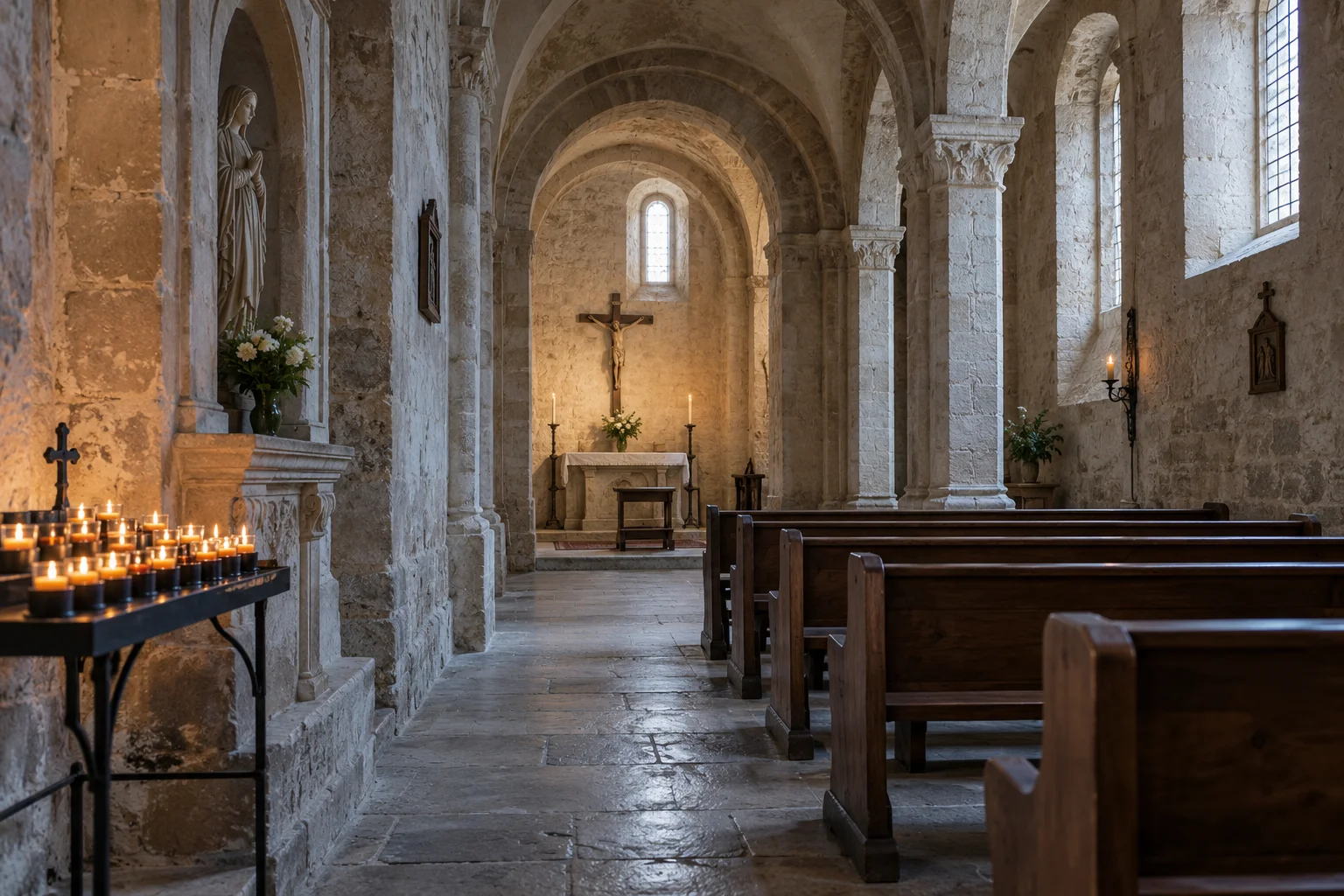
Confession, in the Church's law, is a sacrament for the Christian faithful, who are free to confess to any approved confessor (canons 959 and 991). For Christians who are not Catholic, canon 844 applies. Members of the Eastern Churches not in full communion with Rome may receive the sacrament of penance if they ask on their own and are properly disposed (§3). Other baptized Christians may receive it in danger of death, or in another grave necessity in the judgment of the diocesan bishop or the conference of bishops, and only if they cannot approach a minister of their own community, ask on their own, manifest Catholic faith in the sacrament and are properly disposed (§4). On an ordinary pilgrimage those conditions are rarely met.
What is open to everyone is the conversation. At Lourdes, Medjugorje or the Roman basilicas you will see confession everywhere, and it is natural to wonder whether you may go in. You may: begin by saying, "I'm not Catholic; may I just talk?" The priest can listen, offer counsel and pray with you. What he ordinarily cannot give is absolution.
Good to know: what is said in sacramental confession is protected by the seal, which canon 983 calls inviolable. A talk that is not a sacramental confession is not covered by the seal in that strict sense; priests ordinarily treat such conversations as confidential, and you can ask for that at the start. At busy shrines the lines before the evening program are long and the confessionals are marked by language, so choose a quieter hour, or ask the priest traveling with your group for a time to talk.